![MaritimeJournal[Seawork]](https://www.maritimejournal.com/wp-content/uploads/2026/09/MaritimeJournalSeawork.svg)



Systems thinking is critical for complex naval autonomy
 Part of our special report
Autonomy at Sea · January 2026
All 10 features
Part of our special report
Autonomy at Sea · January 2026
All 10 features
Will Alexander, Global Business Development Lead – Maritime Autonomous Systems with BMT, tells Maritime Journal why design and thinking systems matter more than ever with autonomy in an increasingly complex and critical naval domain.

In the face of mounting challenges from rising costs, under-crewing and increasing sophistication of adversaries, the naval domain, like others, is embarking on a strategic transformation. At the heart is a shift from high-value exquisite platforms to a more flexible, disaggregated set of capabilities employing a Systems of Systems Approach (SOSA).
In the UK, the Royal Navy’s approach to transformation is encapsulated in its Hybrid Navy Strategy, which embraces modularity, autonomy, digital and Ai at scale while maintaining flexibility to adapt to meet evolving threats and deliver a spectrum of missions.
The Strategy makes a lot of sense if navies are to maintain operational advantage in today’s uncertain and rapidly evolving strategic context. But implementation is always the hard bit.
The latest technology needs to be developed, proved, integrated and deployed at pace – but pace and cost cannot come at the expense of considered design. In the harsh naval environment, solutions that look attractive on paper but are not engineered for the realities of combat or North Atlantic Sea states will fail to deliver credible deterrence. Time invested upfront avoids the false economy of rework and retrofits later.
The ambition is clear and industry is preparing and investing in this future – many options for uncrewed and autonomous systems exist. The challenge for industry and defence is how to harness this technology in partnership before the end of this decade. There is an urgent need to scale uncrewed platforms, integrate systems and enhance survivability to meet the demands of war-fighting capability.
Credible deterrence at sea depends on coherent, interoperable and interchangeable capabilities, not isolated platforms. A SOSA demands systems thinking from the outset – architecture, integration and assurance designed within, not bolted on later.
Our early concept work on large uncrewed surface vessels identified six critical challenges for scaling autonomy at fleet level: command and control; sensor data management; engineering systems; vessel/mission resilience; maintenance; and logistics and modularity.
Building on this work, we matured the design into the Modular Uncrewed Ship, or MODUS concept, revealed at DSEI London 2025. A concise set of six principles provides the design compass for MODUS: Autonomy, Modularity, Availability, Affordability, Buildability, Adaptability.
Together, these principles ensure that flexibility and modularity are designed in from the outset, creating a platform that can iterate and adapt at pace. MODUS is intended to accommodate spiral development, enabling new payloads, autonomy software and mission systems to be integrated over time without compromising availability or driving prohibitive through-life cost.
MODUS is a family of uncrewed vessels conceived to be part of a mixed-fleet concept. It is designed to leverage the benefits of autonomy: military data gathering/survey, seabed warfare (including protection of critical undersea infrastructure), and Anti-Submarine Warfare (ASW). These are persistent, payload-led missions where long on-task durations and seamless integration are decisive.
Designing for the waters you sail
Designing explicitly for the environment you intend to operate in is essential to delivering credible deterrence.
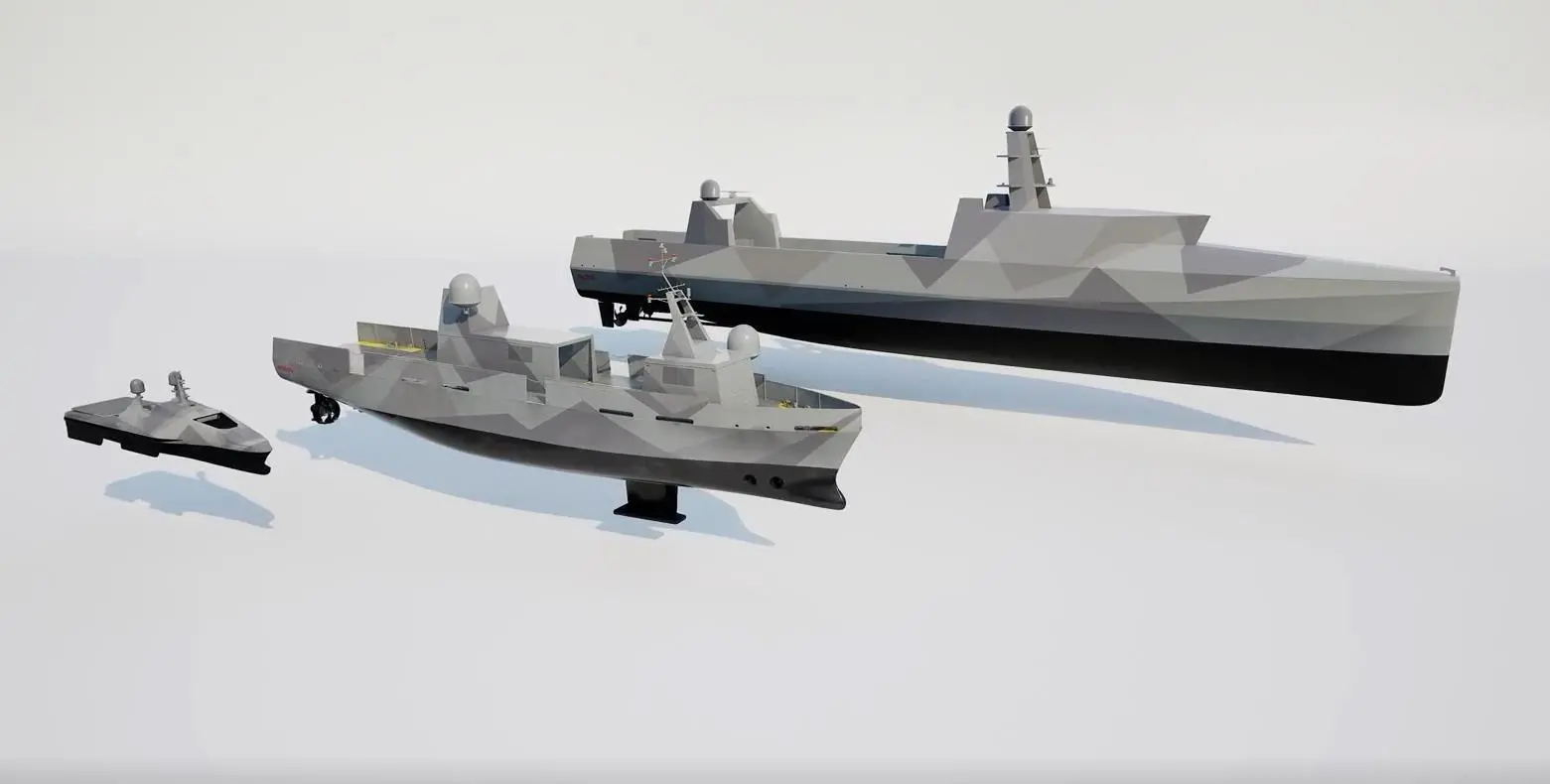
In the Northeast Atlantic in winter, for example, survivability is only the starting point; the real question is whether a vessel can continue to deliver operational effect and has the resilience to sustain that effect. Vessel length and arrangement should align with seakeeping requirements dictated by the environment: our analysis shows that a larger hull, such as the 75 metre LUSV, performs better in the North Atlantic, while medium USVs are adequate for the North Sea – clear guidance to avoid a one-size-fits-all approach.
Autonomy and lean crewing do not make the ocean any less harsh. If anything, they raise the bar on design because vessels must operate safely and effectively without constant human intervention.
Hull-form considerations include lighter materials, balanced design for weight/displacement and theatre-specific stability. The aim is credible, repeatable performance in the seas navies will actually face.
The concept emphasises payload-first architecture. Modular mission systems enable vessels to switch between roles (ASW, seabed warfare, military data gathering) and adopt new technologies at pace. The PODS (Persistent Operationally Deployed Systems) concept underpins this approach, enabling long-term use and ease of replacement. The payoff is agility: rapid technology updates, the ability to swap payloads without deep refits and a pathway to commercial missions when required.
This mission-modular architecture supports rapid technology updates, enables pier-side swap-outs rather than deep refits, and lets navies switch between defence and commercial payloads. Because payloads and software can move faster than hull life, decoupling upgrades from the platform creates a steadier cadence of capability increments across the fleet.
Survivability for autonomous ships differs from traditional warship recovery strategies. For roles closer to home waters such as monitoring, intelligence and protection, threats are more likely cyber or disruptive than direct kinetic attack. Emphasis shifts to susceptibility reduction and resilience: hardening the architecture, ensuring predictable behaviours under interference or partial failure, and building in redundancy where it protects the mission. For larger uncrewed vessels pressing into contested areas, the baseline hardens further with robust system architecture to avoid mission-critical failures.
The common thread remains mission continuity and graceful degradation.
The family approach: variants with commonality, not a single hull
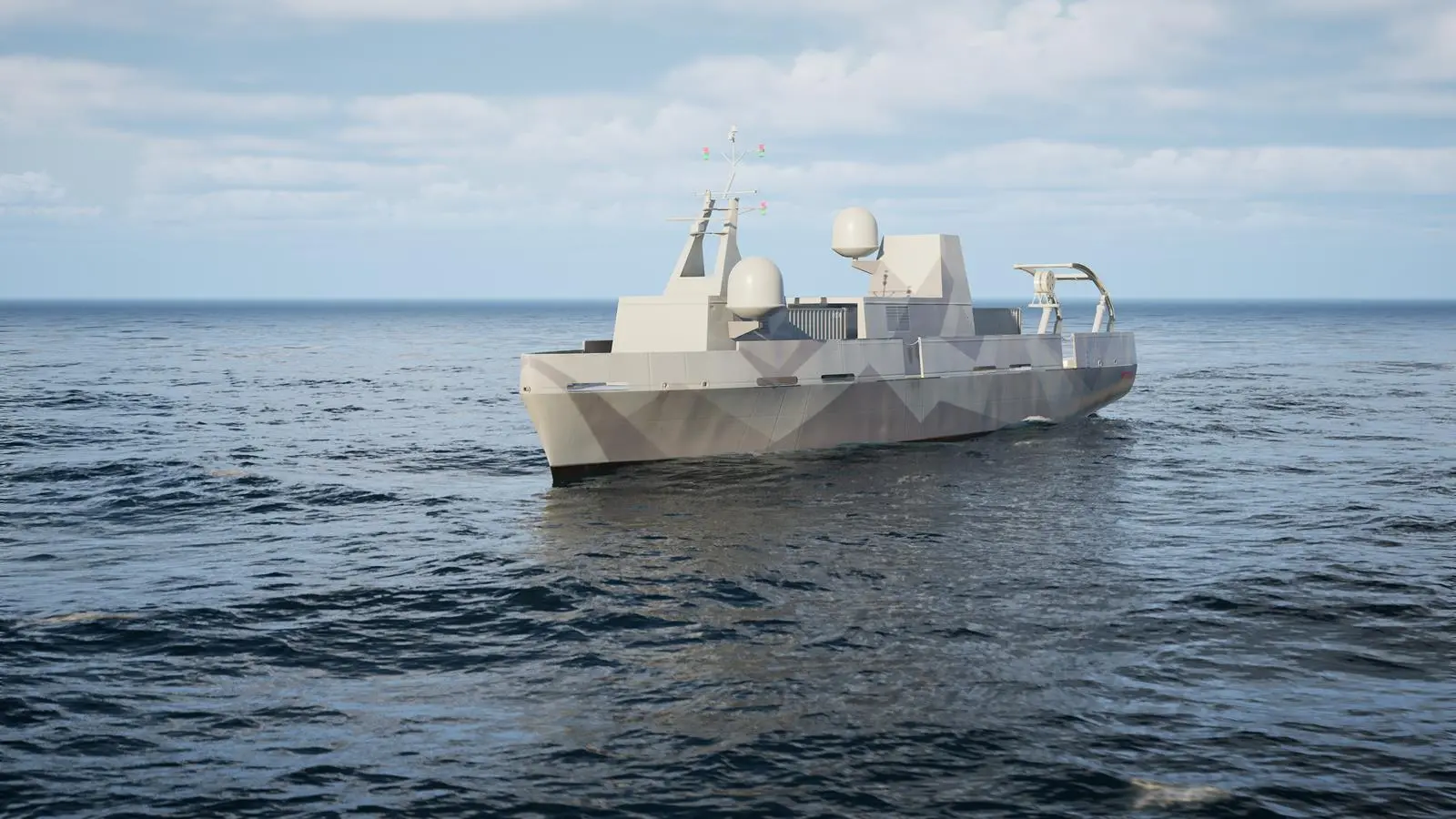
Here BMT’s proposition is distinctive. Rather than a singular multi-role vessel, the approach embraces different solutions for different tasks – categories such as 15m, 40m MUSV and 75m LUSV – to maintain affordability, enable build across a broader range of UK shipyards and avoid disrupting complex warship programmes.
Each vessel works collaboratively in a mixed fleet while remaining adaptable and scalable for defence and commercial applications. By treating the family as a connected whole rather than a collection of standalone platforms, the approach builds coherent capability that is both interoperable and interchangeable. This is central to credible deterrence: the ability to combine and recombine assets rapidly across missions, partners and theatres.
Open, modular interfaces and portable payloads support exportability while allowing partners to integrate indigenous systems. The approach complements complex warship programmes by adding scalable, interoperable mass rather than competing for the same industrial bandwidth.
The call-to-action is collaborative: technology providers, autonomy specialists, payload integrators and shipbuilders should be engaged to fill capability gaps and accelerate delivery, turning a pre-concept vision into a sustained pipeline of trials, prototypes and fielded variants.
The direction of travel
Taken together, the evidence points to a durable thesis: a family of medium and large uncrewed vessels value-engineered for cost efficiency, designed from the bottom up for uncrewed operation and integrated as part of a mixed fleet.
MODUS provides a set of principles and variants aimed at minimising vessel cost while adding naval-credible mass with high availability to fleets at pace. In complex programmes, the same logic applies as on operations: just as time spent in reconnaissance is never time wasted, history shows that time invested upfront in rigorous design and systems engineering saves time and cost in the long run and is far more likely to deliver an enduring solution.
By combining our design and innovation heritage with deep domain knowledge and engineering excellence, BMT applies that rigour to inform decisions quickly and effectively – turning the Royal Navy’s Hybrid Navy vision into credible, resilient capability for the most demanding seas.
Related Articles
 OTHER NEWS
 MARINE CIVILS
 MARINE CIVILS