![MaritimeJournal[Seawork]](https://www.maritimejournal.com/wp-content/uploads/2026/09/MaritimeJournalSeawork.svg)





World’s deepest subsea cables laid in Mediterranean
Paris-based power transmission company Nexans says It has installed the deepest subsea cable in the world at 2,150 metres.
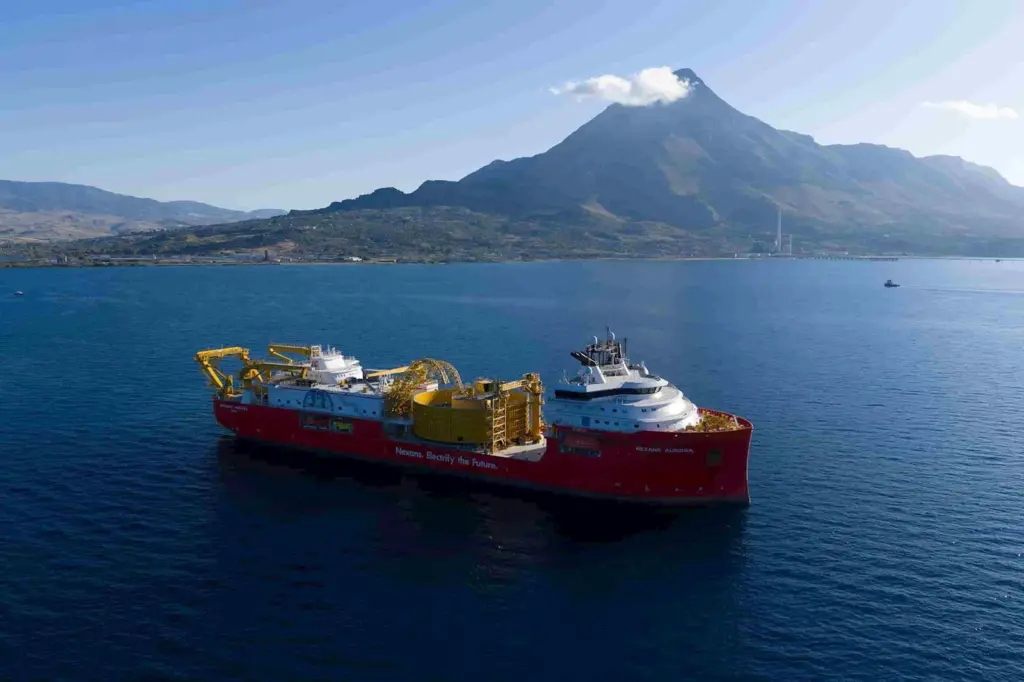
It has laid a 500kV high-voltage direct current (HVSC) cable 2,150 metres deep as part of Italy’s Tyrrhenian Link project, with the completion finalised on January 1 to connect cable landing points between Terra Mala in Sardinia and Fiuetorto in Sicily.
The Tyrrhenian Link is two parallel 500 kV HVDC submarine connections, each roughly 970 kilometres long, with a total planned transmission capacity of 1,000MW.
Once fully operational, the link is intended to strengthen electricity connections between mainland Italy, Sicily and Sardinia, improving grid resilience and flexibility.
The whole €3.7 billion project is being run by Terna, the Italian Transmission System Operator.
“Installing a 500 kV HVDC cable at such depths requires exceptional precision and discipline across engineering, manufacturing, route preparation and vessel operations,” said Pascal Radue, Executive Vice President, PWR-Transmission, Nexans.
While Nexans is claiming the world record for cable installation depth, Prysmian is hot on its heels, with sea trials having taken place in 2024 for cable installation at the same depth for the same project. Prysmian’s cable layer Leonardo da Vinci was used in the sea trials.
Depth challenges
Reaching depths beyond 2,000 metres poses huge engineering and operational challenges.
At such depths, cables are subjected to extreme tension during laying, while installation vessels must maintain precise positioning over long periods in deep and often complex seabed conditions.
The Tyrrhenian Link installation required extensive route preparation, detailed seabed surveys and carefully sequenced offshore operations to manage these risks.
Terna said the depth record highlights the growing role of advanced submarine power technologies in expanding transmission networks across challenging marine environments.
With subsea installation now largely complete, onshore and offshore jointing will now be required, as well as the necessary HVDC converter stations, which are being built in Sardinia, Sicily and mainland Italy.
The Link has been enabled thanks to a loan of €1.9 billion from the European Investment Bank, with Terna making up around the other half.
“ The Tyrrhenian Link is an extraordinary project — not only for its scale and record-breaking installation depth as the first of its kind to be installed, but for the lasting impact it will have on Italy’s energy future,” said Pascal Radue, executive vice president, PWR- Transmission, Nexans.
Related Articles
 OTHER NEWS
 MARINE CIVILS
 MARINE CIVILS