![MaritimeJournal[Seawork]](https://www.maritimejournal.com/wp-content/uploads/2026/09/MaritimeJournalSeawork.svg)


A buoyant response from Seaflex
A salvage operation of national importance carried out by Unique Seaflex and Salvesen UK has rescued the only surviving landing craft from D-Day in 1944 from the seabed in Birkenhead Docks.
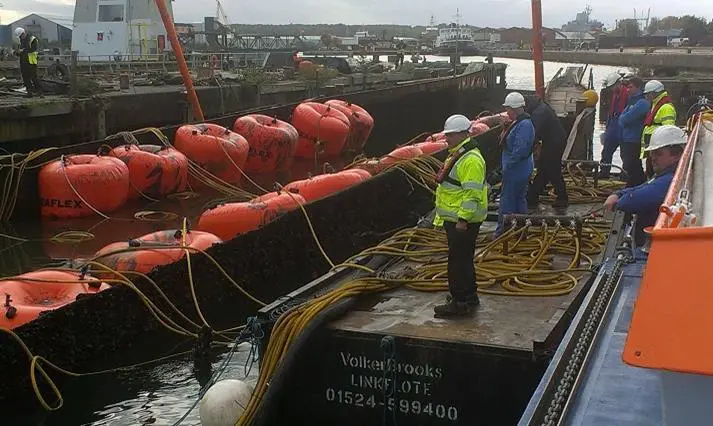
Landing craft LCT 7074 (Landing Craft Tank) is one of over 800 landing craft which played an important part in the D-Day landings on the beaches of Normandy during the second world war. The vessel came out of service at the end of the war and for a short period served as a naval repair facility before being converted to a civilian night club in Liverpool around 1950.
Around four years ago LCT 7074 sank while on its moorings at East Float Dock Birkenhead and as it was the last surviving example of its type, Portsmouth’s National Museum of the Royal Navy embarked on a project to recover the vessel. A grant of over £900,000 from the National Memorial Heritage Fund was secured in what was seen as a last chance to save a priceless example of naval heritage.
Following a dive survey by Salvesen UK it was established that the hull was in good enough condition to attempt refloating and three weeks of further diving work was carried out to clean the vessel in preparation for internal diving operations. For the actual lifting phase of the job Seaflex deployed 230t of buoyancy and while open-ended parachute-style air lift bags are generally preferred for salvage operations, on this occasion the combination of relatively shallow depths and the requirement to squeeze buoyancy into tight spaces meant enclosed units fitted with pressure relief valves were the ideal solution.
Salvesen then installed eighteen 5t single connection vertical Seaflex Mono Buoyancy Units into the wing tanks running forward and aft, port and starboard. Holes were then burnt either side of the vertical frames in the wing tank bulkheads to secure a further twenty 5t buoyancy units. As these units would break the surface before the vessel was fully afloat, it was calculated that the full lift potential of 190t would not be achieved, but could however be supplemented by the inclusion of eight 5t multiple connection horizontal inflatable buoyancy units in the main engine room.
To prepare for the physical lifting operation, a 1.5m square aperture was tunnelled beneath the vessel’s 10m beam allowing two 100t soft slings to be inserted which were restrained and connected to two spreader beams. A floating crane was mobilised to assist with the final lift and initially loaded to 50t. Lifting bags then inflated sequentially providing a stable and controlled lift with stresses on the vessel monitored throughout by digital strain gauges at various locations on the hull.
Once all the bags were inflated, the load on the crane was gradually increased in five ton increments and with the weight registering 105 tons LCT 7074 slowly began to rise from the seabed. Once the tank deck level was reached, around 400,000 litres of water was pumped out and the vessel successfully refloated. The accumulated salvage material was next removed from the hull and final preparations made for its transfer to Portsmouth Naval Base for restoration.
Unique Seaflex operate out of purpose built premises in Cowes of the Isle of Wight and are manufacturers of air-filled bags for salvage and installation operations and of water-filled bags for testing and ballasting purposes. The company was acquired by Unique Maritime Group in 2011 and are gradually extending their global reach with a presence and stock available on every continent except Antarctica: they also have a presence in most of the main oil and gas markets around the world.
By Peter Barker
Related Articles
 SPECIAL REPORTS
 TUGS & SALVAGE
 EQUIPMENT