![MaritimeJournal[Seawork]](https://www.maritimejournal.com/wp-content/uploads/2026/09/MaritimeJournalSeawork.svg)





A study of Voith tractors in ice
Hard winters frequently lead to the formation of ice in many ports and harbours. Tugs often act as icebreakers and to the uninitiated some modern tugs appear to be particularly susceptible to damage.
A recent report confirms that the Voith tractors do not fall into that category. The report was produced following testing at the ‘Aker Arctic Ice Laboratory’ in Helsinki, and in the ‘circulation tank’ at Voith’s headquarters in Heidenheim. Even under extreme conditions, tugs with Voith Schneider Propellers have proved to be highly effective icebreakers.
Aker Arctic laboratory has a test tank with a glass bottom, enabling the propellers to be viewed from below during their operation in icy waters. The following factors were examined: the position of the VSP in the hull, the direction of the propellers rotation, ice thickness, broken and solid ice sheets, and the shape of the vessel’s hull.
The test results provided a significantly improved understanding of the physics of Voith Schneider propulsion systems working in ice-covered waters. Due to the specific physical effects and the interaction between the blades of the VSP and the ice floes, the ice floes hit the VSP blades in a different way compared with hitting the blades of screw propellers. As a result, the risk of damage is considerably reduced.
An important factor was also the ability of the Voith propeller to resist damage, thanks to the high strength stainless steel blades and the strength and quality of the components in the blade steering kinematics. The low rotational speed of the VSP, with its high inertia, has a positive effect during collisions with ice floes. Hydraulic Voith turbo couplings employed in the driveline to each propeller offer additional protection for the engine and transmission.
During model tests in the Voith circulation tank, the propeller blades were hit by true to scale ice floes while the propeller was rotating. The speed of the VSP and the size and the number of the ice floes were varied during the individual test runs. All of the tests proved the advantages of the VSP in icy waters. Due to its stepless and highly precise thrust variation, the Voith propulsion system provides the icebreaking vessels with maximum manoeuvrability. The propeller wash can be accurately controlled, enabling the ice floe to be moved in the desired direction to allow a channel to be cleared.
The findings are consistent with the practical experience of Svitzer in Gothenburg, URAG in Bremerhaven and Bugsier in Rostock.
1. The impact point of the ice floes at the propeller blade is usually in the upper part of the blade near the bearings. This results in a lower bending moment. The magnitude of the bending moment has a significant influence on the service life of the propeller blades.
2. Collision with the ice floes occurs at the leading edge of the blades. In this load situation, the section modulus of the blade profile is at its highest, which reduces the risk of damage.
3. The ice floes are immediately pushed to the side after the first impact with the propulsion system and do not get caught in the VSP.
4. Voith water tractors have the advantage of having VSPs positioned close together and rotating outwards. The general advantage of the tractor concept lies in the deeply immersed propellers, which are less likely to get in contact with ice.
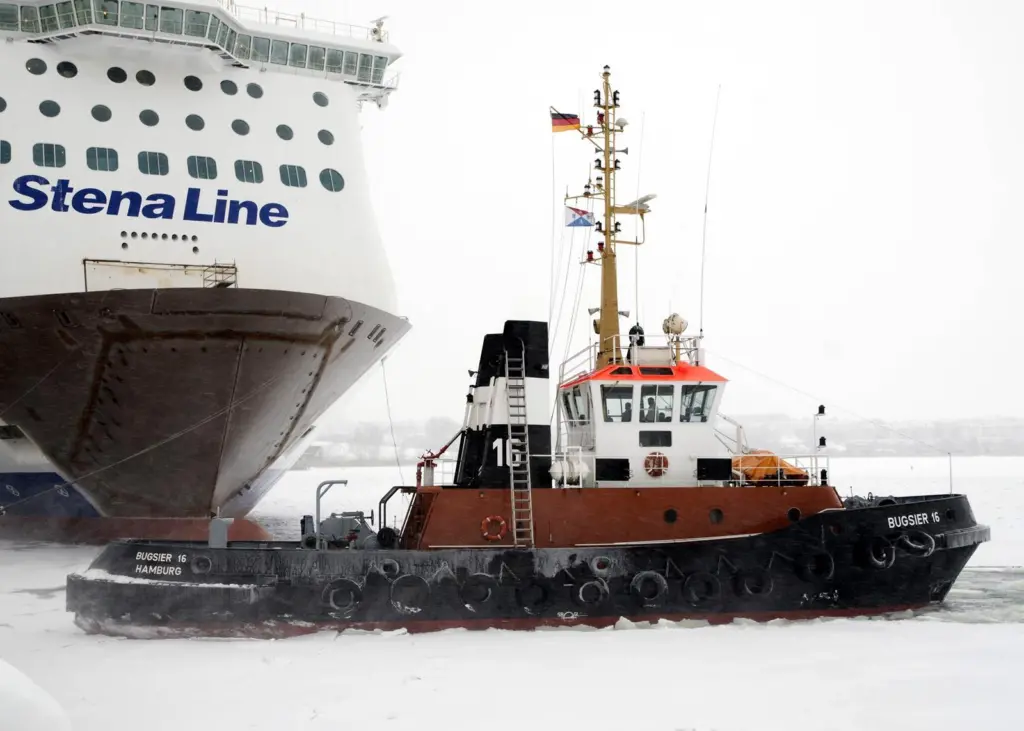
Comments from Captain Siegfried Kempe, a tugmaster aboard the Voith tractor tug Bugsier 16 since 1994, confirm the results of the study. “I have carried out numerous towing jobs in ice. Quite frequently we have to clear the channel in Rostock harbour but we have also had successful operations in iced-up Swedish waters. Unlike jet (nozzle) propellers, which are quickly blocked, Voith Schneider Propellers have no problem with ice floes. The VSP can push the ice aside without any trouble. The propeller slipstream can be steered in such a way that the ice is quickly and completely flushed away and what’s more, the wake of the Voith Water tractor has another interesting effect, the channel clearance is much wider. This is beneficial for the ships that follow us.”
Related Articles
 SPECIAL REPORTS
 TUGS & SALVAGE
 EQUIPMENT