![MaritimeJournal[Seawork]](https://www.maritimejournal.com/wp-content/uploads/2026/09/MaritimeJournalSeawork.svg)



A tough new RAstar 3200 is delivered to Mexico
A recent design by Robert Allan Ltd is the new RAstar, a powerful ASD tug introduced to meet the stringent requirements of gas and oil terminal operators. The first examples of this design were delivered to Svitzer in 2008 to operate at the new Milford Haven LNG facilities in the UK (Maritime Journal – January 2009).
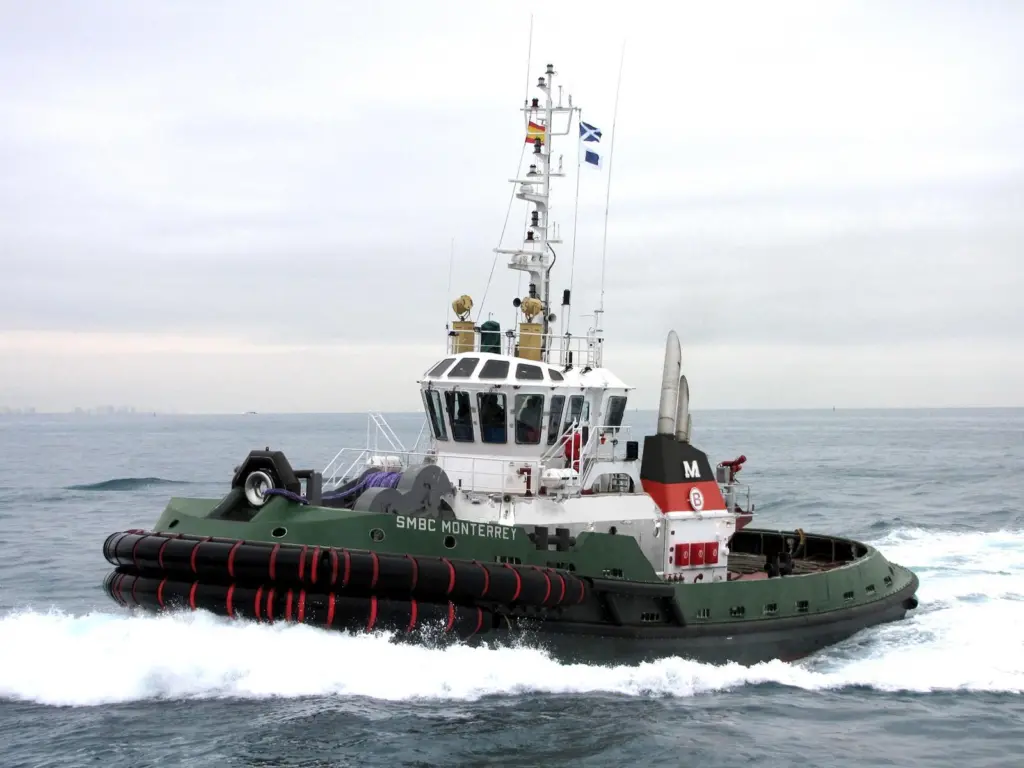
Another important delivery in the development of this new breed is
SMBC Monterrey
, the first of a series of four new RAstar 3200 class vessels to be completed by Union Naval Valencia (UNV) of Valencia, Spain, in February for Servicios Marítimos de Baja California, S de RL de CV of Mexico. The latter is a joint venture between Moran Towing of the USA and Grupo Boluda of Spain.
The tugs were expressly designed to work at the Costa Azul LNG terminal on the northwest coast of Mexico, a facility exposed to fully developed Pacific swells. A prime requirement stipulated that the tug and its winch must be able to sustain a line pull of 75 tons throughout the entire approach to the terminal in a significant swell of over 2m.
In order to meet that requirement, a massive and extremely powerful winch is required which dominates every aspect of the vessel’s design. This was complicated further by the owner’s requirement that the resulting vessel should be less than 500grt. To cope with the predominant sea conditions, RAL chose to utilise the new RAstar hull form but the tonnage constraint forced some minor modifications to that concept and resulted in a shorter forecastle. A large forward mounted escort skeg, in conjunction with the ‘sponsoned’ hull shape, enhances the tug’s indirect towing capability and provides greatly improved stability.
All of those requirements and many other advanced features have been incorporated in a vessel of 32m in length, with a relatively large beam (moulded) of 13.20m, and a maximum draft of 5.68m. The tug is Classed by ABS: +A1 Towage Service, Escort Vessel, Fi-Fi 1, +AMS, Unrestricted Service.
SMBC Monterrey has a pair of MTU-16V4000 M71 main engines generating a total of 6,698bhp (4,930kW) at 2,000 rpm, each driving Rolls-Royce US255 fixed pitch fully azimuthing propulsion units. Power is transmitted via Lufkin MV1600S reduction gearboxes and hollow carbon fibre intermediate shafts with no line bearings. On trials the vessel performed exceptionally well, achieving a mean bollard pull of 82.5 tons, and achieved a free running speed of 14 knots.
The most distinctive feature of this series of tugs is the main twin drum towing winch on the fore deck that, unlike that of a normal ship handling winch, is of ‘waterfall’ configuration. This solution, proposed to the winch manufacturer by RAL, has the drums in line, making escort operations through a single staple on the centre line much easier. Manufactured by Markey, the DESDF-48WF winch is claimed by the manufacturer to be the most advanced high performance electric towing winch in the world. Rated at 521kW, each of the winch drums can carry 200m of 80mm UHMW-PE soft line capable of sustaining a bollard pull of 75 tons. The unit was designed to perform close escort service in conditions up to Sea State 5 with 3m significant wave height and a 14 second wave period. Using variable frequency electric drives, dynamic motor braking and water cooled disc brakes, this winch is capable of asymmetric render/recover operation that will maintain constant line tension under such rough sea conditions. The after deck is served by large ‘H’ bitts and a 15kW capstan vertical capstan for general line handling.
The choice of an electrically powered winch, unusual in Europe but common in America, has led to an ‘all electric’ outfit for all deck machinery and even the fire fighting system utilises electrically driven Nijhuis pumps. To provide an electrical supply capable of serving the substantial loads imposed by the winch, deck machinery, fire fighting system and domestic onboard services, four diesel generating sets deliver a 460 volt, 3 phase, 60Hz power output. Two ship’s service alternators, rated at 125kW each, are intended for normal operations. When the winch or Fi-Fi systems are operated, one of the two larger alternators, rated 800kW each are used. The winch and Fi-Fi generators are configured for parallel operation. The ship service generators are configured for operation on one generator, with the second generator on standby, and the system is provided with an auto-start capability that allows automatic start-up of the selected standby generator and connection to the dead bus in the event of a generator failure.
In keeping with other RAstar class vessel, the standard of outfitting and accommodation for a crew of six is high. Noise and vibration levels have been kept to a minimum by utilising advanced methods of isolating main propulsion machinery, and the use of high grade insulation and floating floor techniques.
The introduction of other powerful RAstar class tugs for terminal work continues to grow rapidly. In April the first of four RAstar 3600 tugs of the same basic design, the Lamnalco Sana’a, was delivered to Lamnalco in the United Arab Emirates by Med Marine of Turkey. Measuring 35.8m in length, 14,5m beam and with an operating draft of 6.5m, the powerful tug is equipped for typical ship handling and escort duties. The tug is powered by two Wartsila 9L26 diesels, developing a total of 8,315bhp (6,120kW), coupled to Lips CS300-S1WN-K ‘Z-drives’. On trials in Turkish waters the vessel delivered performance beyond all expectations, achieving a bollard pull ahead of 118 tons, 110 tons pulling astern and a free running speed of 15.1 knots. The deck machinery is electro-hydraulic and the inventory of equipment is impressive.
Related Articles
 SPECIAL REPORTS
 TUGS & SALVAGE
 EQUIPMENT