![MaritimeJournal[Seawork]](https://www.maritimejournal.com/wp-content/uploads/2026/09/MaritimeJournalSeawork.svg)





An intensive two day Tugnology in London
The biennial Tugnology 13 conference was held this year in the heart of London’s Docklands at the Britannia International Hotel on 14 and 15 May.
As always the event, organised by the ABR Company, was filled to capacity by 330 delegates from many countries who came prepared for two days of intense presentation and discussion. Although the area has ceased to be part of the working Port of London, the venue was located just across the dock from Canary Wharf and a few minutes away from Central London, a feature appreciated by many delegates.
This fourth Tugnology attracted tug owners, designers and equipment suppliers, many of whom are involved in the towage industry on an International scale. Seventeen papers were presented over the two day period. The morning sessions were chaired by Mike Allen, the regular chairman of the ITS and OSV conventions. Dawn Gorman, editor of International Tug & OSV magazine, presided in the afternoons. In keeping with all Tugnology conferences to date, virtually every seat in every session was occupied, a powerful indication of the quality of the papers selected.
Tugnology 13 was formally opened by Mr Allan Brunton-Reed, chairman of the ABR Company, who introduced the inaugural speaker, Marc Niederer, current chairman of the British Tugowners Association and managing director of Svitzer Europe and Svitzer Marine Ltd UK. His address covered many aspects affecting the towage industry, ranging from safety to market conditions. He said that the market was steady but lacked growth and highlighted the need to cut costs, increase versatility and introduce more cost effective maintenance.
Several papers presented over the two days addressed the various aspects of the structural and hydrodynamic aspects of tug design. Mr Vince Den Hertog, vice president, engineering, from Robert Allan Ltd, delivered a paper entitled ‘A System Approach to Towing Arrangements on High Performance Tugs’. This paper outlined a method of ensuring the strength and durability of all elements of the towing gear and associated equipment, including winch mountings, towing staples and other fittings, during even the most extreme operational conditions. The graphics shown demonstrated the complex stresses generated within the structure of a powerful vessel such as an escort tug, and highlighted areas requiring special care.
The paper ‘Winches Specific to Escort, Assist, and Ocean Towing Tugs in North America’ was presented by Mr Barry A Griffin, president of BA Griffin & Associates, representing Markey Machinery Co, USA, and Mr Joel Altus of Foss Maritime Company, USA. They Illistrated the design considerations applying to the next generation of winches specific to escort and shiphandling tugs, and the application of derivative technology to winches specific to next generation ocean and coastwise tugs, with examples from two current new vessels.
The use of Computational Fluid Dynamic (CFD), mentioned by several speakers, is now a common tool used in tug design. ‘A Closer Look at the SAFETUG Data Through the Extensive Use of CFD’, a paper by Dr Dirk Jurgens and Michael Palm, demonstrated how CFD can be used to evaluate the hydrodynamics of new hull designs. Brendam Smoker and Bart Stockdill of Robert Allan Ltd took a similar approach in their paper ‘Escort Tug Performance Prediction using CFD’.
Mr Tim Ryder, director – professional market, of Simrad, Navico AS produced a paper entitled ‘Solutions for Adaptive Auto Steering in Tugs’, in which he explained the evolution of the Auto-Pilot in larger vessels and the challenges involved in adapting such equipment to operate efficiently in relatively small tugs, some double-ended, designed to manoeuvre forwards, backwards and sideways. He offered guidance on the equipment required and setting-up required for an effective, speed-adaptive steering system even in tractor tugs of various types. Such a system can improve course stability and reduce fuel consumption.
‘The Dynamics of Open Ocean Towing’ was a thoroughly practical paper presented by Bradon Durar of JohnRie Intertertech and Capt Ron Burchett of Burchett Marine Inc. The paper addressed the matter of deepsea towing and dealt with calculating the forces involved, the equipment required and many other aspects to be considered when undertaking an operation of that kind.
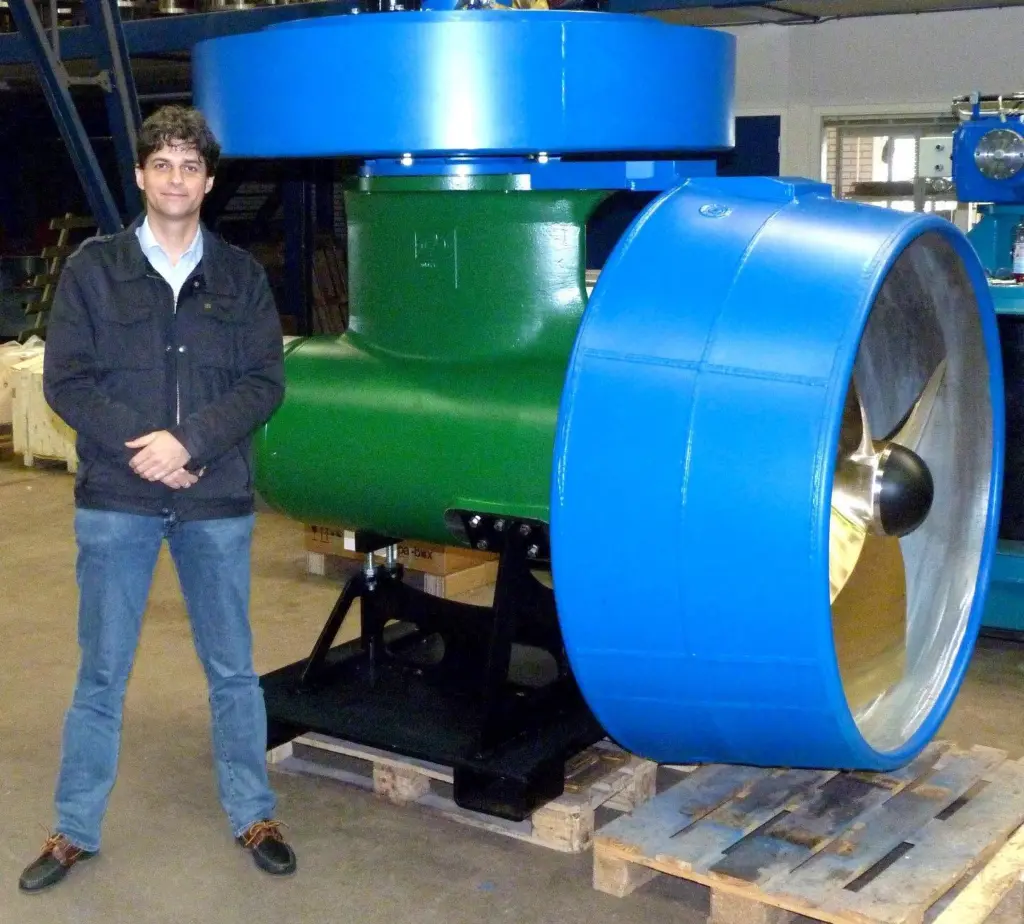
No stranger to Tugnology or ITS conferences is Markus van der Laan, ,managing director of IMC Maritime Development BV and the source of many innovative concepts. On this occasion he delivered a paper along with Dutch associates Dick-Jan de Blaeiy of Verhaar Omega BV and Herbert Koelman of SARC BV with the title ‘The V-POD: A New, Attractive Electric Propulsion’. Its subject was the development of the Verhaar POD (V-POD), a fully azimuthing ‘pod’ style propulsion unit incorporating a medium speed electric motor and planetary reduction gearing. A unique hollow motor shaft and a long propeller shaft passing horizontally through the whole unit and sturdy bearings enable low propeller revolutions and high torque, for a high bollard pull performance. Examples of the V-POD are in use aboard a Dutch inland waterways vessel and the prospects for further development are promising.
The subjects of ‘hybrid’ propulsion systems, the use of LNG as an alternative fuel, and performance monitoring were also keen subjects for discussion. Safety and training are never far from the minds of the present day tug operator. Papers alluding to those and other towage related subjects were included in the programme.
As with previous Tugnology and ITS conferences, the hospitality offered and the opportunities for ‘networking’ were excellent. On the evening prior to the conference, a drinks reception was sponsored by JonRie InterTech and lunch, provided on both days of the event, was sponsored by Uzmar Workboat & Tug Factory. A dinner sponsored by Damen Shipyards was organised during the first evening, with pre-dinner drinks sponsored by Samson Ropes. MTU sponsored coffee and tea breaks.
An exhibition area provided the setting for ‘table-top’ displays, where manufacturers, designers and tug builders could display their wares. This aspect of the event was apparently quickly sold out and had to be extended, taking up all of the maximum space available. As in all Tugnology and ITS & OSV events, the exhibition area was widely used by delegates as a meeting place during breaks in the scheduled conference proceedings.
Tugnology has once again proved to be a winning formula and an excellent intermediate event which ‘dovetails’ in very well with the long established major ITS & OSV conventions.
By Jack Gaston
Related Articles
 SPECIAL REPORTS
 TUGS & SALVAGE
 EQUIPMENT