![MaritimeJournal[Seawork]](https://www.maritimejournal.com/wp-content/uploads/2026/09/MaritimeJournalSeawork.svg)



Armon built tugs bound for Spanish operators
Spain’s Astilleros Armon recently delivered two Robert Allan Ltd (RAL) compact tugs to domestic operators, each combining efficiency and performance for shiphandling duties.
Spanish Ibaizabal Group’s history dates back to 1861 and encompasses a range of activities in the shipping industry. As well as management of its own fleet along with those of third-party owners it also oversees a number of associated towage and oil recovery activity companies. Fleet composition of its towing division satisfies requirements of not only harbour and terminal shiphandling services but also: ocean towage, salvage, fire-fighting and oil recovery. It is to the account of Compañia de Remolcadores Ibaizabal SA of Bilbao that Ibaizabal Doce was delivered.
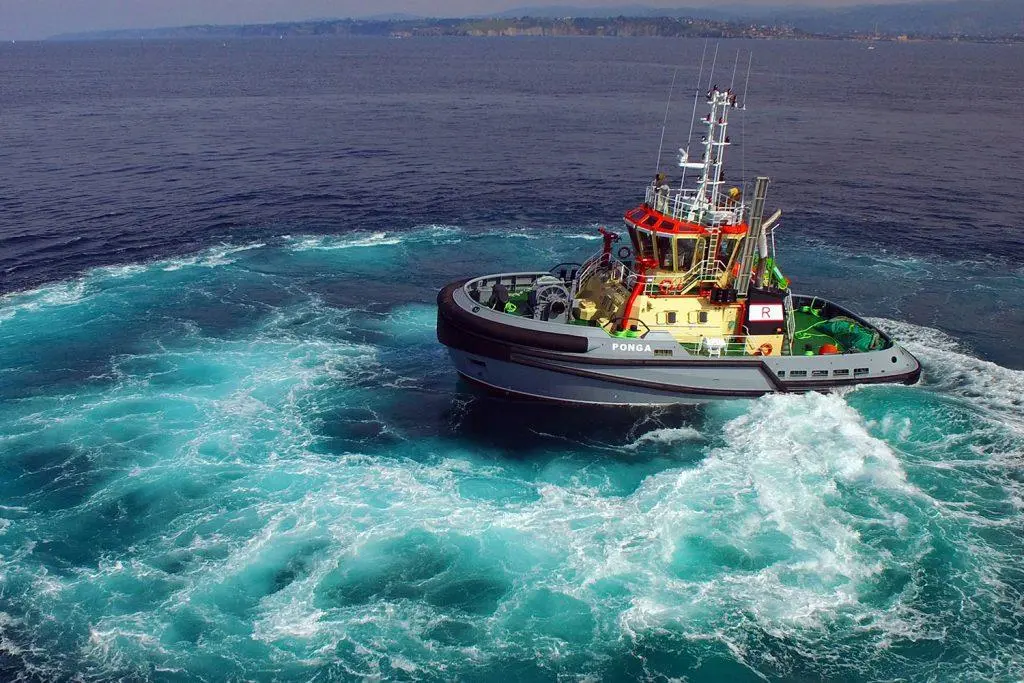
Remolques Gijoneses SA provides port towage services at Gijón on Spain’s north coast and like Ibaizabal also offers coastal and ocean towage services along with marine rescue, anti-pollution and fire-fighting capabilities. Its fleet of around nine vessels, recognisable by their grey hulls, is dominated by ASD tugs featuring Schottel propulsion and that pattern continues with this latest addition to its fleet, and the second Armon-built tug in this report, the ASD tug Ponga.
Both Ibaizabal Doce and Ponga are RAmparts 2400-W designs and the description below is relevant to both vessels. Before we look at them in detail it is worth taking a step back and reviewing the actual vessel design as described by RAL who state it is a ‘powerful yet agile compact tug featuring standard RAmparts class characteristics.’
The vessel has an adequate deadrise improving thruster performance along with a modest side flare. Seakeeping performance is enhanced with a semi-raised forecastle and gently rounded deck line in plan ensuring that manoeuvring alongside and leaving assisted vessels can be carried out safely and easily. RAL describes this as ‘avoiding the “shoebox” shape of many other common tugs’.
A conically shaped double-chined stern form, unique to all RAL tugs ensures the vessel can run astern at high speeds, maintaining good control and directional stability in all directions. Merits of these design features are evident in the photos accompanying this article showing the Ponga performing a high-speed turn about its own axis without any water on deck, RAL state: ‘This compares favourably to many other types which can corkscrew themselves into deep water easily, totally and dangerously immersing the aft deck.’
The hull is under the 24m length rule for International Load Line and Tonnage Convention requirements. For shiphandling, towing is carried out over the bow and the deckhouse and wheelhouse are biased aft for working under the flare of modern vessels, also providing a large and safe forward working deck.
Turning now to finer details of Ibaizabal Doce and Ponga, main dimensions are: LOA 24.4m, breadth moulded 11.25m, depth moulded 5.1m and load draught (maximum) 5.08m. Main tank capacities are: fuel oil 84,000 litres, potable water 10,100 litres, reserve potable water/water ballast 44,600 litres.
Main machinery consists of two Caterpillar 3516C engines, each rated 1,920kW at 1,600rpm, driving Schottel fixed-pitch SRP1215 FP azimuthing thrusters through a straight-line shafting system. Performance figures include a mean bollard pull of 70t and free running speed of over 13kn. Fire-fighting capabilities are from a 2,800m3/hr Jason centrifugal pump operating via a Kumera gearbox and supplying two Jason water/foam monitors.
Ibercisa supply the hydraulically-driven, split-drum, anchor/towing winch forward which includes an anchor cable lifter and horizontal warping head. Limited towing over the stern is provided by a tow post and tow hook with a vertical warping head and deck crane also provided aft.
Accommodation on both tugs is provided for six persons in two single and two double cabins, all above the deepest load waterline. Fendering is to the usual required standard for vessels operating in a tough working environment, comprising 800mm diameter hollow cylindrical fendering forward with a lower run of 600mm ‘W’ block fenders, the same configuration protecting the stern and transom corners. The sheer strake is fitted with 300mm hollow ‘D’ fendering.
By Peter Barker

Related Articles
 SPECIAL REPORTS
 TUGS & SALVAGE
 EQUIPMENT