![MaritimeJournal[Seawork]](https://www.maritimejournal.com/wp-content/uploads/2026/09/MaritimeJournalSeawork.svg)






Armon delivers the first tractor tug for Panama
Spanish ship building and repair company Astilleros Armon SA has delivered the tug Cerro Itamut, the first of a series of fourteen azimuthing tractor tugs for ACP – the Panama Canal Authority.
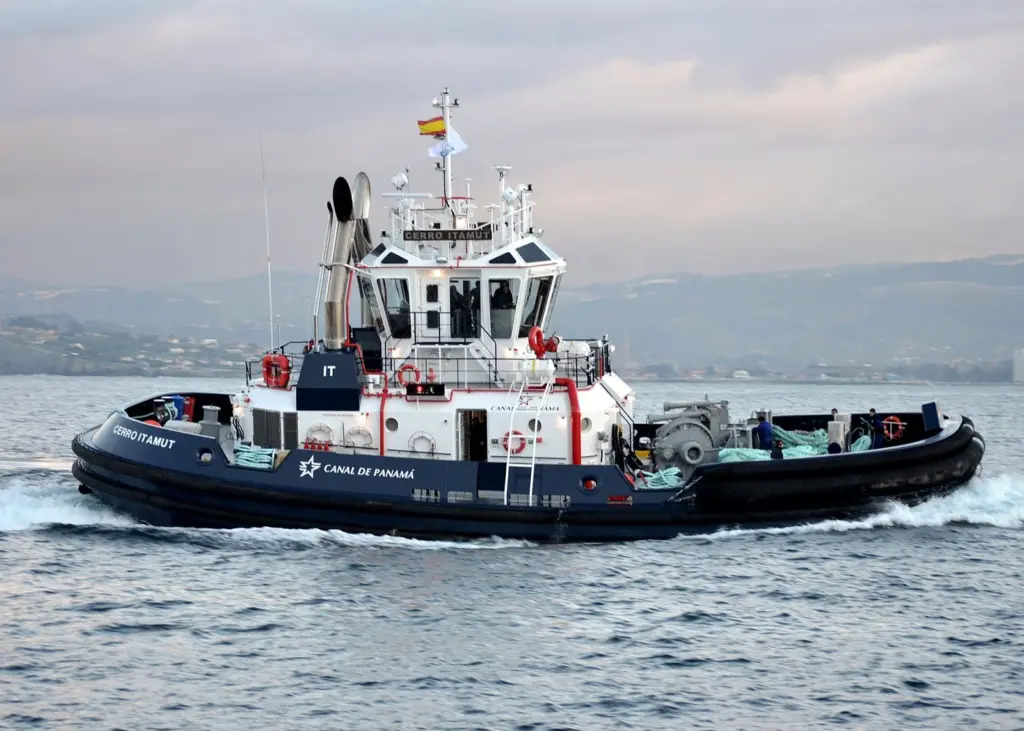
The tug underwent extensive trials during mid-March, after which it left Spain on its delivery voyage under its own power.
The contract was awarded to Astilleros Armon on 11 October on the basis of a ‘best value proposal’ for the construction, testing and staggered delivery of fourteen tractor tugs of 70 tonnes bollard pull. Valued at $158.3 million, the contract was subject of an open tender competition involving 20 companies from countries in South America, Europe and Asia. A contractural condition required the first tug to be received within 600 days of it being awarded.
The tugs will assist larger vessels transiting the current and improved canal and attend anchoring and other maneuvers in the waterway. A fleet of 36 tugs are currently employed on the Panama Canal to assist more than 14,000 transits every year. The new sections of the canal, under construction, will operate with tugs to assist the transit of ships, unlike the existing canal which uses locomotives.
Cerro Itamut and its sisterships are twin-unit azimuthing tractor tugs of 28.90m in length overall, with a design breadth of 13.50m, depth to main deck of 5.17m, and a maximum draft of 6.18m. The vessels are constructed in accordance with the American Bureau of Shipping, class notation: +A1 Towing Vessel + AMS + ACCU.
The configuration of these vessels is interesting and broadly similar to many of the later tugs currently in service on the canal. Two fully azimuthing propulsion units are located beneath the superstructure, about one third of the vessel’s length from the bow. The hull has a pronounced sheer towards the bow, a very short fore deck and an exceptionally long deck aft. A large central skeg is mounted beneath the stern to aid course stability and increase towing forces when operating in the ‘indirect’ (escort) mode.
Tank spaces are provided in the hull structure to accommodate 122.6 m3 of fuel, 16.6 m3 of fresh water, 48.8 m3 of water ballast and 8 m3 of fire fighting foam compound. Smaller dedicated tanks are also provided for waste products such as oily water, sludge, grey water and dirty oil.
Work on the Panama Canal is very much a ‘contact sport’ and the tugs are fendered appropriately. The hull aft is heavily fendered with several layers of ‘D’ section moulded rubber and cylindrical moulding on the aft bulwarks to protect the tug during ‘push-pull’ operations. ‘D’ section mouldings are also used extensively to protect the bow and sides of the vessel.
The single level deckhouse is relatively short and positioned very close to be bow. A well glazed wheelhouse is mounted above, along with two large exhaust uptakes at the forward end and a single fire fighting monitor aft. The wheelhouse has two control positions, one forward and one aft, both with split consoles and a Captain’s chair on a central track.
Towing gear aboard Cerro Itamut and its sisters is configured to offer maximum versatility when employed on the canal. Two Ibercisa MR-H/50/150-65/1 single drum hydraulic towing winches are installed on the after deck, close to the deckhouse and angled slightly inward towards the centreline. Both drums have a maximum brake holding load of 210 tonnes and two speed and render and recover capability. Each drum can accommodate 152m of 82.6mm polypropylene towline. The winches can be controlled from the wheelhouse or on deck.
The towlines are deployed via two stainless steel faileads, one massive structure on deck aft of the winches and one built into the aft bulwarks. Both have two stainless eyes and allows both towlines to be deployed at the same time when required, one to each forward (or aft) quarter of the ship being assisted, a method common when shiphandling in a canal environment.
The tugs are equipped for fire fighting with just one powerful, remotely controlled, water/foam monitor. A Jason type 250×350 OGF angular step pump coupled to the port main engine FM 200 HJF-V-C-02, rated at 1200 m3/hr, supplies the monitor and the self protection water spray. The remote controls are electrically operated from a portable console and joystick.
In keeping with many other vessels in the existing tug fleet this, new series from Armon is powered by General Electric diesel main engines. All fourteen tugs will be fitted with two General Electric 8L250MDA10 engines, each developing 2,333kW at 1,050 rpm, a total of approximately 6,256 bhp. Power is transmitted to a pair of Schottel SRP 2020FP propulsion units via Twin Disc MCD 3000-8hd slipping clutches.Each unit incorporates a five blade fixed pitch propeller of 2,800mm diameter. This powerplant gives the tugs a bollard pull of 82 tonnes and a free running speed of 12.5 knots.
Electrical power is supplied by two Deutz BF6M1013M diesels coupled to Stamford UCM274E 125 kW alternators. A Kawasaki hydraulic pump for the winches is driven by a PTO on the port main engine.
The main electrical switchboards, machinery monitoring and alarm systems are housed in a full width sound-proof control room adjacent to the engine room.
Fully air conditioned accommodation is provided for up to ten persons, including cabins, a messroom, galley and the usual sanitary spaces.
Related Articles
 SPECIAL REPORTS
 TUGS & SALVAGE
 EQUIPMENT