![MaritimeJournal[Seawork]](https://www.maritimejournal.com/wp-content/uploads/2026/09/MaritimeJournalSeawork.svg)


Busy second quarter for Tsavliris Salvage
Greeces Tsavliris Salvage has reported a busy 2015 second quarter highlighting the importance to both the world of maritime commerce and the health of the environment of a professional salvage industry.
Maritime salvage is by its nature an industry of peaks and troughs. Long periods of inactivity call for strong nerves from professional salvors awaiting the next call on their services: they are preferred to be at arm’s length when all is behaving well but when things go wrong they become vital for the resolution of situations that can be disastrous both financially and environmentally, as their latest report illustrates.
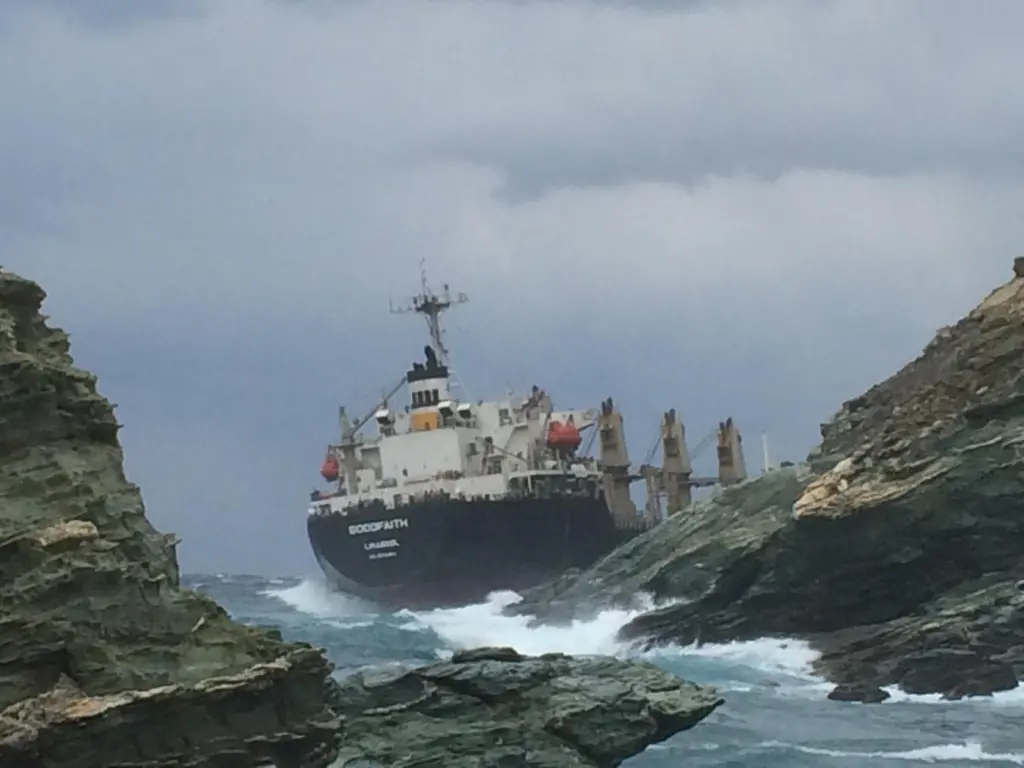
For many years now, environmental salvage has taken over as the priority in ship casualty situations, often coming above preservation of the ship and cargo, but of course after that of ensuring the safety of the crew. In mid-February this was demonstrated when the bulk carrier Goodfaith (27,308 dwt) ran aground on the north west coast of Andros Island, Greece in adverse weather condition while on ballast passage from Elefsis, Greece to Odessa, Ukraine.
The ship’s crew of 22 were rescued by helicopters and special forces from the shore but it was clear the vessel had sustained severe damage and Tsavliris were contracted to provide salvage assistance. Their 6,250bhp tug Megas Alexandros was despatched from its Piraeus salvage station and EPE S.A. (Environmental Protection Engineering) was engaged to provide environmental protection and anti-pollution services. The oil recovery vessel Aegis I was mobilised from Lavrion, Attica to the Port of Gavrion, Andros with salvage and anti-pollution teams on board.
Bad weather at the site prevented salvage crews from boarding the casualty either by sea or from land and the Megas Alexandros stood by off the Goodfaith. Four days after the grounding, salvage teams managed to board the vessel and carried out an inspection. The ship had clearly suffered extensive damage with the fore peak tank, engine room and holds numbers one, three, four and five all flooded and holds four and five and the engine room contaminated by oil. The vessel was wedged between rocks aft with a 12 degree port list.
Six days later the weather became a little kinder allowing Megas Alexandros and Aegis I to proceed to the casualty with a salvage team including divers along with salvage equipment. The initial priority was removal of pollutants and after preparations were completed the first oil was pumped onto the Aegis I from Goodfaith’s engine room service tank. By the end of March around 300 tonnes of fuel oil and 10 tonnes of diesel oil were removed after which demobilisation of personnel, vessels and equipment commenced.
RESCUE TOW
Assisting disabled ships is part and parcel of the work of salvage tugs and a request for assistance in May demonstrated how such operations can involve more than just a quick tow to port. When the Aframax tanker Lady M, laden with around 93,000 tonnes of low sulphur fuel oil became disabled some 500 miles south of the Azores following a fire in the main electrical panel, the tug Tsavliris Hellas was tasked and proceeded from its permanent salvage station at Ponta Delgada, Azores. Delivered in 1978 as the Abeille Normandie, the Tsavliris Hellas has flown the Tsavliris flag since 2007 and at 16,000ihp well equipped for ocean towing.
Tsavliris Hellas arrived at the Lady M three days later and commenced towing the disabled tanker towards Gran Canaria Las Palmas, arriving 11 days later. A team boarded the vessel by helicopter and carried out an inspection after which a detailed salvage plan was approved by the harbour master. Following inspections by Spanish Maritime Administration’s survey teams permission to enter port was granted by the Maritime Coordination Centre.
With assistance from four port tugs, Lady M was berthed alongside the Leon Y Castillo Maciente container terminal 18 days after the initial breakdown. The operation was not yet complete however. Electrical power for the tanker was provided by portable diesel generators provided by the salvors and the following day the vessel was moved to another berth with Tsavliris Hellas still in attendance providing stand-by and safety services.
Heavy equipment was flown in from Holland for the next stage of the operation, making the cargo environment safe. This included supplying inert gas to cargo tanks from a portable shore inert gas generator along with supply of steam to cargo tank heating coils to bring the temperature to a safe level. After chemists confirmed the cargo to be in a safe condition demobilisation of all personnel, vessels and equipment commenced two weeks after Lady M’s arrival at Las Palmas.
The last quarterly update reported in this column told of the Tsavliris contribution to the operation to refloat the capsized dredger Tiandao at Port of Gizan in Saudi Arabia. In conjunction with Chinese harbour construction company CHEC and Huta Marine Works the operation has now been successfully completed with refloating of the dredger.
As this article was being written Tsavliris Salvage informed MJ that they had also recently provided salvage assistance to the bulk carrier Katherine laden with 26,400 tonnes of hot briquetted iron following collision with the bulk carrier Baru Satu in Kafirea Strait, Aegean Sea.
In other associated news, Tsavliris have announced the appointment of Walter J Hinneberg GmbH, Hamburg as exclusive representative for the German shipping and marine insurance market. With over 60 years of experience in shipping they are considered well placed to handle salvage, towage and maritime service cases.
Finally, Tsavliris recently hosted the 52nd Annual General Meeting of the European Tugowners Association (ETA) in Athens. Established in London in 1963, ETA is one of Europe’s oldest maritime trade organisations, widely recognised as sole representative body of European tug owners and operators.
By Peter Barker

Related Articles
 SPECIAL REPORTS
 TUGS & SALVAGE
 EQUIPMENT