![MaritimeJournal[Seawork]](https://www.maritimejournal.com/wp-content/uploads/2026/09/MaritimeJournalSeawork.svg)

Busy start to the year for Tsavliris Salvage
Piraeus based Tsavliris Salvage have reported on a busy first three months to the year responding to incidents ranging from on-going assistance to a sunken dredger to providing rescue towage services.
Tsavliris Salvage is widely recognised as one of the world’s most active emergency response contractors for marine casualties. They are one of the few remaining emergency responders to maintain tugs permanently on salvage station at strategic locations worldwide including the Mediterranean, the Red Sea and Atlantic and Indian Oceans. They also have salvage masters and experts available at remote locations to provide rapid professional response in regions including Argentina, South Africa and Singapore. Like many other professional salvage companies, Tsavliris also have a comprehensive stock of salvage, anti-pollution and diving equipment available for immediate despatch to locations worldwide.
Tsavliris have carried out more than 1,800 salvage operations in the last 40 years at an average of 25 each year and have been the most frequent user of the Lloyd’s Open Form of Salvage Agreement with, in 2000, fifty LOF contracts being signed the highest number ever recorded by Lloyd’s in a single year.
The extent of actual ownership of tugs by salvage companies has changed over the years and the company sub-contracts tugs and other suitable vessels where appropriate, as is the case with some of the incidents recounted here, however they also operate a fleet of salvage tugs of their own. Perhaps the two most notable vessels which Tsavliris have been involved in working with are the two Russian super-tugs Fotiy Krylov and Nikolay Chiker, which at 40,000hp each, lay claim to the world’s most powerful dedicated salvage tugs.
SUNKEN DREDGER
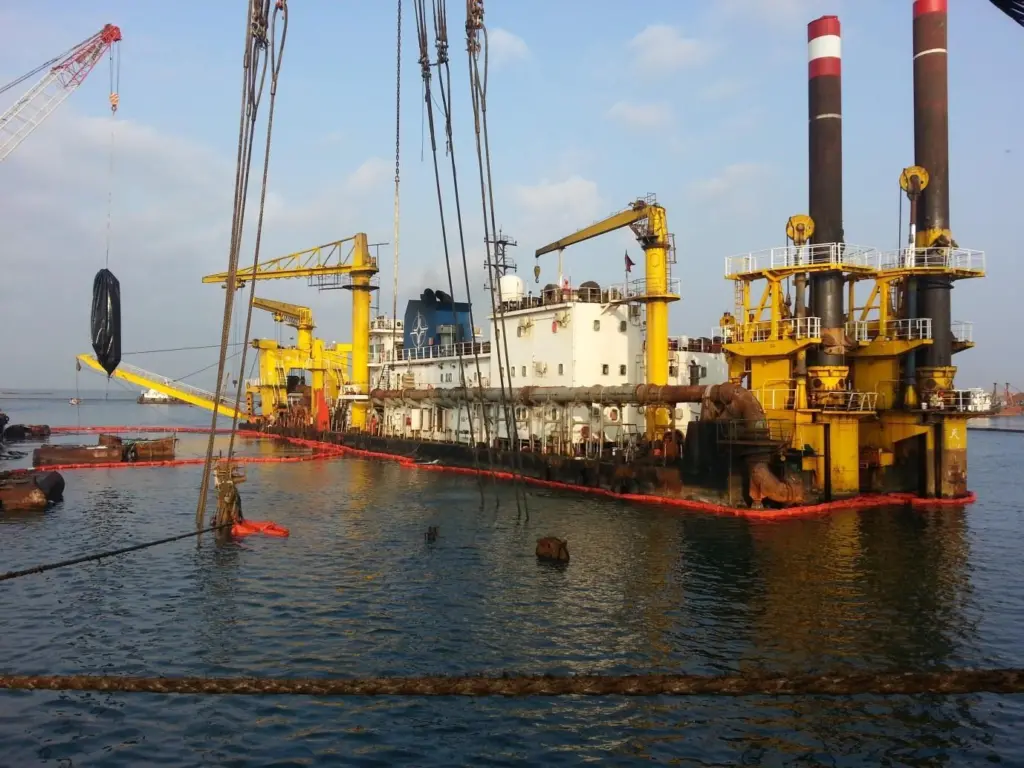
The first incident Tsavliris report on actually started at the end of November 2014 when the cutter suction dredger Tiandao caught fire at the port of Gizan in Saudi Arabia. The vessel subsequently capsized and sank and Chinese civil engineering (harbour construction) company CHEC were reported as being made responsible for its refloating/raising. They in turn engaged Huta Marine Works’ 1,200 ton sheerlegs crane vessel Huta 311 to assist in the operation. Within a few days Tsavliris Salvage were contracted by Huta to provide technical consultancy and support including planning, surveillance and risk assessment. A temporary halt was made with the operation when further water-tightening work became necessary with operations expected to continue during 2015.
The tug Megas Alexandros is a famous name in the world of salvage and has served in Tsavliris fleet for over 30 years. At 6,200 bhp and 73 tbp it is a more than capable asset and one of the old traditional breed of salvage tugs. In mid-January it was tasked from its salvage station in Piraeus to provide assistance to the general cargo vessel Lady Gaia. The 7,643 dwt vessel was fully laden with a cargo of cement when it encountered machinery problems, leaving it immobilised in the Kafireas Straits. Megas Alexandros arrived at the casualty’s position later the same day and established a towage connection with the Lady Gaia before commencing the tow to Piraeus Roads which were reached safely the following morning.
A similar but more complex operation followed just a few days later when another general cargo vessel Andromeda S laden with 2,500 mt of “Etibor-48” powder (the most common form of sodium borate used in industry) also encountered engine problems. The vessel was around 50 miles south east of Tarragona, Spain at the time and was on its way from Bandirma, Turkey to Tarragona: Tsavliris were contracted to provide salvage assistance.
Adverse weather conditions and strong currents resulted in the vessel drifting towards the northern coast of Palma de Mallorca from where the tug Marta Mata proceeded. The 5,092 bhp, 60 tbp tug is part of the Spanish SASEMAR sea search and rescue organisation (literally translated means Maritime Security and Rescue Society) and after connecting up with the disabled ship arrived at Palma de Mallorca Port several days later.
The Andromeda S had of course been bound for Tarragona and the story subsequently continued around two weeks later when the tug Charuca Silveira, (part of the Spanish Remolcadores Nosa Terra SA marine services company based in Vigo) towed the vessel to its discharge port.
JUST IN TIME
The fourth and last incident Tsavliris Salvage report on is another rescue tow and an example of where time can be of the essence requiring a rapid response to avert an otherwise manageable situation escalating into a more complex salvage operation. Early in March the chemical/product tanker FT Odin (3,471 dwt) was on passage, in ballast, from Augusta Italy to Port Said Egypt when it encountered mechanical failure and was left drifting. At the time it was 12 miles south, south west of Kythira island Greece and once again Tsavliris Salvage were contracted to provide salvage assistance.
The salvage tug Christos XVIII (2,366 bhp 32 tbp) originally served with the fleet of Unterweser Reederei as the Hoheweg, now more at home in the Eastern Mediterranean it was soon underway from Souda, Crete towards the FT Odin’s position. Due to gale conditions prevailing in the area, the casualty was drifting towards the shore and in the meantime the passing chemical/product tanker Medkem Three provided stand-by services and endeavoured to connect a tow line to the vessel to prevent it from grounding. In an attempt to slow its drift towards the shore, the FT Odin managed to deploy its anchors but significant dragging of both was experienced.
Upon its arrival at the casualty’s position Christos XVIII was able to establish a towage connection with the disabled tanker and commence towing it to the port of Gulluk, Turkey. The convoy arrived safely at the destination port just two days after the incident started.
By Peter Barker
Related Articles
 SPECIAL REPORTS
 TUGS & SALVAGE
 EQUIPMENT