![MaritimeJournal[Seawork]](https://www.maritimejournal.com/wp-content/uploads/2026/09/MaritimeJournalSeawork.svg)

China to build two rescue tugs with MAN propulsion systems
The China Rescue and Salvage Bureau (CRS) of the Chinese Ministry of Transport is to build two large rescue and salvage vessels for use in the provinces of BeiHai and DongHai.
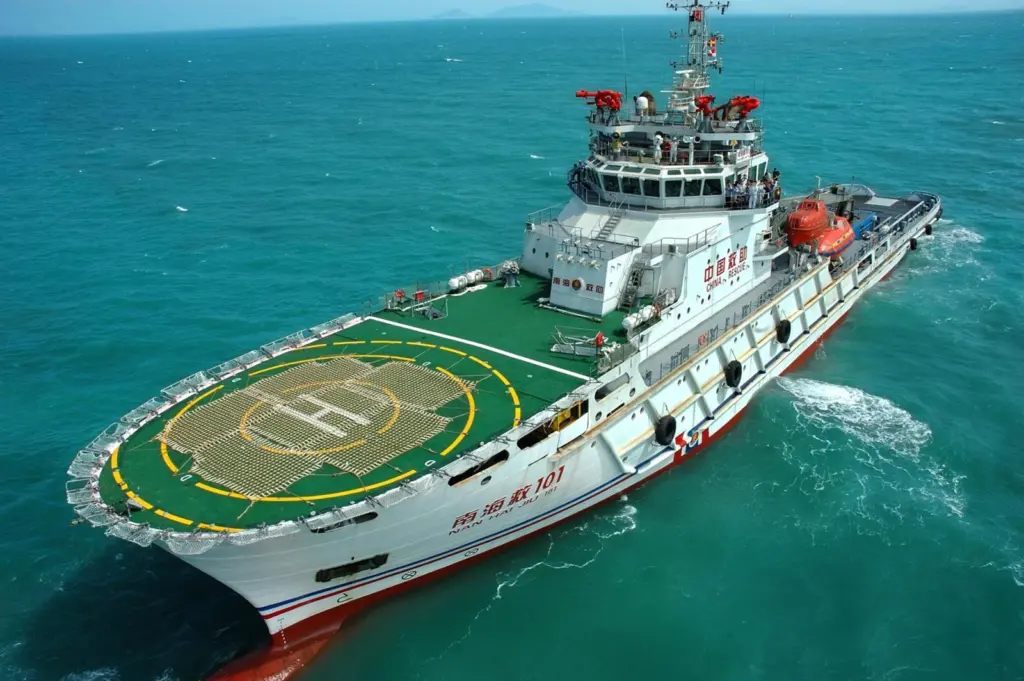
Measuring 116.95m in overall length, with a moulded breadth of 16.20m, and with a design draft of 5.50m, the ships will be similar in size and configuration to the Nan Hai Jiu 101, introduced in 2007.
Both new ships are to be built in China by the CSSC GuangZhou HuangPu Shipbuilding Company Limited. In common with the earlier vessel, much of the vital propulsion and other equipment will be imported. In a prominent contract, MAN Diesel & Turbo will supply two complete twin screw propulsion packages based on its latest MAN L48/60CR engines, Renk RSHL reduction gears, and newly designed Alpha Mk 5 propellers.
The new rescue vessels will have a specified free running speed of 22 knots at 100%MCR and a predicted bollard pull of 1,400 kN (approximately 143 tons). Each ship will be powered by two MAN Diesel & Turbo’s six cylinder, four stroke, medium speed engines of the well established 48/60CR (Tier II common rail) range, rated at 7,200 kW each at 500 rpm for a total of approximately 9,655 bhp each. Each engine will be coupled to a Renk RSHL1000 reduction gearbox, incorporating a power take-off for a 2,400 kW shaft generator. Gear specialist Renk AG is a MAN Diesel & Turbo sister company.
This power train will drive twin four blade 4.0m diameter Alpha VBS1020 controllable pitch propellers of the new high efficiency Mk 5 design, mounted on 20m long tailshafts. The propulsion system’s power and speed functions will be controlled from the main bridge, aft bridge, and engine control room by Alphatronic 2000 propulsion control and management systems.
Mr Goetz Kassing, general manager of MAN Diesel Shanghai Co. Ltd. Explained, ‘The 48/60CR engines have been chosen for these rescue vessels due to their wide operational flexibility and their combination of favourable fuel efficiency, low emissions levels and invisible smoke under part-load operation. With flexible control of injection pressure, timing and rate shaping, common rail fuel injection allows emissions and fuel consumption to be optimised over the engine’s entire load range. Combined with the new Mk 5 generation of Alpha CP Propellers, ultimate ship propulsion power and speed flexibilities are offered for the many operating modes and mission tasks of the rescue vessels.’
The first ship set of engine and propulsion equipment is due for delivery in October 2011 and the second ship set in March 2012.
Emergency response and rescue vessels of this type are used in China for a wide range of coastal and deepsea operations. The vessels are fitted out for towage, salvage, and rescue duties, including the operation of helicopters and the ability to handle large numbers of survivors.
Related Articles
 SPECIAL REPORTS
 TUGS & SALVAGE
 EQUIPMENT