![MaritimeJournal[Seawork]](https://www.maritimejournal.com/wp-content/uploads/2026/09/MaritimeJournalSeawork.svg)

Cory Riverside modernise Thames tug fleet – By Jack Gaston
The arrival of new purpose built tugs for what used to be referred to as the Thames ‘lighterage’ industry is an extremely rare occurrence.
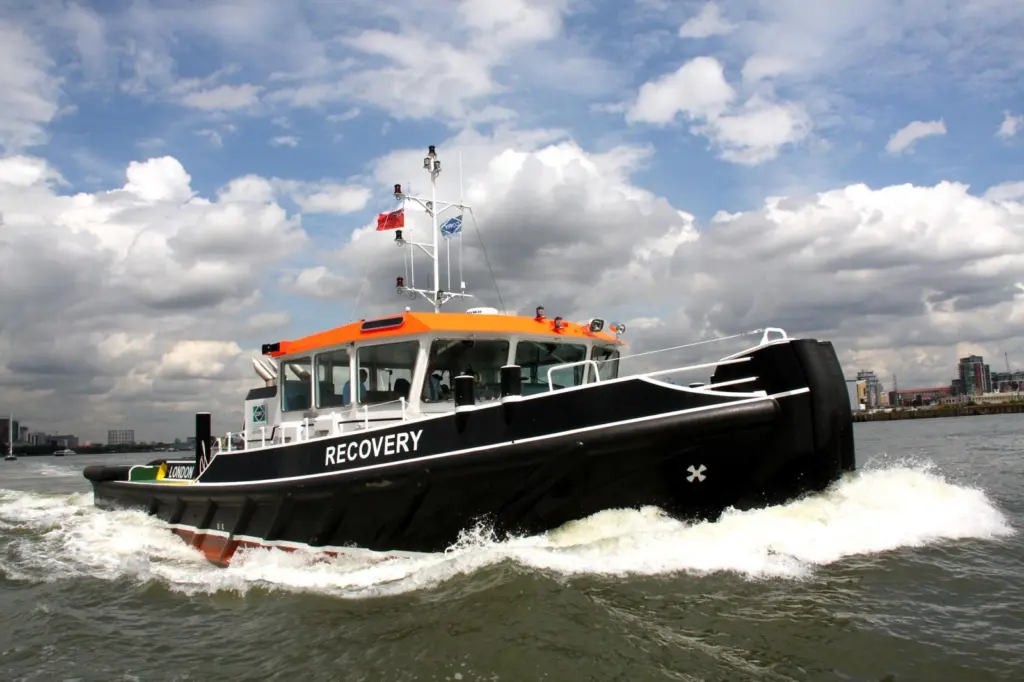
A batch of four virtually identical vessels for one operator is nothing short of a major event. Cory Riverside, a subsidiary of Cory Environmental, is in the process of introducing a quartet of modern twin screw barge handling tugs to replace some very elderly tonnage and reinforce their fleet to meet a new operational challenge. Named Recovery, Resource, Redoubt and Reclaim, they are the first new tugs to be built for the business in over a decade.
The Cory Riverside tug and barge operation provides a unique and well established service transporting refuse from a number of London boroughs through central London and down the Thames for disposal at sites in the lower reaches of the river. Refuse is compressed, containerised, and carried aboard purpose built barges, each capable of carrying 26 containers.
The barges are currently towed by a mixed fleet of single and twin screw motor tugs in tows of two, four, and under certain circumstances, six barges. Barges are taken downriver fully loaded and returned with a cargo of empty containers. Such operations are carefully timed with respect to the challenging Thames tidal regime, with its average rise and fall of something like 6.5m. The use of tugs with an extremely low air draft and suitably low water draft is an absolute necessity. Added to the specific requirements for a low profile, suitable power, manoeuvrability, towing gear and accommodation, there is the need for an extremely rugged vessel to endure the rigors of handling heavy barges in the tideway.
Damen Shipyards at Hardinxveld, a division of the Damen Group, well known for its ability to produce expertly customised solutions, was contracted to design and construct this new generation of tugs. The Damen design team carefully studied the present tugs and their mode of operation and, in close cooperation with Cory Riverside technical staff, produced a new design designated the Shoalbuster 2208S. A well established Shoalbuster hull form, push knee and machinery layout has been utilised but any further similarity to the standard product is hard to find. A study of the hull reveals that a massive amount of additional steel has been built into this new variant, the most obvious being many heavy ‘half round’ steel rubbing strakes extending well below the waterline to protect the sides.
Each vessel measures 22.65m in length overall with a moulded beam of 8.00m, a depth at the sides of 2.99m and a maximum draft of 2.00m fully loaded. A large but low profile wheelhouse has been designed to meet the specified air draft of 4.30m. The tugs meet the Bureau Veritas requirements +15 IN(2) Z Navigation area restricted to Thames Tug .MC and MCA Category 3 (category 2, fair weather).
This new breed of Thames barge handling tug embodies many interesting features and considerable attention to detail. At deck level, bulwarks are provided where practical and replaced where necessary with guardrails. In the bow the bulwarks have been cut away on either side of the push knee to afford a little additional visibility forward from the wheelhouse. A hatch in the rear face of the push knee structure enables an otherwise vacant space to be used to house a diesel powered portable emergency pump. A single anchor on the port side is handled by a small hydraulic windlass.
The stern is configured and fendered to offer maximum protection from ‘over-running’ barges and when manoeuvring to make up a tow. The towing gear comprises a Mampaey 25 tons SWL quick release tow hook, mounted on ‘Dutch style’ towing bitts and incorporating a purpose built shock absorbing mechanism in the righting arm. Massive tubular bollards, located to either side of the towing bitts, act as a ‘stop posts’ when towing, to reduce the chance of girting.
In addition to the normal mandatory lights the single mast carries aerials for the two VHF radios, the AIS, the ECS charting system and the Thames Isophase system. Rearward facing CCTV cameras mounted on the wheelhouse roof enable both the tow and afterdeck of the tug to be monitored from within the wheelhouse. The mast can be lowered when necessary by a hydraulic mechanism.
The wheelhouse is large in plan view, with three control positions and a seating area. All of the controls for the main propulsion machinery and instrumentation for the auxiliaries are located on a central ‘U’ shaped console, in typical Shoalbuster fashion, with additional main engine and steering controls on either side. The main console includes the CCTV display from the roof mounted camera.
In keeping with other vessels in the Cory Riverside fleet they will be operated on a shift basis and are fitted out as ‘day boats’. However, facilities have been provided onboard for a maximum of 12 persons, including the crew and associated watermen. The accommodation below decks includes a large combined mess room and galley, toilet facilities, a locker room and changing area. Access is provided via a watertight door and companionway from the deck and from the wheelhouse. A direct access from the deck enables crew in wet or dirty clothing to enter the changing area without passing through the wheelhouse. The wheelhouse mess and galley are fully air conditioned.
Recovery and its sister ships are each powered by two Caterpillar 3412E TA/A main engines producing a total of 1,200bhp at 1,800 rpm. Power is transmitted to a pair of Promarin fixed pitch propellers via Reintjes WAF 364L gearboxes with a 4.29:1 reduction. The propellers rotate within widely spaced Van der Giessen Optima high performance nozzles located in tunnels beneath the stern. Manoeuvrability is enhanced by fitting a 100bhp hydraulically powered transverse bow thruster in the push knee. The result is a tug with good handling characteristics, a bollard pull of almost 17 tons and a free running speed of 10.9 knots.
Recovery and Resource were delivered in June and the remaining pair, Redoubt and Reclaim, and due to follow at the end of July. The tugs are part of an overall plan to open a new ‘Energy from Waste’ plant on the river at Belvedere at the end of the year. In the past disposal meant taking the refuse to a highly developed landfill facility on the Essex bank of the river at Mucking. That site is planned to close early in 2011.
The new facility being built by Cory Environmental at Belvedere will turn 670,000 tons of refuse a year from several London boroughs, that previously went to landfill, into electrical power. When the new plant is operational, containers will be offloaded from the barges at a new, purpose built jetty. Energy generated from the combustion process will be sufficient to make the plant self sufficient and provide electricity for 66,000 homes via the National Grid.
Any residual ash will be recycled into road building and construction aggregates. Work on the new facility is well advanced and commissioning will begin very soon. In addition to the boroughs of Lambeth, Wandsworth, Hammersmith and Fulham, and Kensington and Chelsea, Cory is forging links with other councils with a view to utilising the plant’s spare capacity.
Related Articles
 SPECIAL REPORTS
 TUGS & SALVAGE
 EQUIPMENT