![MaritimeJournal[Seawork]](https://www.maritimejournal.com/wp-content/uploads/2026/09/MaritimeJournalSeawork.svg)






Damen unveils the ASD Tug 3212 at ITS 2012
Damen’s very latest Azimuthing Stern Drive tug design, the ASD Tug 3212, was introduced to the world’s towage industry at the International Tug, Salvage & OSV Convention (ITS 2012) in Barcelona last month.
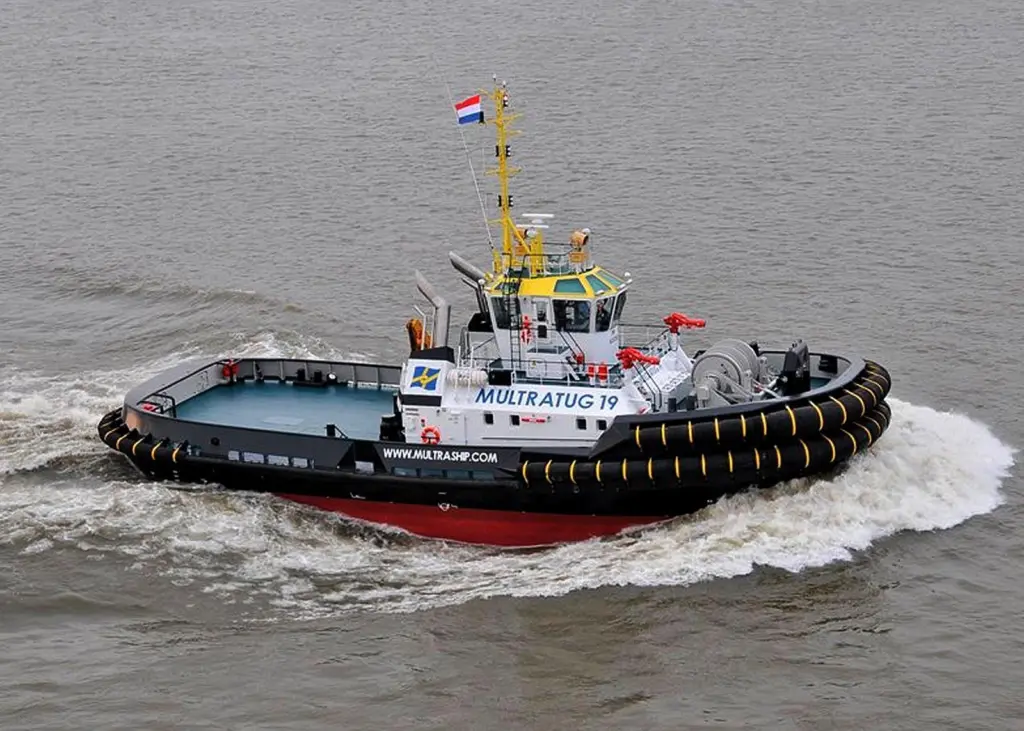
Amid an unprecedented blaze of publicity, the unveiling of this latest new design was supported by the availability of Multratug 19, the first example of this new breed to be delivered to a European owner. Multratug 19 was on its delivery voyage from the Damen Shipyard Galatz in Romania to Multraship Towage & Salvage in the Netherlands and remained open for inspection and trial trips for the duration of the convention.
This innovative and powerful tug, in the 85 tonnes bollard pull range, replaces the highly successful Damen ASD Tug 3111, which was discontinued in 2011. (MJ July 2011).
The design is the result of three years of research and represents a milestone in ASD tug design, capable of a wide range of operational duties and incorporating hundreds of innovations large and small, including a completely revised hull form. This features a higher bow with a more flared and slender shape, resulting in a dry fore deck. Trials confirm a maximum bollard pull of 85 tonnes, a top speed of 14.5 knots, and the ability to operate in waves of up to 3m in height.
Even before the ASD Tug 3212 was officially launched at ITS, Damen had already experienced considerable demand for vessels built to the new design, which is already in full series production. Four have been delivered to clients; two to an Australian coal terminal operator, the Multratug 19, and the Kin for delivery to Intertug SA of Colombia in June. Twelve deliveries are expected in 2012 alone and 10 vessels are currently under construction, including two with Ice Class Notation.
A trip aboard Multratug 19 immediately gave the impression of a large and heavily built, yet extremely agile vessel. The high foredeck and fendering alone has been the result of considerable research. Damen’s extensive tests found that when pushing at maximum bollard pull, the contact pressure should not exceed 20 tonnes/m2. A new super absorbent bow fender design was developed for maximum energy absorption, comprising a double cylindrical rubber fender.
Measuring 32.70m in length overall, the tug has a beam of 12.82m, a depth (at sides) of 5.35m and a draft aft of 5.50m. The tug has been constructed and equipped to meet the requirements of Lloyds Register; +100 A1 Escort Tug (+), LMC, UMS EP Fire Fighting Ship 1, including tonnage and loadline and GMDSS area A1 certification.
Multratug 19 has the standard propulsion package for the production ASD 3212, a pair of Caterpillar 3516C HD+TA/D diesels delivering a total of 5,050 bkW (6,772 bhp) at 1,800 rpm. Each engine powers a Rolls-Royce US255CP fully azimuthing propulsion unit incorporating a 2,800mm diameter controllable pitch propeller. With this arrangement the tug has a highly responsive performance thanks to the very quick acceleration and high torque at low revolutions, made possible by this engine/propulsion unit combination. Tugmasters trying out the tug in Barcelona remarked on the vessel’s agility, quick response and precise handling characteristics.
During bollard pull trials, Multratug 19 achieved 82.2 tonnes pulling astern and 75.7 tonnes ahead at MCR and a free running speed of 14.4 knots ahead and 14.1 knots astern.
A key feature of the new ASD 3212 is the ‘render and recover’ towing winch developed by the Maaskant Shipyards, Stellendam, a member of the Damen Group, and Bosch Rexroth. Installed on the foredeck, the hydraulically powered winch has two independently powered and controlled drums, each with a maximum brake holding load of 200 tonnes, a recovery capacity of 60 tonnes at 50m/min and a rendering capacity of 100 tons at 100m/min. Each drum is driven by a Hagglund CB840 hydraulic motor coupled directly to the main shaft, eliminating the need for a gearbox. Towline tension and length are preset by the tugmaster and can be adjusted as required, an essential feature when working in the escort role and shiphandling in a heavy swell.
The towline is deployed for shiphandling via what Damen describe as a ‘new generation’ towing bitt, located in the bow. In order to deal with the high forces involved and to avoid damage to high performance synthetic towlines, the special, cast stainless steel bitt has been developed for both its strength and anti-corrosion properties. All surfaces in contact with the towline have been rounded and polished to prevent wear and tear.
Multratug 19 will also have a single drum hydraulic towing winch aft, equipped with spooling gear. The winch has a maximum brake load of 200 tonnes on the second layer and a maximum line pull of 30 tonnes at 40m/min. A Mampaey 100 tonne SWL quick release hook is also fitted.
The fire fighting equipment comprises two Kvaerna 1,200 m3/hr remotely controlled monitors mounted forward of the wheelhouse, supplied, along with the protective spray system, by pumps driven by the main engines.
In keeping with Damen standard practice, the wheelhouse is designed for maximum all round vision and fully equipped to carry out the duties described, with the controls and instruments arranged on a single console. Also included as standard in the wheelhouse is the completely new Praxis MEGA operating and control system, with multifunctional touch screens suitable for day and night use. Duplicate screens are located in the accommodation and in the engine control room to enable the controls, machinery parameters, tanks soundings and alarms to be monitored.
Comfortable, air conditioned accommodation is provided for up to ten persons and is fitted out to comply with all of the very latest IMO and MLC 2006 crew and comfort regulations, with all cabins above the waterline. Noise and vibrations are kept to a minimum, thanks to the flexibly mounted main engines and flexible drive couplings. The accommodation and wheelhouse have floating floors to keep noise levels within 55 dB and reduce vibration.
Related Articles
 SPECIAL REPORTS
 TUGS & SALVAGE
 EQUIPMENT