![MaritimeJournal[Seawork]](https://www.maritimejournal.com/wp-content/uploads/2026/09/MaritimeJournalSeawork.svg)






Electric debris clearance tug for Amsterdam
Waternet is a Dutch company that offers municipalities a service maintaining and clearing waterways, including those of the city of Amsterdam.
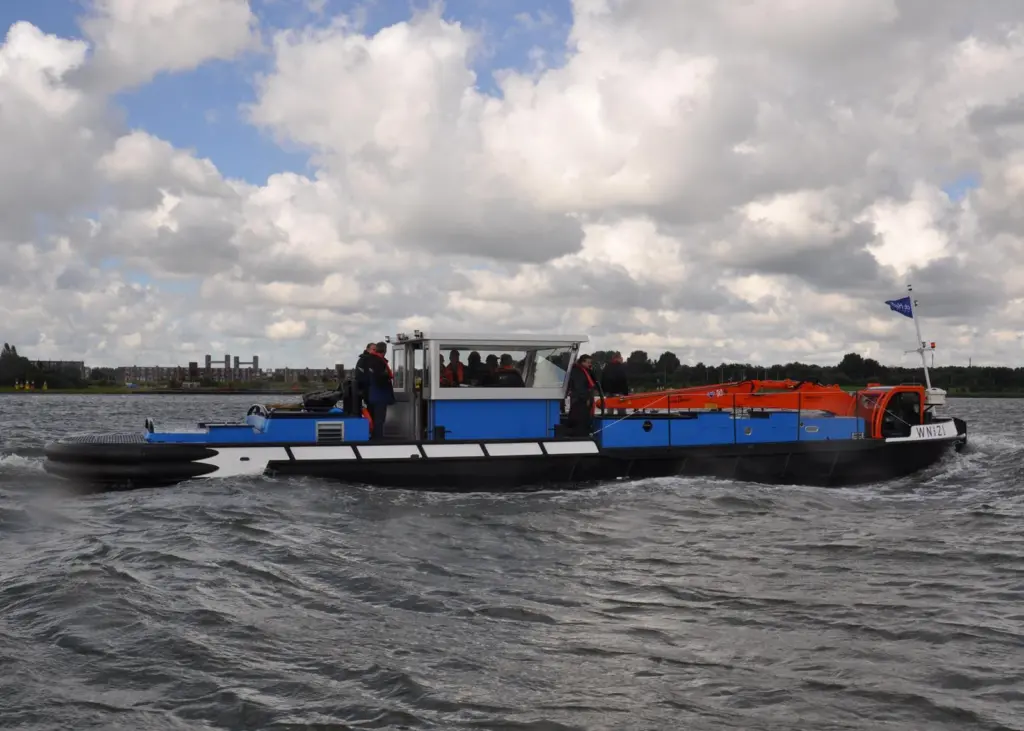
It operates a fleet of about 120 vessels which are engaged in debris clearance and similar services under contract to various authorities. In keeping with a requirement in Amsterdam to reduce pollution in the city on both the roads and the waterways, Waternet has added a new vessel to their fleet that is powered by electricity.
This new multi-purpose crane vessel/tug has a length of 18m, a beam of 4.15m and it will operate with a maximum draft of 1.3m. The design contract was put up for European tender and the building contract was awarded to the D Hass Shipyard in Masssluis, with the electrical machinery installation contracted to Floattech.
The power system selected for this vessel was for an onboard diesel powered generator supplying a power bank of EST Lithium Polymer batteries. The diesel engine chosen was a nine litre John Deere unit which is the first diesel engine from this manufacturer to meet Tier 4 requirements. This diesel is coupled to a 240kW permanent-magnet generator. The generated power can be stored in an EST 200 battery bank comprising 13 units which together can store 136 kW.
The propulsion is provided by three permanent-magnet 70kW electric motors with each motor on the same common shaft. The boat’s hotel load is supplied from the main DC supply by means of frequency converter and transformer into a 3 phase 230/400 volts AC supply at 30kW maximum. The power for the foredeck recovery crane comes directly from the DC bus, with an inverter supplying a maximum of 55kW. In addition, a number of winches and the spud pole (10kW) are also powered directly from the DC bus by the inverters.
This vessel will be used in the canals of Amsterdam for cleaning and for removing old bicycles, trash bags, mattresses, etc that have been thrown into the water. This debris is hoisted out of the canal by the crane and stored in floating containers that are stowed on deck when empty and towed when full. The vessel is able to tow five of these full containers.
The designers claim that by using electric propulsion combined with the battery storage system much better economy is possible because the generator is operating in its most efficient way. This efficiency peak is at about 85% of the diesel’s maximum capacity when the specific fuel consumption is up to 20% more efficient than at partial load or in stationary operation. The vessel will also be a lot cleaner than its conventional counterpart, with lower emissions.
Further information: www.waternet.nl
By Dag Pike
Related Articles
 SPECIAL REPORTS
 TUGS & SALVAGE
 EQUIPMENT