![MaritimeJournal[Seawork]](https://www.maritimejournal.com/wp-content/uploads/2026/09/MaritimeJournalSeawork.svg)



European Tugowners and Pilots discuss shared concerns
During 2009 representatives from the European Tugowners Association (ETA) and the European Maritime Pilots’ Association (EMPA) met to discuss operational problems that both pilots and tug operators increasingly experience when handling the ever larger types of ship arriving in European ports.
The aim of the debate was to establish a common position on ‘Best Practice’ for both pilotage and towage services. The shared problems were quickly established but finding remedies is more difficult. With that in mind, it was decided to put together a ‘Position Paper’ in which those problems that give rise to safety issues, not only with regard to pilots and tug crews but also the ships themselves and their crews, could be brought to the attention of a wider audience.
The first objective for ETA and EMPA is to raise the awareness of all parties involved (crews, tug masters, pilots) in order to enhance the safety and efficiency of towage operations. A second objective is to offer feedback to help remedy some of the shortcomings or limitations in existing ships requiring tug assistance and to extend the knowledge gained for future ship design and construction.
The resulting ‘Joint Position Paper of ETA and EMPA’ was issued on 26 January for circulation to members of the two organizations, ship owners and ship operators, naval architects, classification societies, shipyards, equipment suppliers, and maritime academies. Its aim is to prompt a debate with the objective of eliminating or at the very least minimizing the identified safety concerns.
Entitled ‘BEST PRACTICE/SAFETY in Harbour Towage and Pilotage’, the paper runs to five pages and is unfortunately beyond the scope of this news feature. However, the four main concerns covered by the paper will come as no real surprise to many tugmen or pilots, as this brief summary will indicate:
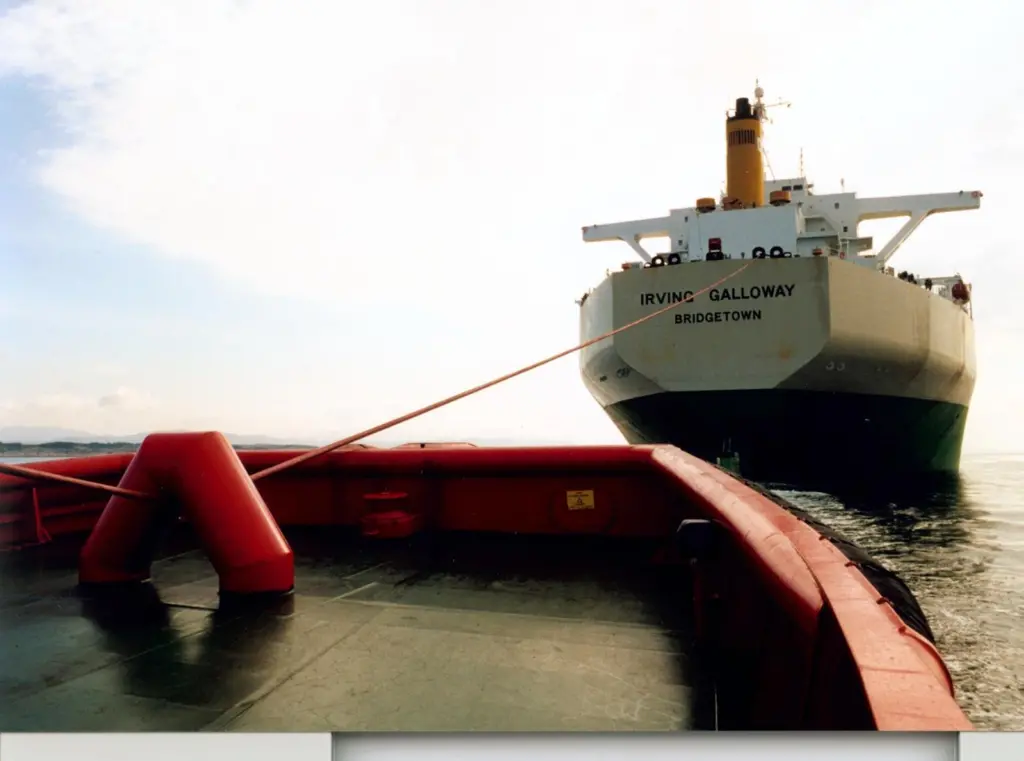
1. High bollard pull of tugboats vs. strengths of ships’ bollards and fairleads. With the enormous growth of ships’ sizes over recent years, the towage industry has been forced to deploy tugs with greatly increased bollard pulls. EMPA and ETA members have frequently experienced the use of bollards and fairleads, on all kinds of vessels, that are not in step with safety requirements. There have been cases were bollards and fairleads have been torn away, especially when tugboats have to work in the ‘indirect towing mode’.
2. Position of ships’ bollards, fairleads and winches. Bollards, fairleads and winches on board vessels are often not placed in the optimum positions for connecting tugs and for different towage manoeuvres. The positions of winches sometimes make it difficult for the ships’ crews to safely handle heavy towing gear. Bollards and fairleads are often too far apart, with the consequence that the towing gear might be damaged.
3. Possible strength problems of ships’ ‘Push Points’. ‘Push points’ on ships’ hulls are located on transverse bulkheads or web frames to avoid damage to the shell plating. None of these ‘Push Points’ is marked with maximum SWLs. Are the acceptable pressures of these ‘Push Points’ known? Will they stand the force of a 70 tons bollard pull tug pushing with full power on less than 1m² plate/hull area? Often no information is available on whether it is acceptable to let tugs push on the transom stern of the ship.
4. High minimum speeds of ships. The latest generation of large container vessels have an enormous main engine output. Engine manufacturers and ship operators, as well as many other players in the maritime business, have focussed on economic fuel consumption, taking advantage of the ever- increasing economies of scale and size of ships. However, the downside is that ‘Dead Slow’ of these large vessels is usually in excess of 6 to 11 knots through the water. Making fast a tug for a harbour towage at this speed, especially on the ship’s bow, is simply dangerous. The maximum speed of a tug is approximately 11 to 12 knots. Once safely connected, high passage speeds are reducing the tugs’ capability. Beyond 8 knots, tugs’ capabilities are very limited and at higher speeds it is getting very dangerous for tug and crew.
The paper is much more detailed and suggests possible improvements and remedies. For further information contact the ETA and EMPA on the joint Email address: empa-eta@elegis.be
Related Articles
 SPECIAL REPORTS
 TUGS & SALVAGE
 EQUIPMENT