![MaritimeJournal[Seawork]](https://www.maritimejournal.com/wp-content/uploads/2026/09/MaritimeJournalSeawork.svg)




Foss Unveils Carolyn Dorothy
The worlds first true hybrid tug, built by Foss Maritime, was welcomed to Southern California at a high profile event at the Port of Long Beach attended by around 300 VIPs on 23 January.
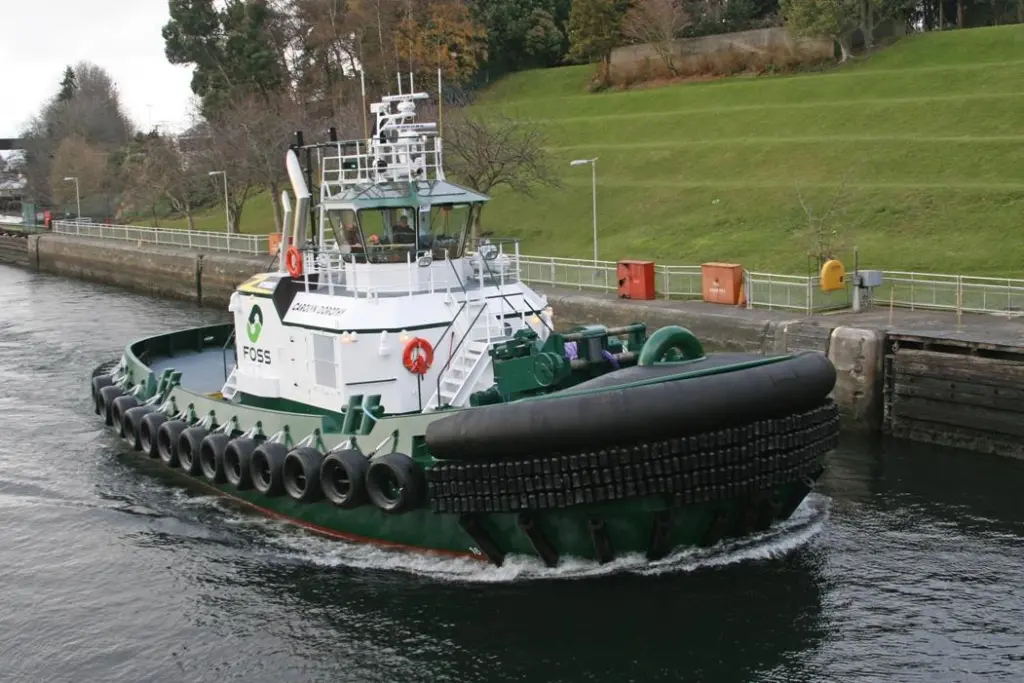
Among those attending from business, government and the media were representatives from California state government, including Governor Schwarzenegger’s office, the port commissioners for Los Angeles and Long Beach, and the environmental agencies.
Named Carolyn Dorothy, the new tug left the Foss Shipyard at Rainier in Oregon soon after Christmas (Maritime Journal – December 2008) and had been running trials prior to the event.
Foss, which currently leads the world in ‘Hybrid Tug’ technology, has now trademarked the project ‘Foss’ Green Assist’. In his speech, Foss President and COO Gary Faber said, ‘The hybrid tug is the culmination of a concept that began at Foss and succeeded because commitment to the environment is rooted deeply in our culture. We were very fortunate to have found like minded partners who believed in our vision, and we are grateful to the South Coast Air Quality Management District and the ports of Los Angeles and Long Beach.’
Foss presented special awards of recognition to the ports of Long Beach and Los Angeles, and the South Coast Air Quality Management District to thank them for their generous support of the development of the Green Assist.
The Foss Green Assist project received a major boost at an early stage when the Port of Los Angeles pledged $850,000 to the project, in association with the South Coast Air Quality Management District. The Long Beach Board of Harbour Commissioners also approved a $500,000 contribution to the vessel’s construction. In exchange for funding, Foss agreed to base the new hybrid tug in Southern California for five years.
The Green Assist hybrid tug was built by Seattle based Foss Maritime and partnered with Aspin Kemp & Associates and their affiliate XeroPoint, which developed the unique hybrid power management system. Carolyn Dorothy and any future Green Assist tugs are expected to significantly reduce emissions compared with the operating duty cycle of the conventional ‘Dolphin’ tugs in San Pedro Harbor, including a reduction in nitrogen oxide, particulate emissions, sulfur dioxide and carbon emissions.
This exceeds the Environmental Protection Agency’s (EPA) Tier 2 emissions requirement for marine engines. Even before this first vessel was launched the design was awarded the EPA’s Clean Air Excellence Award for Clean Air Technology in 2008. Along with less pollution, the Hybrid Tug offers improved fuel economy and lower maintenance costs. It is also quieter than its Dolphin sister tugs when operating on batteries that can also be recharged using shore power.
At the heart of the Foss Green Assist project is the Robert Allan designed Dolphin class ASD shiphandling tug already employed very successfully by Foss in several locations. Only 23.77m in length, the existing tugs are powered by Caterpillar main engines producing a total of 5,080bhp and a bollard pull of 65 tons. Externally the Carolyn Dorothy is very little different in appearance to its conventionally powered forbears. The only noticeable evidence of its unique powerplant is a pair of smaller exhaust uptakes.
The tug’s diesel-battery-electric propulsion system comprises two fully azimuthing propulsion units powered by batteries, diesel generators and/or two diesel main engines. A modified engine room accommodates two battery packs, producing the equivalent of 670 horsepower, and two 335 horsepower diesel powered generators. The main engines are substantially smaller and less powerful that those in the existing Dolphin class tugs.
An essential ingredient is the power management system required to produce ‘seamless’ transition from one power source to another depending on the duties the tug is undertaking and the demand for power. In its various modes of operation the new tug employs battery power for low speeds and light running, and a combination of battery and generators for medium power operation. When full power is required the diesel main engines start automatically and are coupled by clutches to the drive system in addition to the electric motors. Surplus power generated at any stage is used to recharge the battery packs.
Although the main engines in the new tug are smaller than those of existing vessels, the same total horsepower and the same 65 tons bollard pull will be available. Data collected from conventional Dolphin tugs revealed that full power was used during only 7% the operational cycle.
Related Articles
 SPECIAL REPORTS
 TUGS & SALVAGE
 EQUIPMENT