![MaritimeJournal[Seawork]](https://www.maritimejournal.com/wp-content/uploads/2026/09/MaritimeJournalSeawork.svg)


Hybrid ice-breaking tug
Gondan Shipbuilders has delivered a significant vessel in the ice-breaking hybrid tug Vilja described as the most powerful tug of its type in the world
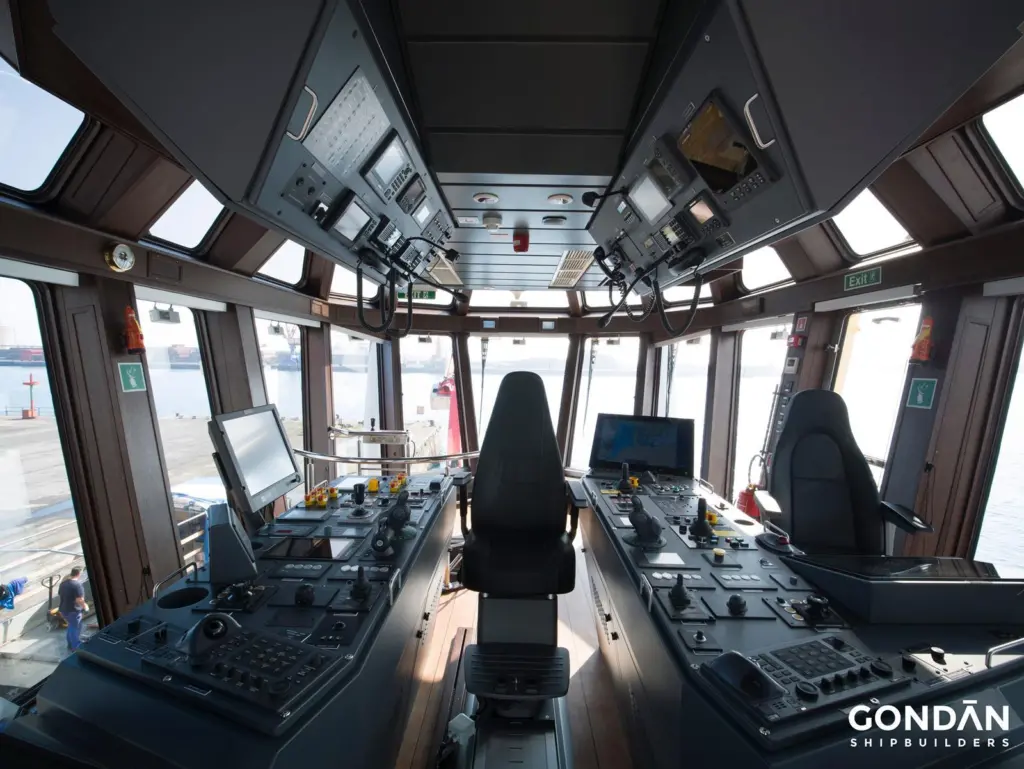
If the Port of Luleå in Sweden was looking for a yard with a proven track record of building vessels not exactly ‘off the shelf’ one look at Gondan’s reference list would have provided a convincing picture of its capabilities. In the field of tugs, perhaps most notable recently were the three LNG dual-fuel ASD ocean-going escort tugs Dux, Pax, and Audax built for Østensjø Rederi A/S and operating often in severe weather conditions at the LNG terminal at Melkøya in northern Norway.
Following an international competition involving the world’s leading shipyards specialising in vessels of this type Gondan won the prestigious order.
Owners, Luleå Hamm Port of Luleå (Sweden) required a multipurpose vessel capable of providing a wide range of services including ice-breaking; ice management; escort, ship assist and coastal towing; firefighting and navigational aid servicing in the northern Gulf of Bothnia. They turned to renowned naval architect Robert Allan Ltd for the design selection and chose its TundRA 3600-H icebreaking tug fully customised and ideally suited to the role.
The result is an LR-classed vessel that exceeds Finnish-Swedish ice-class rules with the capability of breaking 1m ice at three knots and also providing a maximum bollard pull of 100t. At the heart of Vilja is an innovative hybrid propulsion system with two main engines, shaft motors/generators and batteries providing flexibility along with significant fuel, emissions and maintenance savings.
Vilja carries the Lloyd’s Register notation: +100A1, Escort Tug, Fi-fi1, +LMC, UMS, Ice Class 1A Super FS, Descriptive note “icebreaker” and basic specifications include a length overall of 36m on a beam moulded of 13m and a draught of 7m.
The main engines, electrical and automation systems and associated equipment are provided by Wärtsilä Finland OY in the form of two 8L26 main engines, each rated 2,720kW and driving Rolls-Royce US355 CP thrusters (3,100kW each), the arrangement including two permanent magnet PTO electric motors and two PTI motors (1,000kW each). Manoeuvrability is enhanced by a 300kW Brunvoll RDT-1000-F rim drive tunnel thruster.
Ulmatec Pyro S/A supply the boiler on Vilja, and the electrical installation is from Electroinnova Marine SL. The HVAC system was entrusted to Teknotherm Marine and an 118kWE Volvo auxiliary genset was supplied by Andres Vizoso SA. Box coolers were supplied by Weka Boxcoolers BV
Tank capacities include approximately 150m3 of fuel oil, 18m3 fresh water and 230m3 water ballast while the battery pack energy storage capacity is quoted as 600kWh installed, provision for future expansion to 1,200kWh is also included.
The all-important performance figures include: maximum speed of 13.5 knots (approximately), bollard pull ahead 85t (diesel mechanical mode) and 100t (electric boost) with a steering force at 10 knots of 85t. Endurance in electric “green” mode is one hour at slow speed navigation (batteries charged to 90% SOC). The ice-breaking abilities of Vilja were also important performance considerations and the vessel is capable of a navigation speed of three knots through 1m thick ice.
Turning to the deck equipment, the firefighting installation is supplied by FFS Fire Fighting Systems supplying two monitors with a capacity of 1,200m3/hr of water and 300m3/hr foam. The Novec internal firefighting system was supplied by Survitec Fire Solutions Poland SP.
Ibercisa Deck Machinery SA provide an electric escort towing winch forward with an electric conventional towing winch on the aft deck. Hydraulically activated, three pin configured tow pins from Western Machine Works are fitted aft along with an integrated roller with a safe working load of 100t. The fendering system is supplied by Fendertec.
Looking into the accommodation, provision is made for three to six persons in normal operation and ten maximum in five single cabins, four with a second pullman bed and one pullman bed in the office.
The accommodation and exhaust pipe insulation were provided by Lido Marine and looking in detail at the actual accommodation construction, Zaklad Produkvcyjny Bohamet are listed as responsible for the windows and side scuttles with the doors supplied by Libra Plast AS.
Navigation and communication equipment were supplied by Redcai SA with Navis Engineering OY providing the dynamic positioning system.
By Peter Barker

Related Articles
 SPECIAL REPORTS
 TUGS & SALVAGE
 EQUIPMENT