

Kooiman Complete a Sophisticated Pusher for the Rotterdam – Rhine Service
In recent years Maritime Journal has reported on a number of interesting vessels emanating from Shipyard Gebr. Kooiman BV of Zwijndrecht in the Netherlands.
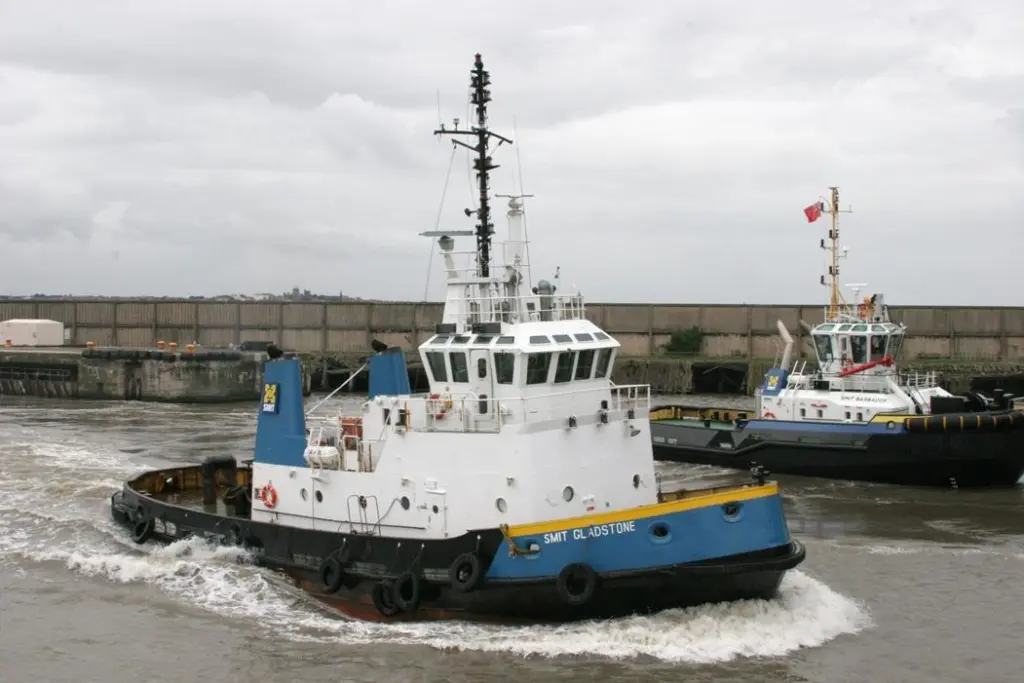
The company has become well known for a wide range of tug and other work vessels and rapid in house construction. Their most recent delivery of a large and powerful pusher tug for the Europort-Duisburg bulk cargo trade certainly deserves special mention.
Named ‘Veerhaven X Orka’ and owned by Thyssen Krupp Veerhaven BV of Breille, the tug is the first pusher to be constructed by Gebr Kooiman and the fifth newbuilding for the Dutch operators. The vessel ran trials in late May and was delivered just twelve months after keel laying.
Veerhaven X is designed to navigate with a total of six push barges, transporting bulk cargoes such as iron ore or coal on the inland waterway route Rotterdam Europort to and from Duisburg. The busy, shallow and winding river, in combination with the tight operational schedules, demands a vessel with good manoeuvrability and considerable power. For those reasons a triple screw propulsion installation with three nozzles and three fishtail rudders was chosen. In order to achieve optimum manoeuvrability when moving astern with six barges the vessel is equipped with two bow thrusters in place of the usual multiple rudder system with flanking rudders. Its performance is reported to stand out among similar pusher tugs operating on the Rhine with regard to its power, speed, manoeuvrability, silence and smooth operation.
This latest addition to the pusher tug fleet measures 40m in length overall with a beam of 15m, a moulded depth of 2.75m and draft of 1.74m (with 50% of consumables onboard). The overall configuration is quite traditional and embodies the usual large push knees forward, a dual anchoring system aft and extensive accommodation.
The propulsion installation is situated in the amidships and comprises three MaK 8M20 marine diesel engines, each rated at 1,848 bhp (1,360kW) at 900rpm. Power is transmitted to the triple propellers via Reintjes WAF 1943 gearboxes and Vulkan flexible couplings. Similar engines are in use in other ThyssenKrupp Veerhaven vessels and are flexibly mounted in a similar manner to reduce noise and vibration, a subject the owner takes very seriously.
The three five-blade Wärtsilä propellers of 2,050mm diameter rotate within Lips/Wärtilä HR nozzles with a maximum speed of 256 rev/min. In order to design an improved propeller/nozzle system, Wärtsilä cooperated closely with ThyssenKrupp Veerhaven. This resulted in stainless steel lined HR nozzles achieving more propulsion power ahead, enhanced thrust going astern and reduced noise and vibration.
Two 400kW bow thrusters are fitted in a thruster nacelle and each thruster is powered by a reversible stepless frequency controlled electric motor.
Electrical power is supplied by four 315kW diesel alternator sets. Each alternator set is driven by a Scania DS-12-62M diesel engine running at 1,500 rev/min to produce 380 kVA at 50Hz. Only one alternator is needed for normal operation but when the bow thrusters are in use additional sets can be put on line from the wheelhouse. A 80kW John Deere harbour generator set is also installed.
Fuel costs are a substantial part of the overall operational costs in a highly powered pusher tug in the coal and ore trade, therefore the performance of ThyssenKrupp Veerhaven pusher tugs BV is closely monitored and tracked using a sophisticated ‘Tempomaat’ system. The resistance characteristics of the river from Europort to Duisburg have been processed along with engine characteristics in a database. Position and speed over ground input is monitored by GPS and during the voyage the actual measured engine data is checked against the engine and river characteristics. After departure the system is switched on, the computer then continuously calculates the optimum speed for a pre-set time of arrival and adjusts the throttles to optimise fuel consumption. This permits the officer of the watch to fully concentrate on navigation. If necessary for nautical reasons the system can manually be overridden.
The accommodation in pusher tugs of this type is always extensive and well fitted out. In this case a two tier superstructure incorporates nine cabins for the crew, including an owner’s cabin, each with separate sanitary facilities. Other facilities include a fitness room, mess room with lounge facilities, galley, stores and a changing room. The living quarters, engine control room and the wheelhouse are all fully air conditioned. To achieve the strict noise levels required, the accommodation is resiliently mounted on pneumatic shock absorbers. Acoustic insulation, sound insulated glass panels and floating floors have been installed to reduce machinery noise in the cabins, where the noise levels do not exceed a maximum of 54dBA.
Considerable effort has gone into achieving a clear view over 360(DEGREES) from the wheelhouse. The double glazed frameless windows are glued directly to the construction to reduce the amount of steel framing. The central command console has been arranged for one man watch keeping and has an unobstructed view to the foredeck during manoeuvring and handling barges. Communication and navigational aids include two raster scan radars, an electronic chart system, two rate turn indicators, one echo sounder, two VHF sets, one integrated auto pilot system, GPS, CCTV camera system for the engine room and rudder indicators for own system and barges.
Related Articles
 TUGS & SALVAGE
 EQUIPMENT
 MARINE CONSTRUCTION