

Magnus Delivered as Harms Building Programme Gathers Pace
The rapidly growing fleet of Hamburg based Harms Offshore Gmbh received another major boost in September with the delivery of Magnus, the first of a pair on new anchor handlers. Since the delivery last year of the smaller Primus (Maritime Journal February 2005), the company has announced orders for a series of new anchor handling tugs and platform supply vessels.
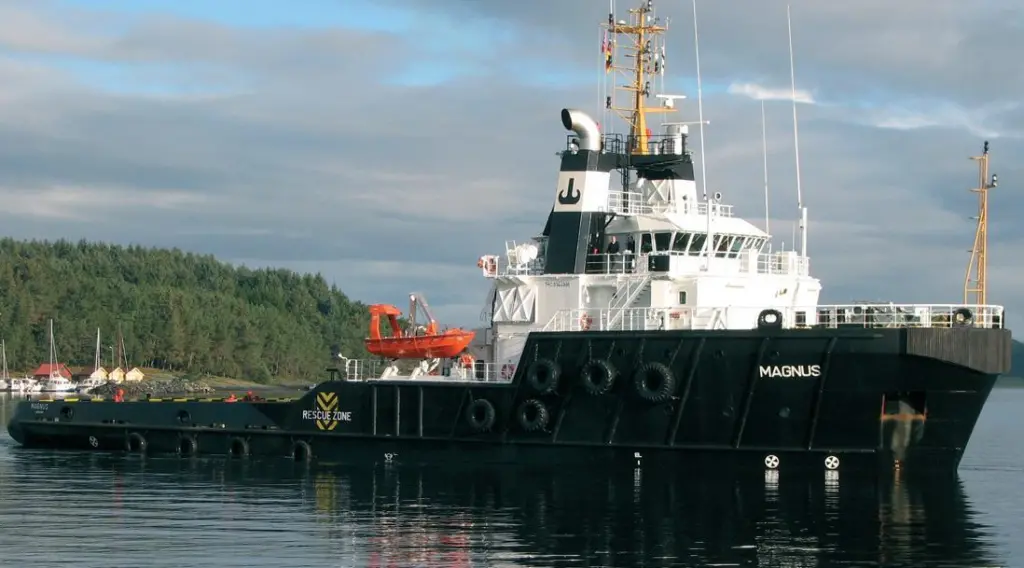
Magnus
and sister ship
Taurus
, due for completion by the end of the year, are products of the Mutzelfeldtwerft Gmbh shipyard at Cuxhaven. The vessels are equipped for long distance towing, anchor and hose handling, berthing, fire fighting and salvage. They will operate under the German flag and meet the exacting requirements of Germanisher Lloyd +100A5 Deep Sea Tugboat (Nav-A4)+MC E2 AUT, FiFi1, DP2.
The tugs are developed from an established design produced by Dutch consultants Worldwise Marine and incorporate a high forecastle and heavy fendering all round. A large after deck and comprehensive outfit of towing and anchor handling equipment underlines the vessel’s prime purpose. Very little provision is made for the transportation of cargo and no bulk tanks are fitted. Construction was undertaken by Mutzelfeldtwerft under contract to Ferrostaal AG of Essen, with the hull and major steelwork built in Poland. Magnus is a conventional twin screw vessel measuring 58.47m in length, with a beam of 14.80m and a draught of 5.80m. Internal tank capacities include 1,060m3 of heavy fuel oil, 100m3 of marine diesel fuel, 54m3 of fresh water and 150m3 of ballast.
Two MAK 14V32/40 main engines are fitted, producing a total of 14,000kW (approximately 19,000 bhp) at 750 rpm. Power is transmitted, via Renk gearboxes, to twin 3,800mm diameter controllable pitch propellers, rotating in fixed high performance nozzles. Handling characteristics are enhanced by means of twin flap rudders, two 400kW transverse LIPS thrusters in the bow and one in the stern. This propulsion system gives the tug a bollard pull of 200 tons at MCR and a maximum speed of 18 knots.Electrical power is supplied by two 1,500kVA shaft generators and two 625kVA alternators powered by MAN D2842 LE 301 diesels.
The fire fighting system is supplied by two pumps, each with a capacity of 1200 m3/hr at 14 bar coupled to the main engines.The towing and anchor handling winch aboard Magnus was manufactured by Hatlapa Marine Equipment and is a twin drum, electrically driven, waterfall winch with a maximum brake holding load of 320 tonnes and a dynamic pull of 200 tonnes. Both drums can accommodate 1,600m of 76mm diameter steel wire rope. In practice, a main towing wire of 1,6000m is carried, along with a spare wire of 1,200m and a 300m work wire. While hauling, the winch can generate rope speeds of up to 31 m/min. A cable lifter for 76-127mm stud-link chain is located on each end of the lower winch drive shaft. The latter can serve two 33.75m3 chain lockers situated below deck.
A separate powered storage reel can accommodate a further 1,600m of steel wire rope.A stern roller with a safe working load of 300 tons and two 10 ton tugger winches are provided. Line handling is carried out using a single set of Karmoy forks and pins, rated at 300 tons. Salvage equipment includes two portable diesel driven salvage pumps and a 50 bhp workboat.
The wheelhouse is fitted out to the highest standards with navigational equipment that includes two ARPA radars, with ECDIS, and a Nautronix DP 2 positioning system. Communications equipment meets the GMDSS Area 4 standard. Fully air conditioned accommodation is provided for a maximum of up to 23 persons and comprises seven cabins for officers and nine for crew, along with the usual galley, mess, stores and sanitary facilities.
Magnus and Taurus are heralded as the most powerful tugs to be operated by a German owner. Magnus has already been taken on charter by Shell EPE to conduct ‘in-house’ rig moves. Shell is reported to have a dozen rigs on hire and Magnus will join two other anchor handlers on term charter in UK, Norwegian and Dutch waters in the North Sea, thus protecting Shell from wild fluctuations recently experienced in the spot market. This is believed to be the owner’s third vessel working on a term charter in the North Sea, expanding their reputation as a quality supplier of offshore tonnage.
By JACK GASTON
Related Articles
 TUGS & SALVAGE
 EQUIPMENT
 MARINE CONSTRUCTION