![MaritimeJournal[Seawork]](https://www.maritimejournal.com/wp-content/uploads/2026/09/MaritimeJournalSeawork.svg)


Meeting the challenge of container ship fires
Fires originating in the cargo on container ships continues to make news but what does this mean for the salvage industry? Peter Barker investigates.
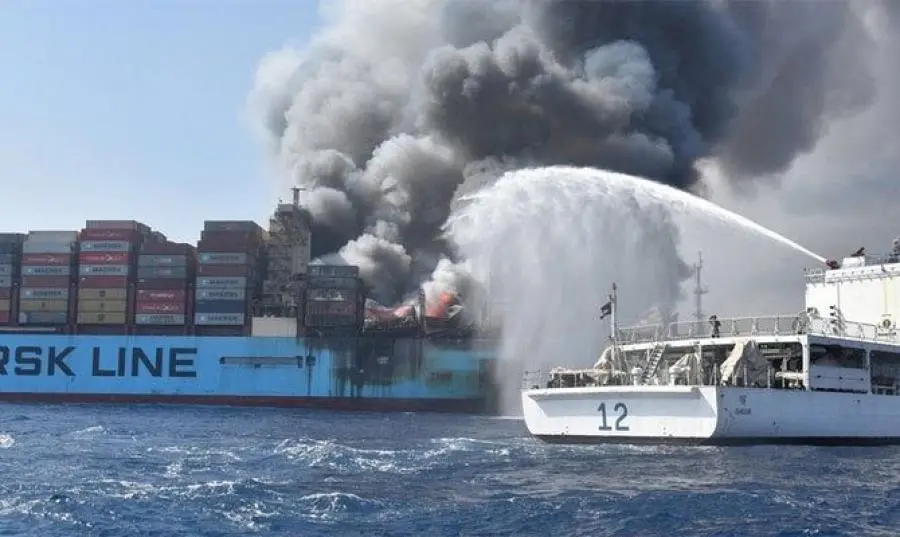
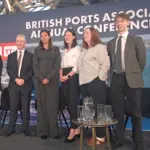
MJ reported recently on the International Salvage Union’s Associate Members’ Day in London, part of which examined the challenges salvors face responding to fires and similar incidents on large container ships. The experiences recounted on the day invited a more detailed examination.
The occasion provided the opportunity to hear first-hand from experts for whom dealing with such incidents could be considered as simply doing what they do. Their accounts however of what is actually involved when they get that phone call in the middle of the night served as a reminder of the ingenuity and skill in the face of danger the salvage industry is known for, not to mention the implications for the affected ship’s crew.
There is an important difference when dealing with a fire on a container ship compared to casualties affecting other types of vessels. Take for example a loaded VLCC aground on a hostile coastline and in danger of losing part or all of its cargo, a scenario that presents a challenging situation for salvors but one where they will have a good idea of what the ship is carrying.
Compare this to today’s largest container ships which can in theory carry over 20,000 twenty-foot equivalent boxes although for various reasons including stability and a mix of different sized containers, they will seldom if ever actually have that number on board. At over 200,000dwt however, huge volumes of virtually anything imaginable from raw materials to manufactured goods, some classified as dangerous will be hidden from view and accompanying the crew on their voyage. The point is that ultimately no one on board can know for sure what each container actually holds.
One speaker told of a random check on containers in the US recently where around 20 per cent of the contents were found to be mis-declared, put another way boxes assumed to be carrying otherwise benign and friendly goods could contain dangerous goods and potentially be loaded alongside other containers with known dangerous goods that take great exception to being in close proximity to other similar goods.
The reasons behind this are for another day but it is suggested, linked to the extra insurance costs and regulatory requirements when transporting dangerous goods. The bottom line however is that when such mis-declared or perhaps badly stowed cargo leads to spontaneous explosions and fire it could potentially be on a giant container ship with a crew of around 20, in mid-ocean hundreds of miles from land and immediate professional assistance.
Faced with this reality, valiant efforts by the crew have often succeeded in containing the conflagration until the professionals arrive but sadly many seafarers have lost their lives attempting to save ship and cargo. The safety of the crew facing the prospect of explosions, noxious gasses and even loss of their ship comes first and if they lose control they will likely and rightly abandon the vessel.
MAERSK HONAM
The featured incident mentioned on the day, and typical of other similar cases was the fire on the Maersk Honam. In March 2018, while in the Arabian Sea around 900 miles south east of Salalah, the 153,153gt vessel reported an explosion and fire among its cargo of containers forward of the accommodation. The Indian Navy quickly responded but sadly four of Maersk Honam’s crew lost their lives tackling the fire which consumed the entire forward part of the vessel and accommodation.
Smit Singapore Pte Ltd and Ardent Maritime NL were engaged as salvors and after a protracted operation to extinguish the fire the ship was berthed at Port of Jebel Ali for discharge of the remaining cargo which was largely undamaged. It is worth remembering here that if a ship loses power on these occasions, the contents of refrigerated containers are also at risk of being lost. In the fore part meanwhile, the contents of the holds were reduced to ash.
With the ship alongside and one part of the salvage complete the next phase could begin, the “excavation” of the remains of the cargo. Boskalis/Smit Salvage was engaged for this operation with dangers potentially as challenging as the initial fire-fighting phase.
Richard Janssen from Smit Salvage presented thought-provoking pictures and facts surrounding the operation where it was estimated some 28,000 tonnes of debris had to be removed. But of course, in the forefront of everyone’s mind and as mentioned above, the actual contents of the affected containers could not be determined with certainty, the assumption having to be made that they would be dealing with an unpredictable cocktail of noxious gasses released to the atmosphere as the debris was removed.
With the use of shore-side cranes ruled out, jack-up barges were positioned each side of Maersk Honam for the excavation. Constant air and water sampling by workers wearing total body protection was required as the mix of what was left of the containers and their contents (mostly ash) was excavated and transported ashore for further processing and disposal.
This reveals an aspect to be considered when determining a suitable port of delivery in such situations. A substantial area ashore has to be available for the safe processing of damaged cargo including avoiding potentially polluted water entering the local water supply; the contractor in effect has to establish a temporary recycling facility.
Following completion of the excavation it was determined that the afterpart of Maersk Honam could be saved. While the accommodation had been sacrificed in the blaze, it had provided a barrier between the fire and the remainder of the ship. The vessel was cut in two, the afterpart transported by semi-submersible heavylift ship to South Korea to be rebuilt.
SOLUTIONS
Captain Nick Sloane, mastermind behind the Costa Concordia wreck removal and Gert-Jan Langerak from RelyOn Nutec (formerly Falck Safety Services) provided further thoughts on dealing with such incidents and options available for mitigating the problem.
When a fire is discovered among its containers the crew of the afflicted ship are faced with a formidable task dealing with the situation until professional help arrives. Limited space between the containers makes access to the seat of the fire difficult and the presence of smoke and noxious gasses makes it a difficult environment to work in at best.
As mentioned there will probably be insufficient crew to maintain a round-the-clock battle for what could be several days with of course the ever-present danger of further explosions should the fire consume adjacent containers.
The approach for the crew and salvor is to simply contain the fire and accept the losses of those boxes already on fire, the thrust of the attack centered on cooling unaffected containers and ship’s structure to prevent the fire from spreading.
An important early measure to take is to position the ship such that smoke, and gasses are directed away from the accommodation or where necessary unaffected containers known to contain hazardous cargo. If the ship itself is unable to achieve this, a tug will be required to apply heading control, action that may take a suitably-equipped vessel away from its firefighting duties.
The speakers discussed various options for a more offensive approach including devices to penetrate burning containers allowing water or other extinguishing agents to be introduced or, as it was put “let it burn, fill it with water”.
An interesting side effect of such situations was where it was stated that the crews of some ships are reluctant to pump out firefighting water (to address stability concerns) because of the implications of intentionally releasing pollutants, it having to be pointed out that this is usually just cooling water sourced from outside the container.
Gert-Jan Langerak showed harrowing videos of salvors cutting holes in hatch covers allowing ‘smoke divers’ to access holds in their attempts to reach the seat of a fire. Considering such endeavours provides an example of the courage and innovative thinking salvors need and perhaps not appreciated when remembering the first two lines of Lloyd’s Open Form which includes: “The Contractors identified in Box 1 hereby agree to use their best endeavours to salve the property specified in Box 2…” Best endeavours involves more than just a recognised legal definition.
Measures to reduce risk were explored including barriers of sacrificial containers filled with fire-retardant material to isolate a fire, a potential answer but one that would come at the cost of reducing revenue-earning space.
Fireproof containers are another possible solution but with estimates of the number of containers globally being anything between the tens and hundreds of millions (there are no official registers of the number) nothing would happen overnight.
HYUNDAI FORTUNE
As well as the Maersk Honam, other similar accidents affecting large container ships were considered, including the Hyundai Fortune explosion and fire.
While on passage from the Far East to Europe in 2006 and south of the Yemeni coast the container ship suffered an explosion below deck aft of the accommodation. The immediate effect was catastrophic with a reported 60 to 90 containers lost overboard, the grotesque sight of a twisted container caught in the explosion landing on top of the wheelhouse a reminder of the forces involved and the potential time bomb crews of such ships accept as their workplace and home for weeks or even months at a time.
The ensuing fire consumed the entire afterpart of the Hyundai Fortune spreading to containers forward of the accommodation. After persistent attempts to control the fire, the 27 crew were evacuated to a nearby Dutch naval vessel.
Firefighting tugs arrived on scene two days later, but the ship continued to burn for several days before it could be towed to Salalah in Oman where the undamaged containers were offloaded.
Despite extensive damage the ship was rebuilt to live another day, but one estimate put the cost of the disaster at over USD800m.
At just 5,500teu Hyundai Fortune was small compared to the 20,000teu+ ships sailing the world’s oceans today, an indication of the challenges the salvage industry would (indeed probably will) face when responding to an incident on such a vessel, not just a fire but perhaps a stranding in a remote and inhospitable location.
This takes us appropriately to the case of the Rena. At 3,351teu even smaller than the previous example, its claim to notoriety was to run aground on the Astrolabe Reef off the Bay of Plenty, New Zealand.
From that moment on the ship was doomed, extensive oil pollution affected the area’s rich fishing grounds and the catastrophe became New Zealand’s worst ever maritime environmental disaster.
The ship broke in two, the stern section disappearing completely below the surface while the remoteness of the location and the inhospitable environmental conditions presented major challenges getting suitable heavy plant to the scene (some from Singapore) to remove as many containers as possible with what was to become a major wreck removal job. The cost of the operation has been reported as being the second highest in history behind the Costa Concordia wreck removal.
The case of the Rena is once again a sobering reminder of the implications of such accidents to the latest giant container ships and an even more important reminder once again of the necessity for a suitably-funded professional salvage industry.
But what of the cost? The cost in financial terms can be huge, 24 Ferraris where reported to be among Maersk Honam’s cargo but probably minimal compared to the overall cost which is not restricted to just financial losses.
The disruption to schedules causes ripple effects that affect people far beyond the inevitable loss of cargo consumed by a fire. It can be weeks or even months before the undamaged cargo can be offloaded, released and transshipped to its original destination. When the MSC Napoli was beached on the UK south coast following major hull damage, production at a South African car assembly plant was brought to a standstill when its consignment of ‘just in time’ components failed to arrive just in time. And spare a thought for the family who lost the entire contents of their home including irreplaceable personal possessions which were in transit to their new home following emigrating.
Above all this of course are the seafarers who have lost their lives attempting to extinguish a fire in their workplace and home and the irony of the situation they face remembering the advice shore-based fire and rescue services give in such circumstances “get out and stay out.”

Related Articles
 SPECIAL REPORTS
 TUGS & SALVAGE
 EQUIPMENT