

More New ETVs for the Spanish Coast
The first of twocoastal protection vessels has been handed over to Spains Maritime SafetyAuthority SASEMAR. Named Don Inda,the vessels primary role is that of an emergency towingvessel (ETV) for tankers of unlimited size under adverse conditions. A bollardpull of about 220 tons makes these vessels the most powerful ETVs in Europewhen it comes to towing. In a worsecase scenario where oil pollution has occurred, the tug is equipped with a fullrange of equipment for oil recovery and clean-up operations.
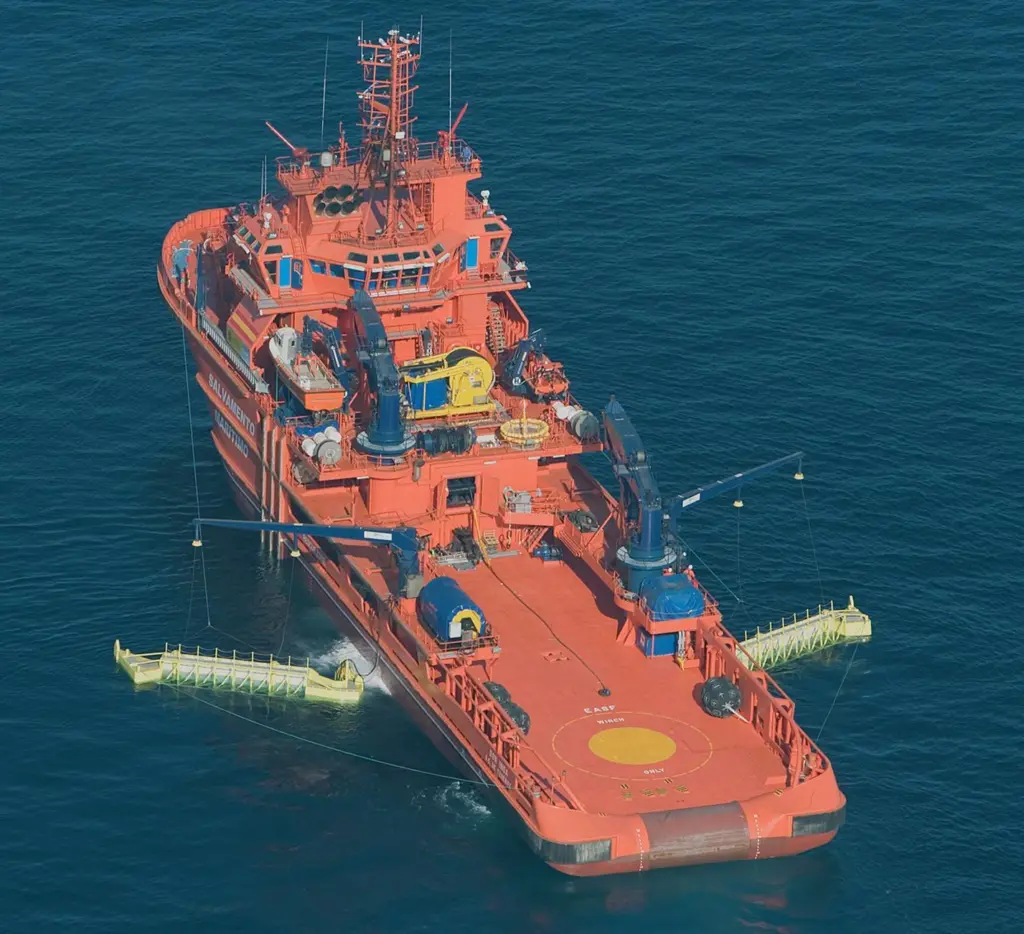
Astilleros Zamakona, based at Santurce-Bilbao, was selected to build the Spanish vessels to a Rolls-Royce UT 722 L design derived from the anchor handler of the same type. Rolls-Royce also supplied much of the vessel’s equipment.
Don Inda
is 80m long, with a beam of 18m and a maximum draught of 6.8m. Hull depth to main deck, however, is considerably larger than the normal UT 722 L at 8.25m. Both vessels will be classed by Bureau Veritas with notations that include fire fighting to FiFi 1 and dynamic positioning notation AM/ATR, the equivalent to IMO DP2 standard.
Four Bergen eight cylinder B32:40 long stroke engines produce a total of 16,000kW (21,740 bhp). Two engines are coupled to each propeller shaft to turn a CP propeller. A fire pump is geared to the forward end of the inner engine of each pair. This propulsion system provides a maximum speed of 17.6 knots and a bollard pull of about 220 tons. Depending on the operating mode, all four engines can be run, or just one on each shaft line. Powerful auxiliary generator sets are installed and a ‘swing-up’ azimuth bow thruster has its own independent 736kW diesel engine. Manoeuvring is enhanced by means of high lift rudders, two transverse thrusters at the stern and one in the bow – supplementing the ‘swing down’ unit.
The towing winch on Don Inda is designed to deal with the tug’s full bollard pull capability. This main winch is a two drum hydraulic Rauma Brattvaag unit carrying 83mm wire towlines and capable of pulling 300 tons with a 550 ton brake holding load. For escort work there is a winch on the foredeck with a 45 ton pull and 250 ton brake load equipped with synthetic rope towlines. A strongly fendered reinforced bow allows the SASEMAR vessels to push on disabled ships if required.
A comprehensive range of oil booms and skimming equipment enable Don Inda to clear oil pollution both on the open sea and in more confined waters. There are two oil booms, one with a 100mm freeboard, the other 600mm freeboard, to enclose oil spills under different sea conditions. Oil can be recovered from within the booms via a Transrec 150 system to dedicated tanks. The recovery tank capacity of approximately 1,730 cu/m is very large and the recovery system is enhanced considerably by a built in oil/water separation system. Tank heating is available to deal with high viscosity oils. will be stationed in northwest Spain and along with its sister ship will give SASEMAR a greatly enhanced coastal protection capability.
By JACK GASTON
Related Articles
 TUGS & SALVAGE
 EQUIPMENT
 MARINE CONSTRUCTION