![MaritimeJournal[Seawork]](https://www.maritimejournal.com/wp-content/uploads/2026/09/MaritimeJournalSeawork.svg)




MSC Flaminia – a marathon salvage operation
The crippled containership MSC Flaminia finally reached a sheltered position off the UK coast of Cornwall on 28 August after a marathon towage and salvage operation lasting over six weeks.
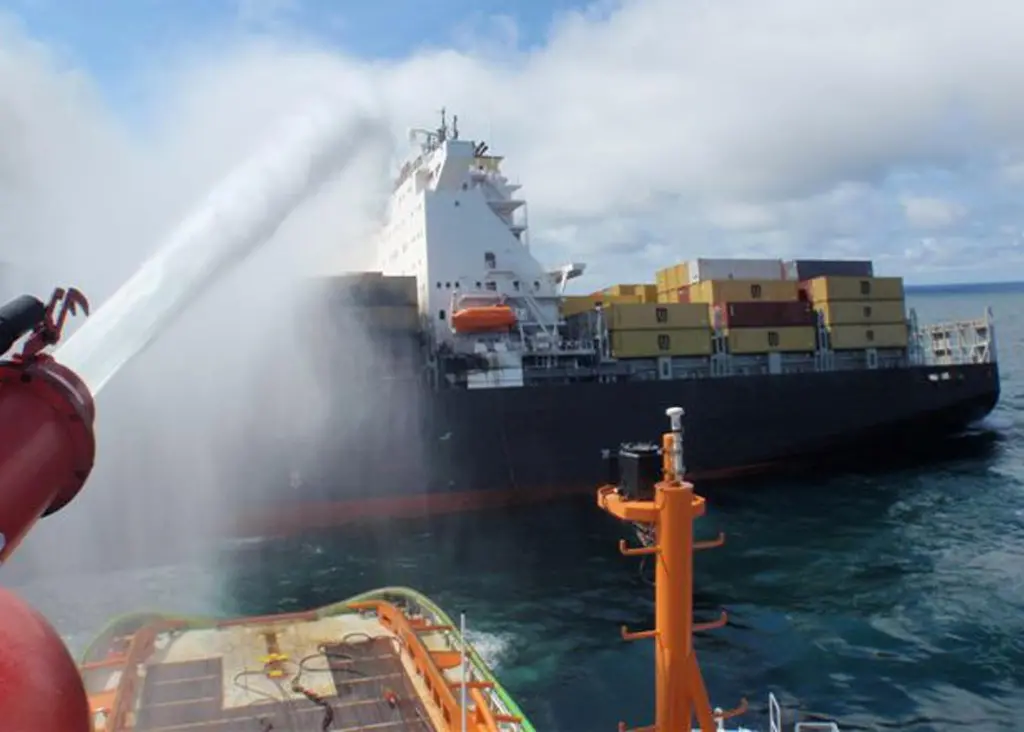
Towed by the deepsea tug Fairmount Expedition and attended by the supporting tugs Anglian Sovereign and Carlo Magno, the salvage team from Smit Salvage has been engaged in a difficult operation dogged by bad weather and seemingly endless legal difficulties.
MSC Flaminia, a German registered containership of 85,823 dwt, suffered a serious fire and explosion among its cargo of containers, on 14 July while on route from Charleston, USA, to Antwerp, Belgium. 25 persons were onboard at the time, 23 crew and 2 passengers. Three of the crew were injured and one missing after the first fire and explosion. A nearby tanker, the DS Crown, took 18 of the crew and the 2 passengers aboard and put them safely ashore in Falmouth. The containership MSC Stella took aboard the three injured personnel that were subsequently taken off by helicopter and flown to hospital in the Azores.
Smit Salvage of Rotterdam responded immediately to the incident and the Fairmount Expedition, a Dutch owned tug from Fairmount Marine, was dispatched from Falmouth Bay. It arrived on 17 July after a trip of some 1 100 miles.and started fire fighting immediately. The JP Knight tug, Anglian Sovereign, sailed from Invergordon and the tug Carlo Magno from Italian owners Augustea was also engaged. All three tugs are equipped for fire fighting.
Hanjin Ottawa, a second container ship managed by Reederei NSB diverted to the scene and the second engineer was transferred to the tug to support the salvage team with his technical expertise and accompany the ship back to Europe.
Fire fighting was interrupted on 18 July by a second explosion, resulting in the salvage team being evacuated. After further inspection it became clear that the fire was located in the mid-ship portion of the ship and that the superstructure, engine room, the stern section and the forecastle of the ship were not affected by the second explosion. The hull of the vessel was intact but due to damaged cargo and extinguishing water took a list of approximately 8 to10°. Anglian Sovereign arrived on 20 July and Capo Magno the day after, increasing the fire fighting effort and support to the salvors considerably.
Fairpount Expedition took the MSC Flaminia in tow towards Europe on 23 July, with the Anglian Sovereign constantly monitoring temperatures aboard the ship by means of a laser thermometer, and ready to resume boundary cooling if necessary.
The tow progressed towards the UK at 4 to 5 knots with the salvors going aboard when conditions allowed to activate the ship’s own fire fighting equipment. Where possible, a detailed inspection of the affected holds and containers was made, checking for pockets of fire. By 29 July the convoy reached a holding position approximately 100 miles off the British coast. Firefighting and shipbuilding experts were assessing the condition of the vessel and its stability. Overall, the situation onboard MSC Flaminia continued to improve but small pockets of fire were being monitored and dealt with.
Requests were being made for permission to enter a sheltered coastal area where more thorough investigations could take place. By 9 August the fires were under control but periods of bad weather had driven the convoy out to 360 miles to find more comfortable conditions. Lack of a decision by the European coastal states was in danger of compromising the salvage effort and causing frustration for all concerned. Helmut Ponath, CEO of Reederei NSB commented, “I consider it shocking that in this situation a ship under the German flag does not receive a permission from the European countries to call at a port.”
It was not until 21 August that the news of a plan to take the MSC Flaminia to a ‘safe haven’ was released. Meantime, the ship’s list had been significantly reduced but inconsistent weather conditions hampered salvage operations and frequently took the tugs and their charge further into the Atlantic.
MSC Flaminia and its attendant tugs finally arrived off the Cornish coast on 28 August, where a safety examination was conducted by two teams of experts. One team comprised international experts, from Britain, the Netherlands and France and another from the German Central Command for Maritime Emergencies.
The results of that inspection was still awaited at the time of going to press but if the results are satisfactory, MSC Flaminia will be towed through the English Channel towards German waters. It will probably go to a deep water anchorage in the German Bight, approximately 12 nm west of Heligoland, for further work and examination prior to being transferred to the Jade Weser Port in Wilhelmshaven.
Related Articles
 SPECIAL REPORTS
 TUGS & SALVAGE
 EQUIPMENT