![MaritimeJournal[Seawork]](https://www.maritimejournal.com/wp-content/uploads/2026/09/MaritimeJournalSeawork.svg)


New Chinese Rescue Tug attends ITS 2008
The big rescue tug Nan Hai Jiu 101, operated by the China Rescue and Salvage Bureau (CRS), travelled to Singapore specifically to attend ITS 2008. A restricted number of delegates, including your correspondent, were invited to a reception aboard this impressive vessel.
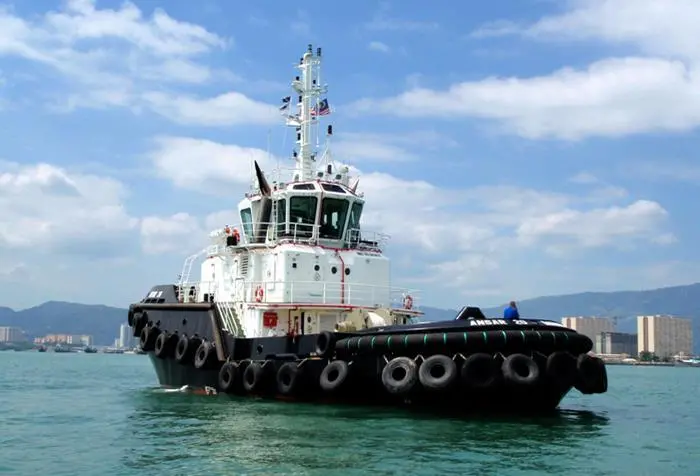
The 4,091 gt tug was completed in September and reflects the strenuous efforts being made by the Chinese government to dramatically improve rescue, salvage and counter-pollution services in coastal and inshore waters and at sea. At present CRS has almost 10,000 employees, 180 vessels of various types, one fixed wing aircraft and ten helicopters.
Capt. Song Jiahui, director-general of the Rescue & Salvage Bureau at the Ministry of Transport, took a very brief break from overseeing operations of four maritime rescue helicopters involved in the earthquake rescue work and flew into Singapore to introduce the vessel to colleagues attending ITS 2008.
Built in China by the Guangzhou Huangpu Shipbuilding Company of the China State Shipbuilding Corporation, Nan Hai Jiu 101 has an overall length of 109.70m, a breadth of 16.20m and a draft of 6m. The tug complies with the rules of the China Classification Society and meets the requirements of Ice Class 2. A relatively traditional hull design incorporates a bulbous bow, and a long high forecastle, incorporating a helicopter landing pad and refuelling facilities. A modern style bridge is located amidships and surmounted by a high level fire-fighting platform mounting four powerful remotely controlled monitors.
Nan Hai Jiu 101 is the fastest rescue tug in China with an impressive bollard pull and the proven ability to work in extreme weather conditions. Two Wartsila 6L46F 4SA 6 main engines producing a total of 19,000bhp are coupled to twin controllable pitch propellers turning in fixed nozzles. The result is a maximum speed of 22 knots and a bollard pull of approximately 200 tons. Manoeuvrability is assured with ‘flap’ rudders and transverse thrusters fore and aft. Fuel capacity onboard gives the tug an endurance of 10,000 nautical miles.
Towing equipment includes a massive hydraulic twin-drum, low profile waterfall style towing winch with maximum brake load of 2,000KN. The winch is equipped with steel wire and imported high strength floating HMPE rope. Line handling gear includes two large tugger winches and hydraulically operated ‘sharks jaws’ and tow pins.
The outfit of rescue and salvage equipment provided onboard Nan Hai Jiu 101 is impressive. A large clear afterdeck of some 490sq/m offers not only a useful working area for salvage but also a large well-equipped rescue zone able to deal with large numbers of survivors.
An array of rescue craft are carried, including four fully enclosed lifeboats in davits, capable of a variety of duties. Two powerful hydraulic cranes, mounted one on each side of the winch deck, can be used for salvage work and to launch some of the smaller rescue craft and workboats.
Provision is made to deal with up to 200 survivors in dormitory style accommodation with purpose built galley, washing and hospital facilities. A lift is installed to transport survivors entering the accommodation at main deck level to the living and treatment areas. The helicopter pad is designed to operate with, but not house, the modern S76 helicopters currently used by CRS. Specially built passages from the forecastle deck enable survivors or casualties brought aboard by helicopter to be moved quickly into the accommodation.
Nan Hai Jiu 101 is the largest, most modern and powerful rescue tug in the CRS fleet but it is understood that plans are in place to build more vessels of a similar type and increase the size of the rescue helicopter fleet.
Related Articles
 SPECIAL REPORTS
 TUGS & SALVAGE
 EQUIPMENT