![MaritimeJournal[Seawork]](https://www.maritimejournal.com/wp-content/uploads/2026/09/MaritimeJournalSeawork.svg)




Ocean Wave – the first of a new generation
Ocean Wave, the first of a new generation of four deepsea tugs for the fleet of the Crowley Maritime Corporation in the USA, has recently completed builders’ trials.
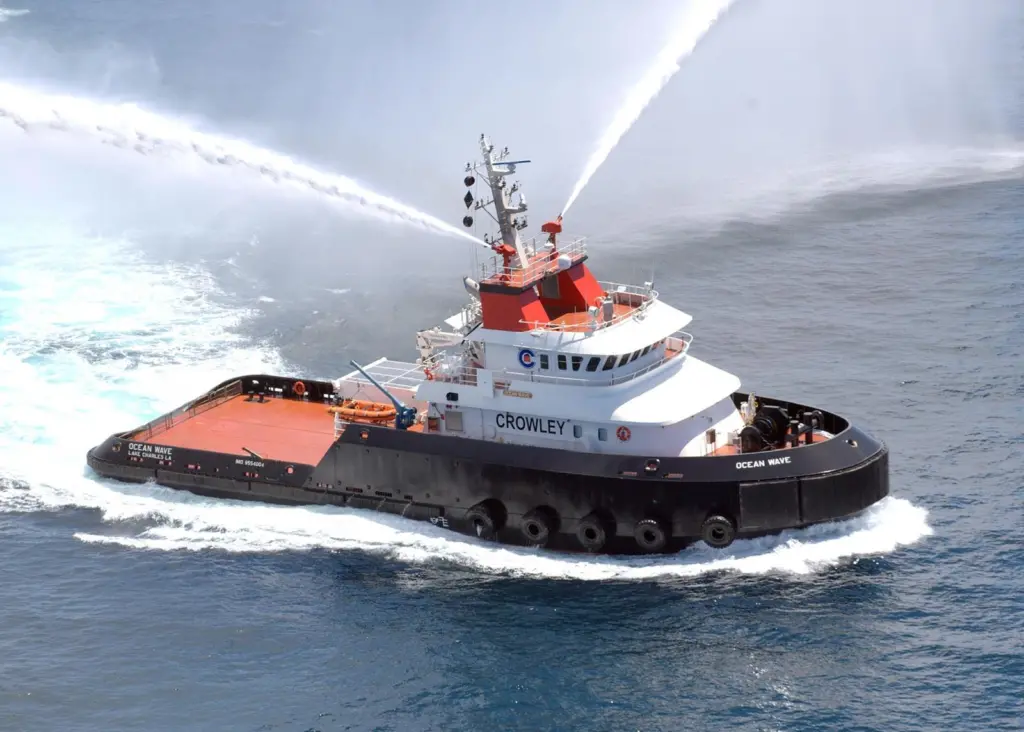
Constructed by Bollinger Shipyards of Amelia, Louisiana, Ocean Wave and sister ship Ocean Wind (still to be completed) are 10,880 hp, twin screw tugs designed to carry out long range ocean towing, firefighting and a wide range of offshore duties. Both tugs are equipped with dynamic positioning systems to DP-1 standard. The third and fourth vessels in this quartet, Ocean Sky and Ocean Sun, are longer by some 3.1m and will have additional thrusters and DP-2 systems for even more precise station keeping.
Ocean Wave and Ocean Wind meet the requirements of ABS Class, A1, Towing Service, +AMS, +ABS +ABS Fire Fighting Vessel Class 1 +ABS DP-1, with U.S. Coast Guard Certificate of Inspection, Green Passport, SOLAS and International Load Line Certificate.
The tugs measure 44.4m LOA, with a breadth of 14.03m, a depth of 7.62m, and a design draft of 6.4m. Welded steel hulls have transverse frames and transverse and longitudinal bulkheads designed to form a ‘double skin’, ensuring that all tanks containing oil are isolated from the outer shell plates. The hull design incorporates a long, forecastle which is one deck in height, a heavily fendered bow and a spacious work deck aft.
The twin screw propulsion system is powered by two Caterpillar C-280-12 Tier II diesel engines, designed to operate on Ultra Low Sulfur Diesel fuel. Each engine is rated 5,440 bhp at 1,000 rpm and is coupled to a 3.9m diameter, four blade, controllable pitch propeller via a Reintjes LAF 5666 reduction gearbox. The propellers rotate within a high performance fixed nozzle, with high lift rudders capable of being controlled in unison or independently. Manoeuvrability is enhanced further with the installation of a Berg VFD 850 hp bow thruster.
Actual bollard pull figures had not been released at the time of writing but a minimum 165 tonnes bollard pull is specified, along with a maximum speed of 16 knots.
Electrical power aboard the DP1 vessels is provided by two 1,475 KVA shaft generators, one 340 kW Caterpillar C-18 Tier II auxiliary generator and one 125 kW Caterpillar emergency generator.
The main engines and auxiliaries are all capable of being upgraded to Tier III or IV compliant standard at a later date.
Tank capacities quoted include 234,738 gallons of fuel oil, the capacity for 2,118 gallons of fuel oil overflow, 1,153 gallons of dirty oil, 1,225 gallons of oily water, 570 gallons of hydraulic oil, 19,060 gallons of fresh water, 6,474 gallons of grey water, 5,582 gallons of sewage, 2,900 gallons of lube oil, and 1,426 gallons of fire fighting foam.
Ocean Wave and it sisters are fitted with a massive Intercon DW275 hydraulic ‘waterfall’ style double drum towing winch. The lower, towing drum, equipped with 1280m of 70mm diameter steel wire towline (SWR), is positioned close to the deck to enhance the vessel’s stability. The upper drum carries a 914m work wire of 63.5mm SWR. A maximum line pull of 227 tonnes is quoted and a minimum brake holding load of 317.5 tonnes.
The winch is partially enclosed for protection from the elements in a housing with a glazed roof, enabling the winch drums to be visible from the wheelhouse aft control position. A ‘touch screen’ winch control panel in the wheelhouse enables all of the major functions to be monitored and adjusted.
A separate independently powered auxiliary storage drum is located on the port side and capstan on the starboard side to assist with line handling. Intercon also supplied a VMS combined mooring winch and windlass, and a10.5 tonne capstan on the forecastle. Two deck cranes are provided, one of 25 tonnes capacity aft and one of 5 tonnes on the foredeck.
Ocean Wave has an open stern equipped with a 1.8m diameter stern roller. A single set of
Triplex ‘shark jaws’ and towing pins, of 350 tonnes SWL, are located on the centreline and controlled from the wheelhouse.
The FiFi 1 standard fire fighting installation was manufactured by FFS in Norway and is supplied by pumps driven by the main engines. Two ‘short barrel’, remotely controlled water/foam monitors are located on a platform above the exhaust uptakes. .
A modern, almost futuristic, style wheelhouse is designed and located to ensure maximum protection in heavy seas and to afford good all round vision. Controls and a ‘state of the art’ instrumentation package have been chosen and positioned to fulfill all the functions expected of a versatile deepsea vessel.
Considerable attention has been given to providing a high standard of accommodation for the crew, with a low level of noise and vibration. A maximum of 13 persons can be accommodated, mainly in double berth staterooms.
Related Articles
 SPECIAL REPORTS
 TUGS & SALVAGE
 EQUIPMENT