![MaritimeJournal[Seawork]](https://www.maritimejournal.com/wp-content/uploads/2026/09/MaritimeJournalSeawork.svg)



One hundred RAmpart 3200 tugs and counting
Cheoy Lee Shipyards of Hong Kong was recently awarded a contract from a South American client for three new RAmparts 3200CL class tugs.
This marks a significant milestone for the popular RAmparts 3200 design as the order includes the 100th tug to be delivered. There are few designs in the world workboat market to achieve this milestone in such a relatively short time.
The RAmparts 3200 design originated from a Robert Allan Ltd. (RAL) internal R&D programme back in the early 2000s. The concept behind the RAmparts series of designs was to provide owners and smaller shipyards alike with a series of high performance, well proven shiphandling tug designs which could be built competitively in the worldwide tugboat market.
Incorporated into these designs are all the features that have distinguished other advanced tugs from Robert Allan Ltd, including high speed, excellent stability, seakeeping, enhanced astern performance and manoeuvrability. The RAmparts 3200 design, together with other RAmpart variants, has proven that the concept has been successful and has benefited the workboat industry.
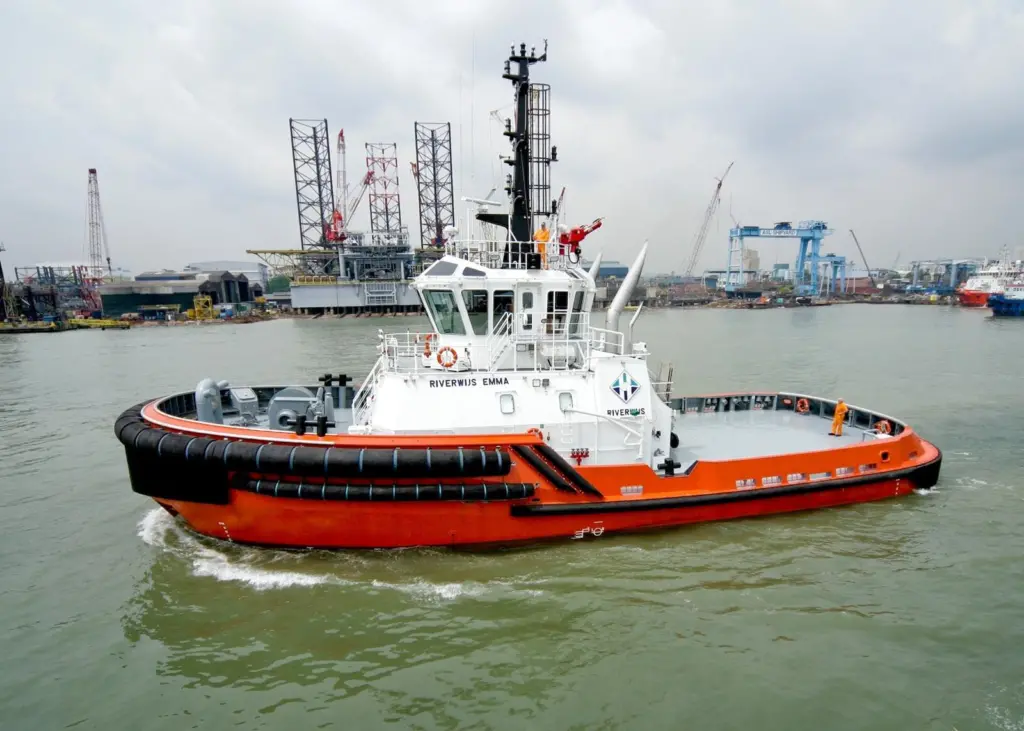
Turkish shipbuilder and tug owner Sanmar had the distinction of building the first RAmparts 3200 tug, the Achille Onorato, delivered to Rimorchiatori Sardi of Italy in 2004. The most recent deliveries, from ASL, Singapore, were the sister ships RiverWijs Emma and RiverWijs Rowan to RiverWijs of Australia.
In the intervening period, more than a dozen shipyards in Turkey, China, South East Asia, the United States, Europe, the Middle East, New Zealand and South America have been involved in the construction of tugs to variations of this design.
The two RAmparts 3000 shiphandling tugs built for RiverWijs were constructed at the ASL Shipyard in Singapore for operation at the LNG terminal in the Port of Dampier, Australia. They also have the distinction of being the 49th and 50th vessels to be completed by the shipyard for the Svitzer group of companies. To mark the occasion, the christening of RiverWijs Emma and RiverWijs Rowan was performed in Singapore by the vessel’s sponsors, Ms. Emma Lok and Mrs. Rowan Campbell.
These latest variants of the RAmparts design are unique, due to a shallow draft requirement of 5m needed specifically for mooring in the tug pen during cyclone season. This successful project is the result of a good working relationship between the owner, the builder, the designer and the client. The tugs were built in accordance with the Lloyd’s Register of Shipping notation: LR X 100 A1, TUG, X LMC, UMS, IWS, Fi-Fi 1 with waterspray, Unrestricted Voyages
RiverWijs Emma and its sister are vessels of 32.55m in length overall with a moulded breadth of 12.40m, a depth of 5.40m and service draft of 5m. Each tug has tank spaces to accommodate 202,000 litres of fuel, 32,000 litres of fresh water, 3,100 litres of main engine lubricating oil and 10,000 litres of foam compound. Dedicated tanks are also available for sludge, oily water, grey water, and sewage.
Two resiliently mounted Niigata 8L28HX main engines, each deliver 2,206 kW at 750 rpm for a total of approximately 5,916 bhp. The engines are coupled to a pair of Niigata ZP-41 propulsion units fitted with fixed pitch propellers with a diameter of 2.7m.
Electrical power onboard is supplied by two Caterpillar C6.6 diesel generators, each rated at 100kW.
On trials, RiverWijs Emma and RiverWijs Rowan met or exceeded expectations with a maximum bollard pull towing ahead of 83.8 tonnes and 78.9 tonnes towing astern, along with a maximum free running speed of 13.5 knots.
Shiphandling operations are carried out using a Kraaijeveld KASW-20-H-TR-22D/22D towing winch in the ‘Safe-Winch’ configuration mounted on the foredeck. The single drum is equipped with 200m of 72mm diameter synthetic towline and the line pull available varies from 25 tonnes at 20m/min to 7.5 tonnes at 60m/min, with a brake holding capacity of 200 tonnes. Deck equipment aft comprises a 5 tonne Kraaijeveld vertical capstan, a towing bitt and Mampaey tow hook with 100 tonnes SWL.
Bow fendering is fitted to protect both the ship and tugs whilst carrying out push-pull operations. A two stage approach is a feature of RAL fender design and comprises a 900mm diameter hollow cylindrical rubber moulding forward, with a lower run of 480mm by 300mm “W” section blocks. A second strake of cylindrical rubber runs below the larger upper course. The stern and transom corners are also fitted with 480mm by 300mm ‘W’ block fender and the shear strake is fitted with 350mm hollow ‘D’ fendering.
The vessel is outfitted to the latest Australian standards, with three single berth cabins and one with four berths. A fully equipped galley, a spacious crew lounge/mess room, and ship’s office are also provided.
In the wheelhouse, a large ‘split style’ console forward carries the controls and instruments used in the majority of vessel operations. Located below decks is a large machinery control room overlooking the engineroom and a fully equipped workshop. All accommodation and control spaces are fully air conditioned.
Related Articles
 SPECIAL REPORTS
 TUGS & SALVAGE
 EQUIPMENT