![MaritimeJournal[Seawork]](https://www.maritimejournal.com/wp-content/uploads/2026/09/MaritimeJournalSeawork.svg)



Phenix is New and Highly Refined
Solent Towage Ltd has stationed the new Voith escort tug ‘ Phenix’ in Southampton Water in support of their towage services at the ESSO terminal at Fawley. The tug was delivered to Solent Towage, a subsidiary of Ostensjo Rederi of Haugesund, Norway, in late December by the Spanish shipyard Astilleros Gondan SA of Figueras, Asturias.
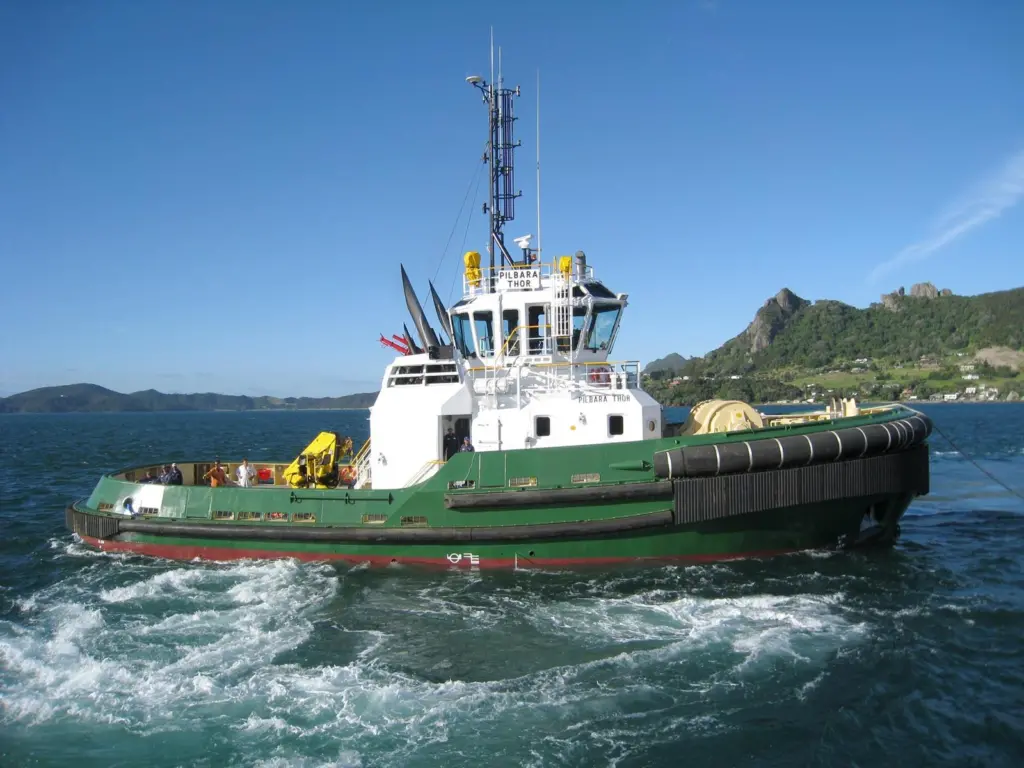
Phenix is one of two identical high tech tanker handling and escort vessels ordered by the parent company. The second tug, ‘Apex’, is scheduled for delivery in the spring of this year. Both vessels are to be registered under the UK flag.Phenix was built to the same design as ‘Tenax’, delivered to Fawley early in 2006, where it operates alongside the ASD tug ‘Thrax and two tug/workboats to provide shiphandling, escort and line handling services for the terminal. (Maritime Journal – February 2006) Phenix and Apex are the third and fourth tugs of this type constructed by the same yard but benefit from a number of refinements incorporated in the light of experience with the earlier vessels.
Phenix is a powerful but compact Voith tractor tug designed to carry out tanker handling and escort duties safely and efficiently. The tug has been constructed to meet the requirements of DNV +1A1 Tug, EO, OILREC, FiFi 1 Escort(150/10) ISM ISPS and measures 37m in length overall with a beam of 14m and an operational draft of 6.9m. Robert Allan Ltd, Canadian naval architects and consultants, were responsible for the design, working in close cooperation with Ostensjo’s technical consultant Carl J Amundsen. The highly developed and unusual hull design, incorporating a bulbous bow, sponsons, and bilge keels, is optimised to operate effectively while moving ahead or astern and achieve very high steering forces when operating in the escort (indirect) towing mode.
Two Rolls-Royce – Bergen C25:33L8P main engines produce a total of 6,850 bhp (5,040 kW) at their maximum continuous rating to power a pair of five bladed Voith Schneider 32R5/250-2 propulsion units of the very latest type. An improved ‘slotted’ protection plate is also utilised. Phenix has a static bollard pull of 67 tons and a maximum free running speed of 15 knots. Maximum steering forces, while operating in the indirect towing mode at 10 knots are 150 tons and a similar figure for maximum braking force.
One of the most significant improvements achieved is a dramatic reduction in noise and vibration whilst operating at high power settings when compared with the earlier tugs. This is due improvements in the flexible mountings and couplings on the main engines.
Also in keeping with the earlier vessels, Phenix is fitted with a ‘Voith Turbo Fin’ (VTF), intended to maximise ‘lift’ and provide very high steering forces when the tug is operating fin first in the escort role. The deep vertical skeg has a rotating cylinder fitted within its leading edge (the leading edge when travelling ‘skeg first’) to improve boundary layer flow and provide a significant increase in ‘lift’. Direction of rotation is critical and automatically adjusted to suit the tug’s angle to the towline, to port or starboard. A hydraulic motor of only 45 kW powers the unit and the cylinder has a maximum rotational speed of 245 rpm.
Electrical power is supplied by two identical Volvo-Penta TAMD74A auxiliary diesels driving Stamford 136 kW alternators. Hydraulic pumps for the main deck machinery system and the fire pumps are coupled to the forward end of each main engine via Kumera–Norgear step-up gearboxes.
The towing equipment installed includes a hydraulically powered Karmoy towing winch with two large ‘split’ drums on a common shaft with a maximum line pull of 200 tons and a 300 ton brake holding capacity. Each drum is fitted with a high performance Steelite man made fibre towline of 92mm diameter and 350m in length, with a maximum breaking strain of 500 tons. One towline can be replaced by a 1000m steel wire towline should it be required. The winch is operated from the wheelhouse and the length of towline and the maximum load applied can be predetermined automatically during escort operations.
A towing staple (fairlead) of unusual design is intended to accommodate both steel wire and a synthetic towline and aid stability in both escort and towing roles. The fairlead can be water lubricated when required to minimise friction and heat damage. Other deck equipment includes specially designed towing pins on the after bulwarks, a capstan and anchor windlass. A hydraulically powered Effer 44000-3SL knuckle boom crane, complete with a winch and wire lifting mechanism, is fitted on the starboard side of the winch fairlead, for use in handling stores, towing gear and deploying a Desmi skimmer.
Fire fighting equipment fitted to meet the FiFi 1 standards includes two Unitor monitors located at boat deck level. One monitor is capable of delivering 20,000 litres/minute and the other water/foam at the same rate. Two pumps driven by the main engines are rated at 1,500 m3/hour to supply the monitors and the mandatory self protection spray system. Phenix carries equipment to dispense chemical dispersant, deploy a skimmer and a protective boom. The skimmer is stowed below deck in the equipment store and the boom on a hydraulically powered reel located within the superstructure.
The wheelhouse affords excellent visibility when operating bow or skeg first and the controls are optimised to afford the tug master the best possible control position when operating in the escort mode, where maximum concentration is required. Navigational equipment includes two Furuno radars, a gyrocompass, autopilot, electronic charting, DGPS, an echosounder, log and Navtex. The communications outfit meets the GMDSS and IMO standards for use in Sea Area A2.
The tug is fitted out to the highest standards for a crew of up to six persons in fully heated and air conditioned accommodation. Six single cabins are provided and facilities include a spacious lounge/mess room, a modern fully equipped galley and a fitness room.
Related Articles
 SPECIAL REPORTS
 TUGS & SALVAGE
 EQUIPMENT