![MaritimeJournal[Seawork]](https://www.maritimejournal.com/wp-content/uploads/2026/09/MaritimeJournalSeawork.svg)



Powerful pusher tug from Gebr. Kooiman BV
Scheepswerf Gebr. Kooiman BV in the Netherlands has delivered a powerful new pusher tug for ThyssenKrupp Veerhaven BV, also in the Netherlands. The boat was delivered twelve months after the keel laying.
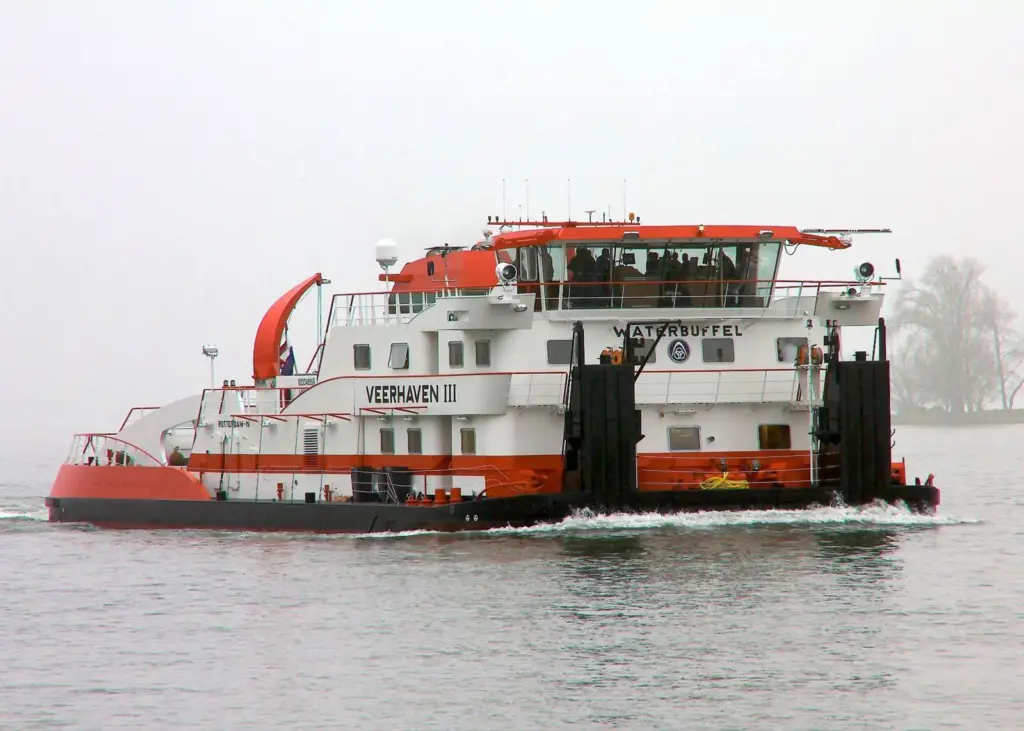
The Veerhaven III, ‘Waterbuffel’, is the third push boat built by Scheepswerf Gebr. Kooiman BV and was designed to navigate with a total of six push barges on the inland waterway route Rotterdam Europoort to and from Duisburg. The busy, shallow and winding river, combined with the tight schedule, demands a vessel with good manoeuvrability and considerable propulsive power.
Veerhaven III is thus powered by three MaK 8M20 marine diesel engines, rated 1,360 kW at 900 rpm, each fitted with a Vulkan highly flexible coupling of the type RATO-R G2120R-2200 and a Reintjes WAF 1943 marine reduction gearbox to drive a triple screw installation with three nozzles and three fishtail rudders. In order to maintain optimum manoeuvrability when navigating astern with six barges attached, the vessel is equipped with two bow thruster units.
Accommodation is situated in the two tier superstructure and comprises nine cabins for the crew, including an owner’s cabin, each with separate sanitary facilities. A fitness room, a mess room with lounge facilities, a galley, stores room and change room have also been provided. The living quarters, the engine control room and the wheelhouse are fully.air conditioned. In order to obtain the strict noise levels required by ThyssenKrupp Veerhaven BV, the accommodation has been resiliently mounted on pneumatic shock absorbers. Acoustic insulation, sound insulated glass panels and floating floors have been installed to prevent machinery noise from penetrating the accommodation area, where the noise level in the cabins is about 54dBA at maximum.
There is a clear view over 360° from the wheelhouse, a feature attained by avoiding steel construction at the front and rear, with only a minimum of steel construction in the sides. The frameless windows are made of double glass which is glued directly to the construction and to each other. The spacious wheelhouse contains a central command console which has been arranged for one man watch operation.
In order to have an unobstructed view to the foredeck during manoeuvring and coupling of the barges, the two radar monitors are fitted on a separate swing arms, which can be shifted from the position in front of the central command console to the side on a rail system integrated in the command consoles. The vessel’s navigation and communication equipment is fitted in the central command console and in overhead displays. The communication and navigational aids include two raster scan radars, radar chart overlay system, two rate of turn indicators, one echo sounder, two VHF sets, one integrated autopilot system, GPS, CCTV camera system around the engine room, rudder indicators for own system and barges, and an anemometer.
Technical specification:
Length: 40.00m
Breadth: 15.00m
Depth moulded: 2.75 m
Draught: 1.74 m (half load)
Power: Three MaK 8M20, each 1,360 kW
Speed: 18.5 km/h when pushing six loaded barges
Related Articles
 SPECIAL REPORTS
 TUGS & SALVAGE
 EQUIPMENT