![MaritimeJournal[Seawork]](https://www.maritimejournal.com/wp-content/uploads/2026/09/MaritimeJournalSeawork.svg)




Preparing for Supership salvage operations
The advent of Very Large and Ultra Large Crude Carriers in the 1970s represented a step change in vessel size. Much the same can be said of today’ s 14,000 TEU plus super containerships.
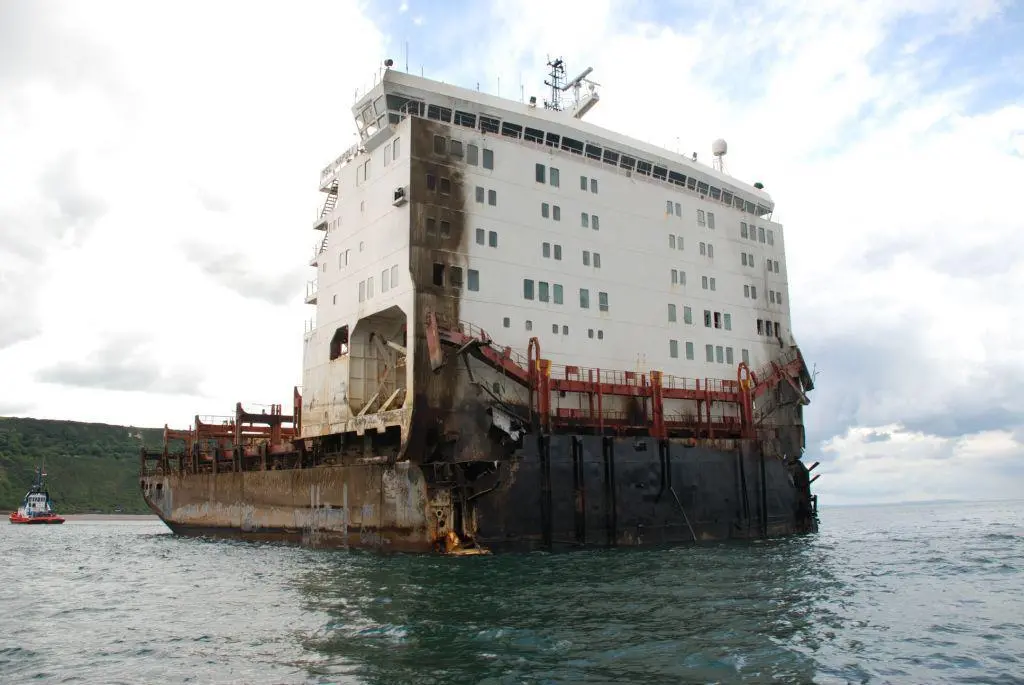
Only a relatively few years ago the 4,000 TEU size class represented the boxship size perimeter. Today, there is also the prospect of 400,000 DWT Very Large Ore Carriers. Any braking effect on this tendency towards ever larger ships, due to the current global economic and financial crisis, is unlikely to persist in the longer term.The challenge of modern containership salvage is demonstrated by the case of the MSC Napoli, which involved a vessel of only 4,000 TEU capacity. SMIT Salvage is fully aware of the huge difficulties likely to be presented by an 8,000 TEU (or larger) fully laden casualty. These problems include logistics. The MSC Napoli operation came very close to swamping the UK’s port of Portland, which became the base for salvage operations. A much larger boxship casualty would test even the largest of dedicated container terminals.
One of the major issues here is the length of time required to achieve real progress when a fully laden boxship goes aground at an exposed location. The longer the casualty remains exposed, the more it can be expected to deteriorate. The critical risk is the arrival of a severe storm and additional damage that could turn a prospective refloat into a total loss and costly wreck removal.
SMIT Salvage recognises the importance of continued investment in 21st century salvage technologies and systems. In the case of super containerships, there is a requirement for a modular, high capacity emergency discharge system, with the necessary long reach. How to fund such a costly system is another matter.
This is one of many issues surrounding supership salvage requirements now being explored by a SMIT Salvage Working Group. Members include SMIT experts and representatives of external parties specialising in ship operation, transport and logistics, together with the equipment manufacturers, including crane builders. These discussions are being guided by SMIT’s salvage specialists manning the company’s Innovation and Business Development Department, including experienced salvage naval architects.
There are also operational requirements for more effective firefighting systems for super containerships. SMIT Salvage has used the Cobra firefighting lance to penetrate and extinguish fires in containers. Results have been very encouraging. However, access to fires deep within huge container stacks remains a difficult problem to solve. These challenges become ever more severe with the steady growth in boxship size. One option is the remote use of a Cobra derivative system, capable of penetrating individual containers and dealing with persistent fires by means of mist extinguishment.
Meanwhile, modular solutions are already available for extreme parbuckling and lifting operations. Recently, SMIT Salvage commissioned a new chain puller system. Each puller has a capacity of 200 tons. So far, 16 pullers have been ordered, offering a total capacity of 3,200 tons and with the possibility of substantial future increase, as required.
One of the key issues in supership salvage is speed. Huge impact forces can be generated in grounding and collision situations. Furthermore, should a supership grounding occur at a location with a big tidal range, immense stresses will be imposed on the vessel’s structure.
On the commercial front, the salvor also grapples with a persistent problem in containership salvage operations, which is obtaining security from hundreds, even thousands, of cargo interests. Security is essential if cargo is to be freed for onward shipment. Many such problems have no obvious solution at present. It is important, however, to define the problems and begin the task of confronting them, so as to be ready to meet the ultimate operational challenge of supership salvage.
Related Articles
 SPECIAL REPORTS
 TUGS & SALVAGE
 EQUIPMENT