![MaritimeJournal[Seawork]](https://www.maritimejournal.com/wp-content/uploads/2026/09/MaritimeJournalSeawork.svg)



Recovering trapped oil from sunken wrecks
Norwegian company Miko Marine have developed a tool to quickly and economically recover trapped oil from sunken vessels before it has a chance to escape and cause environmental damage.
No one has ever been able to calculate the amount of oil trapped in wrecks beneath the sea but everyone is reminded of the lurking threat when from time to time raw crude or bunker fuel appears unannounced on the surface resulting in pollution. A particular threat is drawing closer from the thousands of ships sunk during the second world war whose plates are slowly being eaten away by corrosion.
In 2012 Miko launched its Moskito research and development project attracting interest and support from the Norwegian Coastal Administration who were addressing the problem of pollution from such wrecks. Miko are specialists in providing innovative solutions for the marine salvage industry including magnetic plaster patches, underwater magnets and the ShipArrestor parachute-shaped sea anchor. Taking up the challenge was therefore a somewhat natural development for Miko.
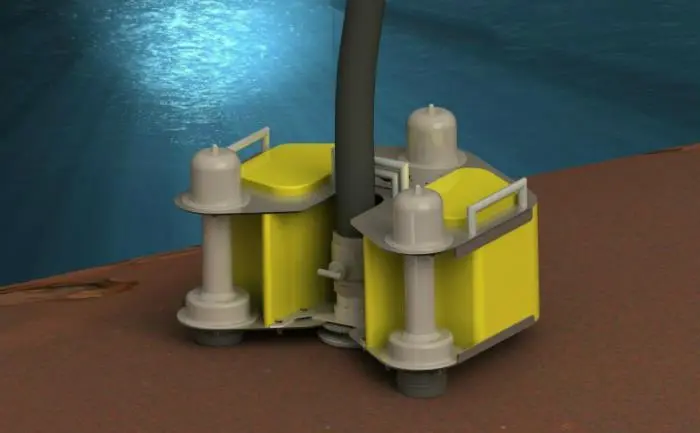
The Moskito oil recovery system was named after the similarly named insect reflecting its lightness, versatility and ability to be able to attach itself to the tanks of a sunken ship which can settle at any angle and position relative to the rest of the wreck. Once the location of the tanks have been determined, just like the insect the Moskito attaches itself to the outside of the tank where it penetrates the skin and inserts its proboscis allowing the liquid to be sucked out.
The unit is 65cm long by 45cm, weighs just 80 kg and is able to be attached by divers or an ROV at any ocean depth. Once held in place by three magnets, a 75mm diameter electrically powered tank cutter drill is activated by an operator on the surface who controls the procedure through a dual video link.
The drill can penetrate steel tank walls up to 40mm thick after which the cut disk falls into the tank and is followed by a patented spring latch coupling, this automatically connects and locks a hose to the tank without any of the contents escaping. Once secured in place a submersible pump is activated allowing oil to be extracted at the rate of 12m3/hr.
If it is required to relocate the device it can be repositioned by a diver or the ROV without it returning to the surface. The compactness of the Moskito also allows multiple units to be positioned close together if a higher rate of extraction is required. Nicolai Michelsen, general manager Miko Marine said: “It provides a solution to a problem that has remained unanswered since the first ship sank and we are now hoping that our coastlines and our wildlife will see the benefit.”
By Peter Barker
Related Articles
 SPECIAL REPORTS
 TUGS & SALVAGE
 EQUIPMENT