![MaritimeJournal[Seawork]](https://www.maritimejournal.com/wp-content/uploads/2026/09/MaritimeJournalSeawork.svg)


Salvage round-up
During a busy period for the salvage industry we examine three operations including the salvage of a Norwegian frigate, a capsized pipe-layer and another container ship fire.
Following a collision between the Norwegian frigate KMM Helge Ingstad and tanker Sola S near Bergen late in 2018 it was clear that salvaging the frigate, which subsequently sank on the inclined slope of a fjord, would present major challenges, but of course challenges are bread-and-butter to the global salvage industry and a team of European contractors has now completed recovery of the Helge Ingstad, in one piece.
After initial work to remove pollutants and munitions, Norwegian authorities called on DEME subsidiary Scaldis and Norway’s BOA Offshore to recover the vessel in cooperation with Jan De Nul Group and Herbosch-Kiere.
A “revolutionary” lift method was developed using Scaldis’ two heavylift crane vessels Rambiz and the recently delivered Gulliver. With the similar configuration of each vessel’s two main cranes they made a natural pairing to distribute their total lifting capacity of 7,300t over the length of the frigate, the synchronous capability of the four cranes allowing the lift in one continuous operation including moving the vessel into a horizontal position.
Once clear of the water and supported in the cranes’ slings Helge Ingstad was transported to a nearby location and placed on a partially-submerged pontoon which was then de-ballasted. Rambiz and Gulliver continued to stabilise the frigate until sea-fastenings were secured allowing subsequent onward transport of the barge and salvaged vessel.
Fire originating from cargo on container ships is a continuing news thread of late providing work for salvors and while this piece was being written the shipping community was absorbing news of the Italian con/ro Grande America which capsized and sank near La Rochelle after a fire reported to have started on a vehicle deck spread to containers on deck, thankfully the 27 crew on board were rescued.
There are now real fears of extensive pollution to the French coastline from the reported 2,200t of fuel on board along with the usual mix of cargo with French environmental campaign group Robin des Bois reported as saying: “It’s a car crash at the bottom of the sea, representing hundreds of tonnes of toxic materials in an area very rich in fish, plankton and marine animals.” No doubt the salvage industry will be heavily involved in mitigating the effects and a story that will likely return to this column.
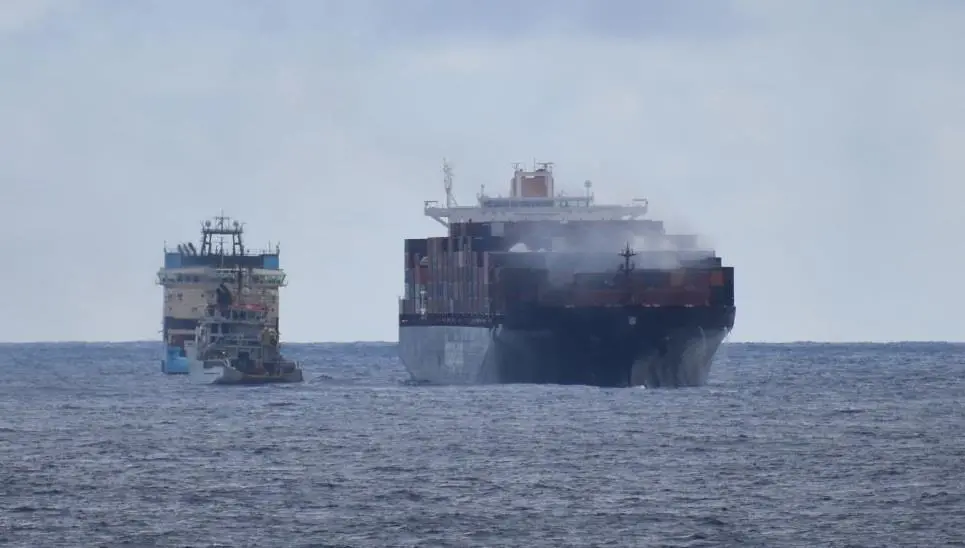
Earlier and just a few days into the New Year, while off the Canadian eastern seaboard and on passage from Colombo to Halifax the container vessel Yantian Express reported a fire among its cargo of containers. Smit Salvage Americas was engaged under a LOF (with SCOPIC) contract and a number of vessels subsequently responded including: Maersk Mobiliser, Smit Nicobar, Atlantic Enterprise and Sovereign.
It took around a week to bring the fire under control and the vessel was able to sail under its own power with tug escort to Freeport in the Bahamas. As usual following such incidents the vessel and cargo owners along with insurance interests then had the task of unloading damaged and un-damaged containers for onward shipment, an operation that was expected to take two months with Lloyd’s Salvage Arbitration Branch reporting that the salvors are requesting the usual security provision.
Meanwhile, on the other side of the world, Smit Salvage Pte Ltd along with PT Samudera Mbiantu Sesami have been appointed to salvage the pipelayer Star Centurion. Bearing similarities to the collision between the Helge Ingstad and Sola S in Norwegian waters and another incident with catastrophic consequences for one vessel occurred off the Indonesian island of Bintan in the Eastern Singapore Strait when the product tanker Antea collided with the 27,082gt pipelaying vessel Star Centurion.
Star Centurion was at anchor at the time and suffered damage that quickly resulted in the vessel capsizing and partly sinking onto its side. Once again it was fortuitous that the crew were rescued, thanks to the efforts of the Singaporean authorities and it became clear once again the ingenuity and experience of the marine salvage industry would be called on to recover the sunken vessel, another ongoing operation to be monitored by MJ.
By Peter Barker

Related Articles
 SPECIAL REPORTS
 TUGS & SALVAGE
 EQUIPMENT