![MaritimeJournal[Seawork]](https://www.maritimejournal.com/wp-content/uploads/2026/09/MaritimeJournalSeawork.svg)


Sanmar are busy with deliveries
Over the past month or so the Turkish tug owner and tug builder Sanmar Denizcilik Ltd of Istanbul has been exceptionally busy with the trials and delivery of new tugs. One of the most noteworthy completions is that of the very first vessel to be built to the new ‘ Sanmar Terminal I’ design.
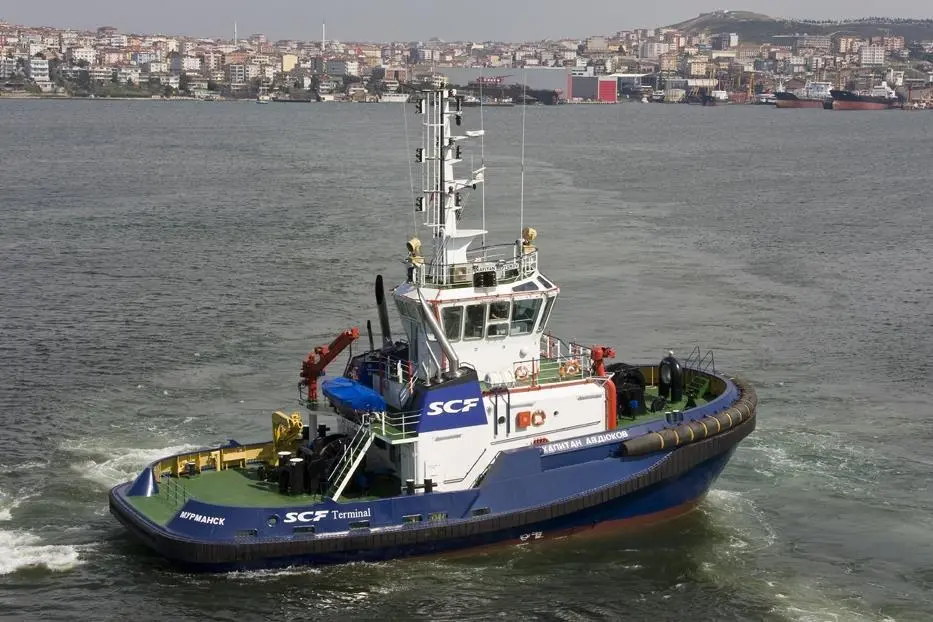
This latest addition to the company’s product range is based on the RAmparts 2800-E Class design by naval architects and consultants Robert Allan Ltd of Vancouver. It is for a 28m, Azimuthing Stern Drive (ASD) tug intended for berthing and unberthing large ships and, when necessary, can operate in the indirect towing mode.
Launched and trialled as the Sanmar Terminal 1, this first vessel of the class was delivered to Sovcomflot Group in the Russian Federation and the name was changed to Kapitan Avdyukov at the flag change ceremony. The tug will operate in the Port of Murmansk and has been modified for use in extremely cold climatic conditions down to -30(DEGREES)C.
Kapitan Avdyukov is a compact, well equipped vessel with an overall length of 28.2m, a beam of 12.6m and maximum draft of 5.1m. The hull is almost eliptical in planform, has a raised foredeck, open stern and is well fendered all the way round with moulded rubber block sections. An additional tubular moulding is added around the bow at bulwark level, giving good protection for push-pull operations. Below the waterline the hull is of a familiar Robert Allan form, with smooth lines, double chine construction and a long, deep skeg. Dedicated tanks can accommodate 119.3 cu/m of fuel, 12.9 cu/m of fresh water, 12 cu/m of dispersant, 12 cu/m of foam, 11.1 cu/m of black water and 3.7 cu/m of oily water. The vessel was built to comply with ABS class +A1, E, Escort Support,Towing vessel ,+AMS; ABCU, Fi-Fi 1
Two Caterpillar 3516B main engines provide power for the propulsion system, generating a total of 4,890bhp (3,600kW) at 1,600rpm. Engine cooling is by means of box coolers and the exhaust systems incorporate spark arrestors. Power is transmitted via cardan shafts to a pair of Rolls-Royce US 205 fully azimuthing propulsion units incorporating controllable pitch propellers and load control options when operating the fire fighting equipment. The four blade propellers are 2,400mm in diameter and rotate in opposite directions.
Electrical power aboard Kapitan Avdyukov is generated by two Lindenberg auxiliary generating sets each rated at 96kW. In order to meet the requirements of the FiFi 1 standard fire fighting capability two pumps are installed, one driven by each main engine to supply a pair of monitors mounted at bridge deck level and the self protection spray system.
A high degree of automation has been adopted in order to meet the requirement of an unattended engine room as per ABS ABCU rules. In normal use the tug will be operated by a crew of two, making this level of automation essential. The machinery monitoring and alarm system includes additional display panels in the wheelhouse, engineer’s cabins and the mess room.
On deck the main pieces of equipment are two Rolls-Royce single drum towing winches. The winch on the foredeck has a maximum brake load of 120 tons, is equipped for shiphandling duties, and is combined with cable lifters for the vessel’s anchors. A second winch located aft has a maximum brake load of 60 tons and is rigged for towing ‘over the stern’ at sea or in harbour. A small hydralic crane is provided for handling equipment and stores and the rescue boat is handled by a single arm davit.
Kapitan Avdyukov has a well designed wheelhouse and superstructure offering the tug master good all round vision. An outfit of navigational and communications equipment, meeting GMDSS Area 2 standard, is more than adequate for a vessel of its type and employment. Fully air conditioned accommodation is designed for a maximum of six persons, with two single and two double berth cabins. Other facilities include a mess room, galley, stores and the usual sanitary facilities.
On trials the Kapitan Avdyukov proved to be a highly agile vessel with a maximum bollard pull towing ahead of 61 tons and 63 tons astern, with a free running speed of 13 knots.
Another recent Sanmar delivery is the second of three Ulupinar class 40 ton bollard pull ASD tugs completed for Remolcadores Dominicanos of Santo Domingo, in the Dominican Republic.
The first vessel of the series, Haina, was delivered early in 2008 (Maritime Journal – April 2008). This latest example, launched as Ulupinar IV, has now been now renamed Nizao and will be delivered to Santo Domingo under its own power. To complete the order Sanmar will deliver the third tug in the first quarter of 2010.
Sanmar has another dozen of the increasingly popular ‘Ulupina’ class vessels on their order book, all to be completed by 2010. At the time of writing the company was busy with the commissioning and trials of a Sanmar Eskort 80 due to be delivered to German owners Bugsier.
Related Articles
 SPECIAL REPORTS
 TUGS & SALVAGE
 EQUIPMENT