![MaritimeJournal[Seawork]](https://www.maritimejournal.com/wp-content/uploads/2026/09/MaritimeJournalSeawork.svg)


Sanmar delivers the first RAscal 1800
Turkish shipbuilder Sanmar have a now well-established involvement with vessels from naval architect Robert Allan Ltd and they have recently added the first RAscal 1800 tug to their own fleet.
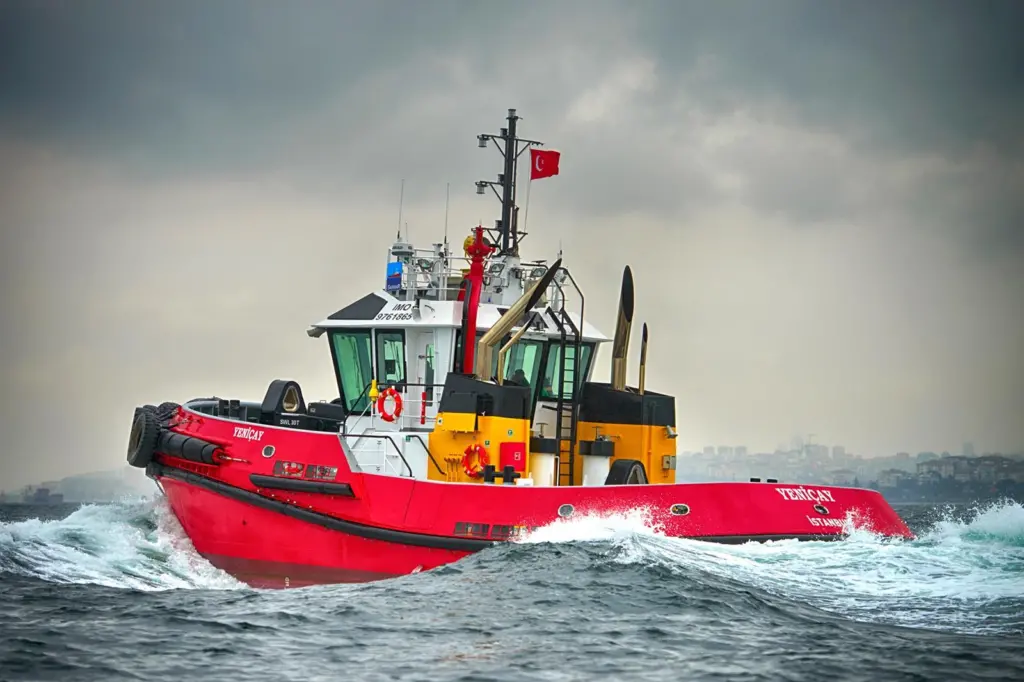
Initial impressions on viewing images of the Yenicay 1 are that of a compact yet sturdy and business-like workhorse, a design that is pleasing to the eye with potential no doubt to appeal to a wide market. The vessel, the first of a new class from the drawing board of Robert Allan Ltd is designated the RAscal 1800 and is a development of the slightly smaller RAscal 1500 Brage delivered to Buksér og Berging in 2014.
What is described as a “high level of cooperation” between both the operational and construction teams of Sanmar AS and designers Robert Allan Ltd has produced the Yenicay 1, built to a high standard and described as “almost yacht finish”. Its range of duties include ship-assist, line-handling, general harbour service and coastal towing and it will join Sanmar’s own fleet of three other tugs operating at Petkim, Aliaga, and Izmir in Turkey.
The tugis built to ABS classification carrying the notation ABS+, AMS, UWILD, BP (30). Main particulars include: LOA 18.7m, beam (moulded extreme) 9.2m, depth moulded 3.5m and maximum draught 3.7m. Tank capacities are: 33,500 litres of fuel oil, 5,776 litres of potable water and 1,618 litres of foam, part of the fire-fighting system.
Caterpillar provide the main machinery comprising two C32 diesel engines, each rated at 970 kW at 1,800 rpm. These drive two Veth VZ-900 fixed-pitch Z-drive units in ASD configuration: propellers are five-bladed 1,700mm diameter Kaplan type turning in nozzles. A PTO shaft off one of the main engines drives a 600m3/hr pump for the manually operated foam/water fire-fighting monitor, both supplied by FFS. Electrical power is supplied by two Caterpillar C4.4 diesel generators, each with an output of 86 ekW. Performance figures include a bollard pull of 31 tonnes and free running speed of 12 knots.
A DMT TW-E 100kN ship-assist hawser winch is fitted on the foredeck for towing over the bow with towing over the stern (from the same winch) facilitated via a hawser duct beneath the wheelhouse. Large stainless steel towline fairleads are fitted on both fore and after deck with a towing hook also included aft. A high standard of fendering around the bow was specified comprising a single 500mm x 250mm cylindrical fender at main deck level with 300mm ‘W’ fenders between the main deck and knuckle. A 300mm x 300mm hollow ‘D’ fender provides protection at the main deck, forecastle deck sheer lines and around the stern.
For a compact 18m LOA vessel the interior of the Yenicay 1 appears particularly spacious and outfitted to the highest standards with accommodation provided for a normal operating crew of four: two cabins are located in the forecastle along with a galley, mess and WC with shower. A particularly noticeable feature is the spacious wheelhouse with full-height windows at the forward end and each side. Squat funnel casing each side aft stop at mid-height of the wheelhouse with suitably angled exhausts continuing above the wheelhouse roof allowing good visibility of the afterdeck. The control station is a standard split console installation with a rail-mounted chair on the centreline.
Particularly low noise levels in the wheelhouse and accommodation are achieved through use of a carefully engineered combination of: resiliently mounted engines, lightweight composite shafting, high-attenuation silencers, resiliently mounted fans and extensive use of sound insulation. Sanmar are also working on a high-powered version of the RAscal 1800 with larger Caterpillar 3512 engines which will see the tugs bollard pull figure increase to 40 tonnes.
By Peter Barker
Related Articles
 SPECIAL REPORTS
 TUGS & SALVAGE
 EQUIPMENT