![MaritimeJournal[Seawork]](https://www.maritimejournal.com/wp-content/uploads/2026/09/MaritimeJournalSeawork.svg)


Schottel reveals US Navy order details
German Propulsion system manufacturer Schottel has reported details of the Rudderpropeller element of the four-vessel tug order for the US Navy.
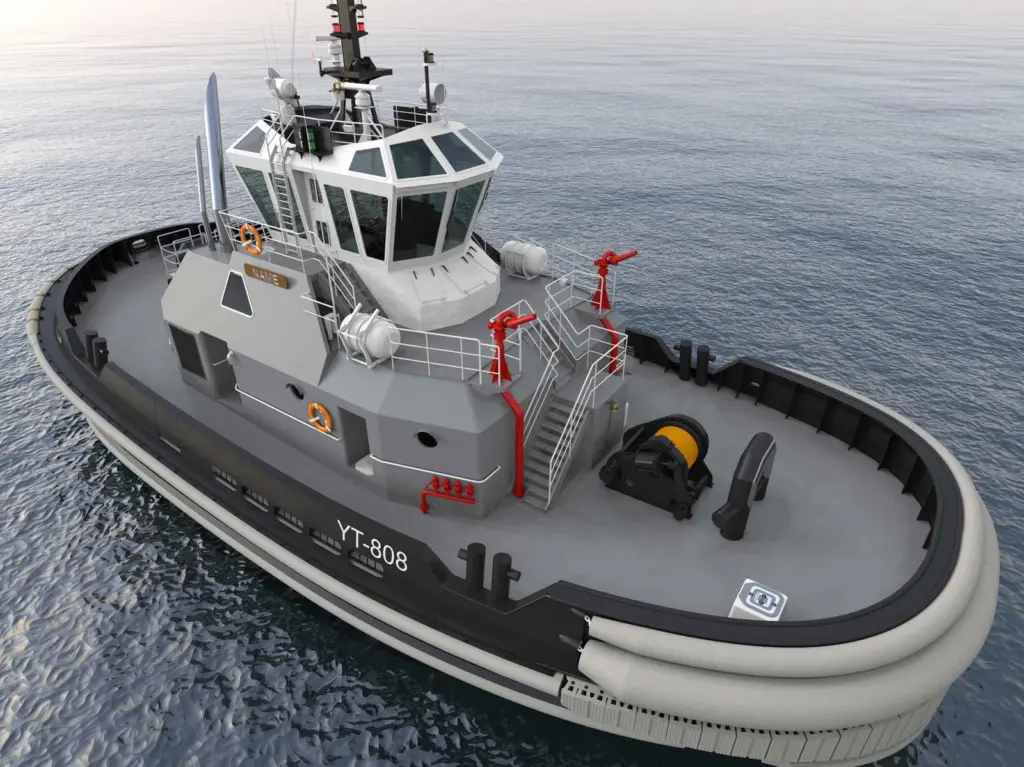
Last month’s delivery and order round-up included the US Navy’s contract with Robert Allan Ltd to design a new version of the Z-Tech 4500 tug with four examples (plus an option for two more) to be built by Dakota Creek Industries in Anacortes, WA. Further detail of the European aspect of these vessels has now come from Schottel who has completed several similar projects for different navies around the world including an earlier six-tug order for the US Navy.
The azimuth thrusters, two per vessel, will be Schottel SRP 340 (formerly SRP 1012) versions along with the DNV-GL certified Leacon sealing system and Schottel’s ProAnode integrated into a high-efficiency nozzle. Twin Caterpillar main engine, each rated 1,350bkW at 1,600rpm will provide power to the azimuthing stern drive units, driving 2.1m diameter fixed-pitch propellers and delivering a bollard pull of 43t and free-running speed of 12k.
The high-performance SDV45 nozzles on the four new Z-Techs are described as offering “provable higher efficiency at open-water speed combined with very good bollard pull values”. In addition, moving the position of the anode from the outside surface into the cross-section of the nozzle extends the thruster’s life-cycle and protects the anodes from external impacts. It also contributes to the optimal hydrodynamic flow of the nozzle and since the smooth overall surface reduces flow interference, the resulting lower fuel consumption will help reduce operating costs.
With separate seals on the seawater and the gearbox side, the Schottel Leacon sealing system ensures that seawater entering, and gear oil escaping from the system is collected in an intermediate chamber avoiding water entering the gearbox and oil from escaping into the seawater environment. An added bonus of the Schottel arrangement combined with the Leacon sealing system is that they are now exempt from current VGP regulations of the US Environmental protection Agency.
The tugs are equipped to handle submarines and are supplied with an extensive array of underwater fendering in addition to standard resilient fendering for handling surface ships and are expected to enter operational service in November 2019 at military bases in the US Pacific Northwest region and Yokosuka, Japan.
By Peter Barker
Related Articles
 SPECIAL REPORTS
 TUGS & SALVAGE
 EQUIPMENT