![MaritimeJournal[Seawork]](https://www.maritimejournal.com/wp-content/uploads/2026/09/MaritimeJournalSeawork.svg)



The ultimate escort tug presented
IHC has revealed a new escort tug design aimed at addressing safety considerations, particularly with the handling of LNG carriers.
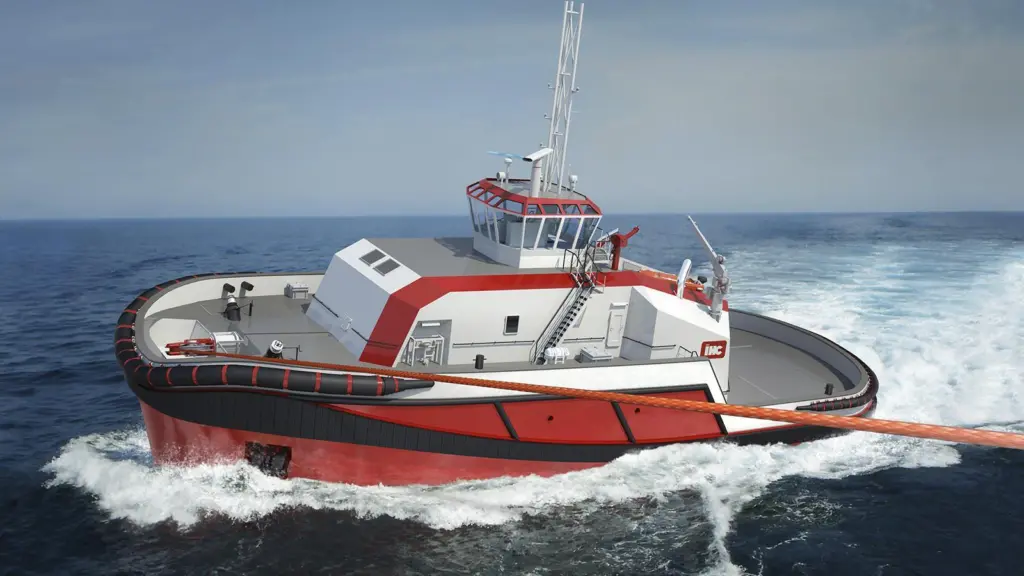
Choices with tug designs can be somewhat bewildering and the 100tbp, 40m, ASD Delta Escort Tug T100-17, a concept initially created by Dutch consultancy Stubitec, addresses the suitability of render/recovery winches for heavy-duty escort towage, an area covered with MARIN Research Institute’s joint-industry Safe Tug project.
Safety requirements when handling LNG carriers demand high specification vessels and the winch of IHC’s tug is central to its design, described as a “breakthrough in technology”. It is enclosed in a space at the aft of the deckhouse, the towing line routed below deck and over the bow from a specially designed sheave-fairlead.
IHC state that response times with hydraulic render/recovery systems are too slow, its own electrically driven version allowing braking power from the drive motor torque to be fed back into the net.
To handle the risk of towline failure from snatch loads in rough weather IHC has an innovative yet simple solution. The winch is mounted on two shock absorbers permitting a degree of longitudinal movement with the winch skid positioned on two pins with strain gauges for load measurement. The foundation is not welded to the deck itself, avoiding distortion of the winch frame. The towline is spooled over the top of the winch drum, the line led under the drum for towing over the stern, alternatively a standard towing winch can be mounted aft of the escort winch.
A small towing line fleeting angle and the bow sheave-fairlead minimises wear and tear on the fibre towline, the distance between drum and fairlead eliminating the need for a spooling device.
LNG is the fuel of choice for the Delta Escort Tug with a dual hybrid system comprising two dual-fuel gensets and redundant energy storage systems acting as main power source while also boosting power in conjunction with the gensets. The arrangement provides maximum efficiency from operations where maximum bollard pull is required for only a small percentage of the time.
IHC report the response from some of the larger players in this niche market has been “purely positive”. Innovation aimed at enhancing safety on this scale deserves success and will hopefully lead to a commitment in the form of orders.
By Peter Barker
Related Articles
 SPECIAL REPORTS
 TUGS & SALVAGE
 EQUIPMENT