![MaritimeJournal[Seawork]](https://www.maritimejournal.com/wp-content/uploads/2026/09/MaritimeJournalSeawork.svg)

Thirty one ‘Rotor Tugs’ and counting
It is just twelve years since Dutch towage company Kotug introduced a series of four ‘Rotor Tugs’ to the ports of Rotterdam and Bremerhaven.
The towage industry at the time was extremely cautious in its response to the new Rotor Tug concept but with 30 vessels now in service or under construction attitudes must have changed. A prestigious order placed in recent weeks for a powerful new variant of the Rotor Tug is further evidence, if any were needed.
The latest news from KST BV, the marketing subsidiary of Kotug, announces the sale of a ‘design and technical support’ package to Groupe Océan of Quebec for the construction of the first RT 110-37E escort tug. This new Rotor Tug variant will provide shiphandling and escort services on the St Lawrence seaway for tankers and LNG carriers using facilities in the vicinity of Quebec city. Although not yet confirmed, the tug is likely to be built by Industrie Océan at Ile-aux-Coudres, a Groupe Ocean subsidiary, with delivery late in 2012.
The RT 110-37E is the first of a new generation of high performance Rotor Tugs suitable for escort towing and a wide range of other duties, including work offshore. Naval architects and consultants Robert Allan Ltd were commissioned by KST to produce the design and carry out tank testing. The design was first introduced to the towage industry at Tugnology 2007.
A large vessel of 37m in length, with moulded breadth of14.50m and a depth of 5.65m, the new Rotor Tug will have a maximum draft of 7.25m. The hull form embodies several features found in RAL tractor tug designs, including sponsons, a pronounced sheer and a bulbous bow. Such features should result in an extremely stable, high performance tug capable of high free running speeds, ahead and astern, side stepping at up to 6 knots, and with good seakeeping characteristics. Three Caterpillar 3516 main engines will be installed, producing a total of approximately 7,500bhp to power three fully steerable propulsion units.
A bollard pull of 110 tons is specified and a maximum speed of 15 knots. Steering and braking forces are expected to be in excess of 150 tons at 10 knots. A retractable aft skeg included in the original design will be replaced in this vessel with a smaller solid fin, due to possible problems with winter ice.
The Rotor Tug concept was originally conceived and patented by the president of Kotug, Mr A M (Ton) Kooren, and the subsequent research and development became a personal crusade to produce what he described at the time as a ‘fourth generation tug’.
At the heart of the ‘Rotor’ tug concept is a unique tractor tug propulsion system utilising three fully azimuthing propulsion units, each driven by a separate main engine. Two Schottel propulsion units are positioned forward of the centreline, in the normal tractor location, with the third unit aft of the centreline replacing the large traditional skeg. This arrangement gives the Rotor Tug the ability to turn rapidly within its own length and apply almost equal thrust in any direction around the vessel. This feature has proved invaluable when the tugs are working with ships in the confines of locks and cuttings, or carrying out precise manoeuvres with plant offshore.
The first pioneering batch of Rotor Tugs, RT Innovation, RT Pioneer, RT Spirit and RT Magic, with 6,300 horsepower installed and a bollard pull of 75 tons, entered service in 1999 based in Rotterdam and Bremerhaven. Twenty six tugs of three different designs have since been ordered by Kotug and other towage providers, many of which have been described in detail in earlier issues of MJ.
The RT 80-32 was developed from the original Rotor Tug design, with a modified superstructure and the same operational features. This variant is 32m in length overall, with a beam of 12m, and draft of 6.1m. A bollard pull of 80 tons is specified, along with a maximum speed of 12.5 knots. Steering forces of over 90 tons can be generated towing in the indirect (escort) mode at 10 knots.
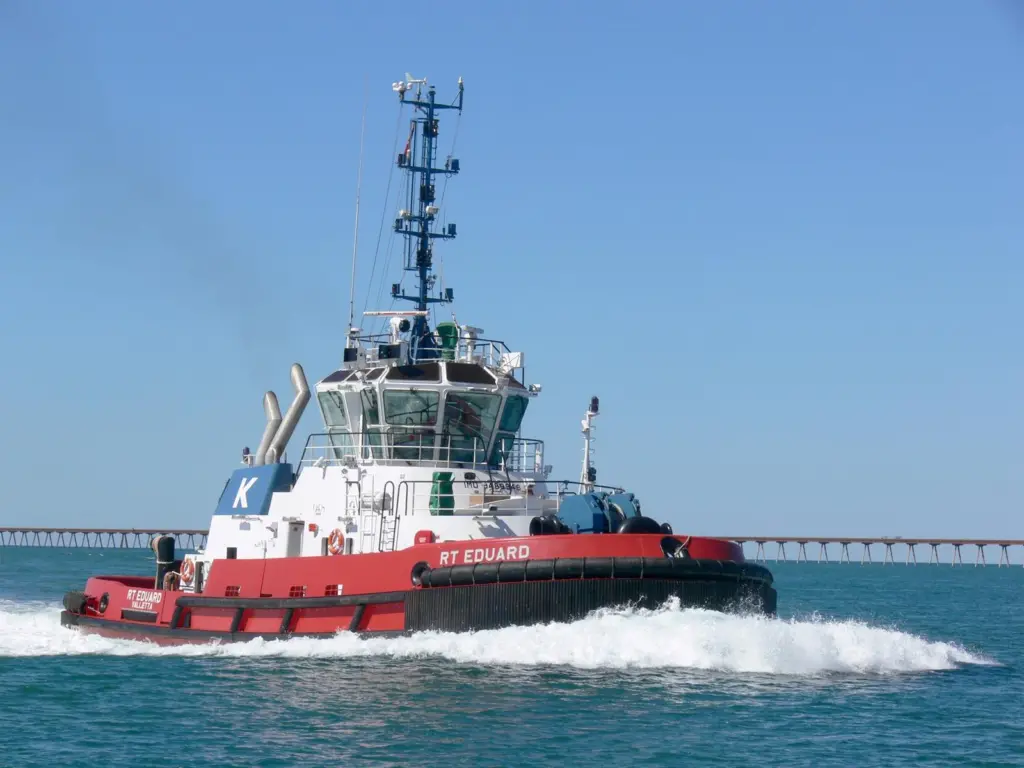
In all, fourteen RT 80-32 tugs have been built or are under construction at either the Niigatta Ship Repair yard in Japan or ASL Shipyard Pte Ltd in Singapore. Among the most recent deliveries are RT Rob, RT Peter, RT Adriaan and RT Eduard, which were delivered in Kotug colours during 2009-2010. RT Eduard is now on charter to Rio Tinto in Dampier, Australia
RT Champion and RT Leader were completed this year and are currently on route to Europe. Also completed by ASL this year, the RT Tough, RT Force, RT Darwin and RT Tasman are on charter to Teekay Shipping (Aus) Pty and on station in Port Hedland, Australia. Four more vessels of the same type are as yet unassigned and due for completion in 2012.
ASL were also responsible for the construction of eight RT80-28 tugs, a shorter, lower profile vessel equipped principally for shiphandling in port, towing over the bow or stern. Of the first four completed in 2008, three were delivered to Bugsier Reederei GmbH of Hamburg and named Bugsier 4, 5 and 6, while the fourth, RT Margo, was taken by a Kotug associate. Four were ordered by Unterweser Reederei GmbH of Bremen. Dorum and Midlum were delivered in 2010 and Accurat and Exact will follow in 2011 but may be sold or chartered.
Related Articles
 SPECIAL REPORTS
 TUGS & SALVAGE
 EQUIPMENT