![MaritimeJournal[Seawork]](https://www.maritimejournal.com/wp-content/uploads/2026/09/MaritimeJournalSeawork.svg)


Thirty year old tug ready for another twenty
German tug owner Otto Wulf turned to propulsion and steering manufacturer Schottel when it had to consider the future of a tug already 30 years old.
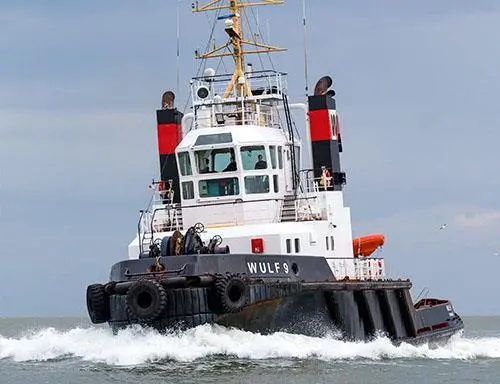
The world of tug construction can perhaps be considered to be in a healthy state given the regular reports of fleet upgrades and expansion. Tug owners are well known however for making their vessels last before often handing them on to new owners to start a new career, for them as much a pride-and-joy as when they were delivered as new. Particularly on Europe’s inland waterways small tugs with modern and stylish renovated accommodation and wheelhouses will have their true age given away by the hull design.
Keeping old tugs going presents challenges however beyond just cosmetics and crew comfort and original equipment will often become obsolete with the procurement of spare parts increasingly difficult. Class requirements also evolve of course with implications for the vessel’s prospects and such a position was faced by Otto Wulf GmbH when considering what the future would hold for its ASD tug Wulf 9.
Built in 1988 by Norwegian shipbuilder Båtservice Verft A/S, Wulf 9 was obviously considered to be worthy of a new lease of life with Otto Wulf but in order to comply with latest class requirements the propulsion system was required to be modernised. As the necessary spare parts were now obsolete an alternative had to be found and it was decided that instead of replacing the entire system including mechanics and hydraulics, only the obsolete controls would be replaced.
Enter Schottel Group and despite the tug having thrusters from another manufacturer installed (Liaan Compass thrusters) the German manufacturer was able to offer Otto Wulf a customised solution presenting comparatively low conversion costs, the regional proximity of the tug owner and Schottel’s production site in Northern Germany described as “decisive” in the decision by owner and operator Andreas Wulf who added: “Within two weeks, the lifecycle of the vessel’s electric components was extended by up to twenty years – always safe in the knowledge that Schottel, as an OEM, is able to equip the Wulf 9 for the next decades.” Replacement of the obsolete electronics was carried out by a local electronics company, significantly reducing costs and operational downtime for the vessel.
By Peter Barker
Related Articles
 SPECIAL REPORTS
 TUGS & SALVAGE
 EQUIPMENT