![MaritimeJournal[Seawork]](https://www.maritimejournal.com/wp-content/uploads/2026/09/MaritimeJournalSeawork.svg)


Tugs & Towing, the last and next 30 years
Evolution or revolution? A fair question reviewing the past and looking to the future as Tugs & Towing considers the towage industry in ‘MJ’s’ 30th year.
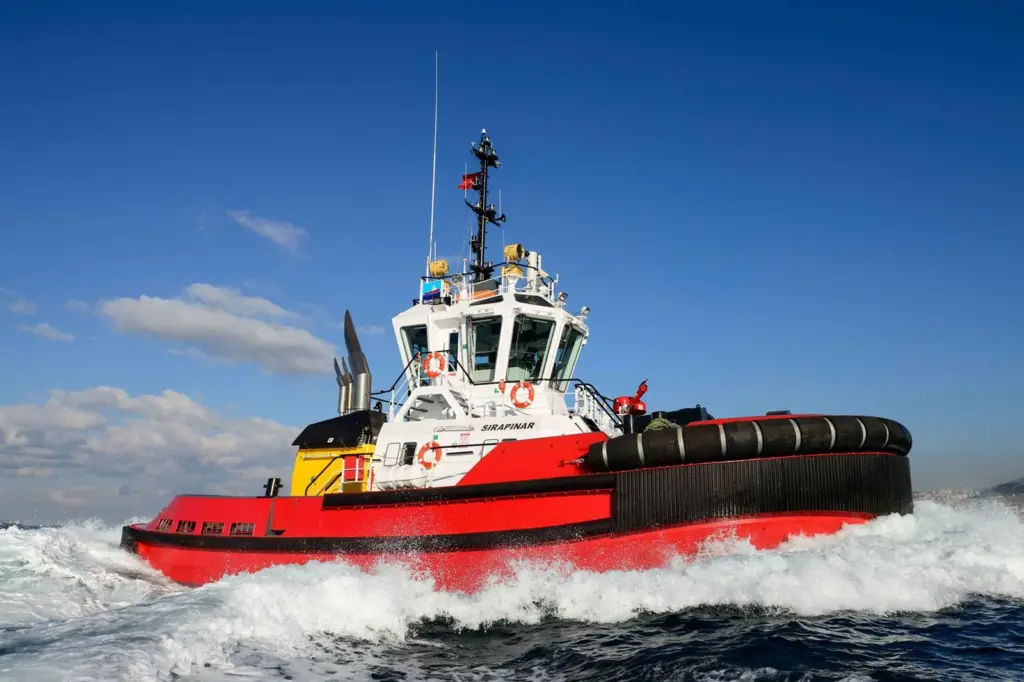
The simple answer is both. Evolution happens naturally, often in reaction to developments from others in the maritime world, but how much of a revolution? Someone retiring from the industry 30 years ago will probably look at the industry today and say there has indeed been a revolution.
Having followed the industry for longer than this review period, your correspondent started by looking through the register of (tug) deliveries to recall the state-of-the-art in 1987.
Single-screw conventional designs were common at that time but of course the influence of azimuth thrusters and cycloidal propulsion was becoming increasingly apparent. Traditional designs continued evolving while the advent of ASD tugs enhanced the practice of towing over the bow, providing a safer environment, particularly when acting as stern tug at speed. Evolution happened where this method of working allowed indirect escort towing to develop further, hydrodynamic elements of hull design becoming an important focus of attention for designers.
So, from where we are today let’s consider the present and the future and ask the question, is the industry on the cusp of a revolution with the advent of new designs including the Rotortug, Eddy Tug, Novatug/RAVE Carrousel tug and Giano Tug? Developments within the clients’ operations certainly bode well for innovation.
BIGGER SHIPS BIGGER TUGS?
Tug development has been influenced by changes in shipping itself. In 1988, at 4,300teu Marchen Maersk was one of the world’s largest container ships. Just 30 years later ships with a capacity of over 20,000teu are sailing the oceans.
Power requirements to handle such vessels have increased, but with the desire to remain within existing vessel size limitations for both practicality and regulation. An indication of the advances in technology is for example at Rotterdam where (on a fine day) just two tugs are sufficient to handle these giant container ships. On the business side, there is the challenge of bigger ships meaning fewer calls with potentially reduced numbers of acts of towage.
The growth of FPSO and FLNG markets has led to bespoke multipurpose tugs (infield support vessels) capable of towing and heading-control duties. This leads us to a trend with specific operations requiring tugs to meet precise specifications to suit the operational requirement and location. As new ports and terminals are built or existing ones extended, planning will usually now include a carefully developed mix of (often new) tugs to suit the profile.
Meanwhile in the engine room revolution is definitely taking place with development of alternative-fuel tugs. Perhaps there has been a perfect storm of demand for efficiencies along with new environmental regulations with hybrid and LNG-fueled options now asking the question of not if but when? As energy storage technology improves and availability of LNG increases, the picture of how shiphandling tugs are powered could change dramatically well before our 30 year chrystal ball horizon.
GOING DEEPSEA
Turning to deepsea towing a somewhat different picture emerges over the previous three decades with traditional ocean-going tugs facing competition from increasingly powerful AHTSs from the offshore oil and gas industry and a reduction in opportunistic salvage work. Some traditional towage companies such as Boskalis (Smit) have however maintained a presence in the offshore sector over the period and investment is not completely off the agenda as evidenced by ALP Maritime’s series of four long-distance tugs providing a shipyard to installation turnkey solution for FPSOs and other large structures.
The coastal towing market is holding its own if investment in fleet replacement and expansion tonnage is anything to go by, particularly for family-owned concerns. The success of Damen’s Shoalbuster is just one example here while ‘multi-cat’ type workboats continue to find work, particularly in an area unheard of 30 years ago, offshore wind.
THE FUTURE
So, what of the future? Tugs will always be required within port and terminal environments. But what will the industry look like in 30 years’ time? Consolidation is taking place and talking to industry figures it seems this trend will continue but to what extent remains to be seen.
Revolution will certainly feature in the future on the technical front. Public pressure on environmental protection will continue regardless of ebbs and flows of political tides and in 30 years’ time shiphandling towing operations could well be dominated by fleets featuring hybrid, LNG or other ‘green’ technologies yet to appear.
Debate has long accompanied two-man crewing on shiphandling tugs but perhaps this is about to become redundant with development of remotely-operated vessels. Most areas of transportation are exploring unmanned operation and recently Rolls-Royce teamed up with Svitzer to demonstrate the world’s first remotely operated commercial vessel. The DP-equipped Svitzer Hermod was maneuvered on and off its berth, turned 360’ and piloted to Svitzer’s HQ in Copenhagen by its master located at a remote base ashore.
The concept is not new, back in November 2015 this column reported on Robert Allan Ltd’s RAmora project of unmanned ‘tele-operated’ tugs. Indeed, connecting towlines via remotely-controlled arms has been demonstrated previously.
Removing crews from tugs would be the ultimate safety measure but will the operator’s ‘remoteness’ affect the natural instinct to protect the asset and avoid environmental damage from accidents? It is suggested that while technology exists for pilotless commercial aircraft there is somewhat greater motivation for a happy ending to the flight when the pilots are up there with the passengers.
The debate around this aspect of the future will be intense and together with other related developments there can be little doubt the next 30 years will continue to follow the paths of both evolution and revolution.
By Peter Barker

Related Articles
 SPECIAL REPORTS
 TUGS & SALVAGE
 EQUIPMENT