![MaritimeJournal[Seawork]](https://www.maritimejournal.com/wp-content/uploads/2026/09/MaritimeJournalSeawork.svg)




UNV delivers a new series of ETVs to SASEMAR
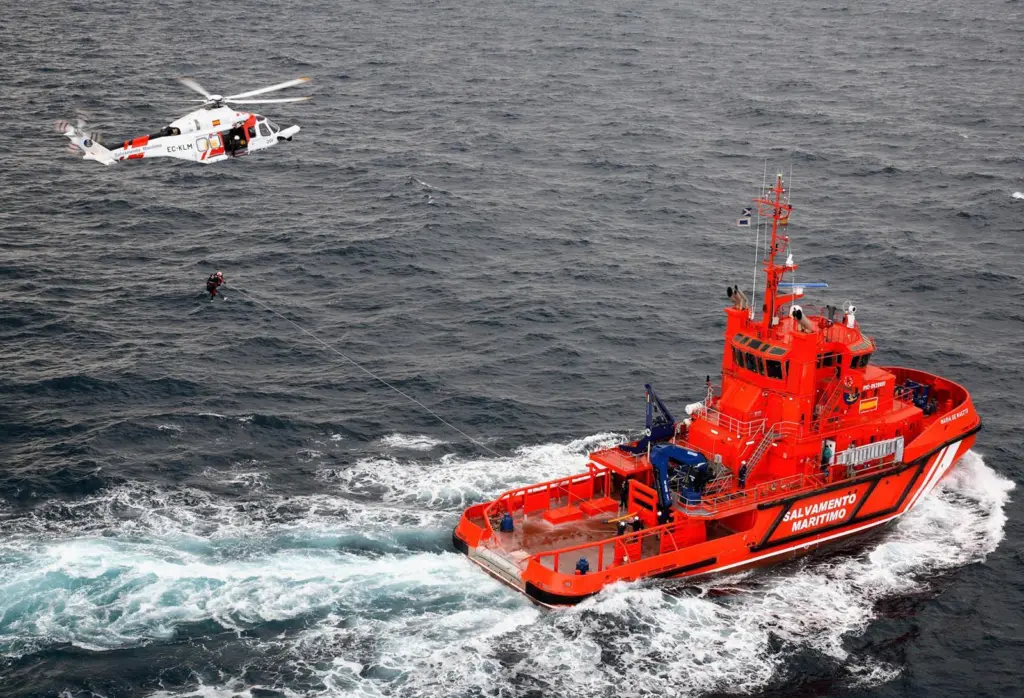
Union Naval Valencia (UNV), a subsidiary of the Boluda Group, is close to delivering a four tug series of salvage tugs to SASEMAR, the government funded Spanish Maritime Salvage Agency.
A contract for all four vessels, intended for use as Emergency Towing Vessels (ETVs), was signed in November 2006. The first tug
Maria De Maeztu
was completed in March of this year, followed by
Maria Zambrano
in May,
Maria Pita
in June, and
Marta Mata
this month.
All four tugs have been designed to carry out rescue, towing, and fire fighting operations on the Spanish coastline and join a growing fleet of specialist vessels operated by SASEMAR.
Accommodation is provided onboard for survivors and equipment is installed to enable the vessels to participate in diving operations and oil recovery. The construction and configuration is based on a salvage tug concept with azimuthing propulsion systems, towing winches fore and aft, and a high forecastle for operation in rough seas. The tugs comply with Bureau Veritas class notation; I + Hull + Mach + Salvage Tug, Firefighting Ship 1, Water Spray, Unrestricted Navigation,
Each tug measures 39.70m in length overall, with a moulded beam of 12.50m and a design draft of 4.20m. Two ABC (Anglo Belgian Corporation) 8DZC-1000-175 main engines generate a total of 5,086 bhp running at 1,000 rev/minute MCR. The engines are flexibly mounted and coupled to a pair of Schottel SRP1215CP fully steerable propulsion units with 2,400mm diameter controllable pitch propellers.
A power takeoff on the front of each main engine drives a 500kVA shaft generator and a 1,500cu/m/hr fire pump. Manoeuvrability at slow speed is very good and improved further by means of a Schottel 200 kW bow thruster.
On trials the vessels have achieved a bollard pull of 60 tons at MCR and a free running speed of 13 knots. A maximum of 359.8 cu/m of fuel can be carried giving a range of 6,000 miles at 85% MCR.
In addition to the shaft generators already mentioned, a Volvo Penta D9MG-KC powered Stamford HCM434F 281 kVA auxiliary alternator is also installed along with Volvo powered harbour and emergency sets of 130kVA and 163kVA.
Mounted on the foredeck is an Ibercisa MR-MAN/H/H/80/300-48/26-D/2/IS combined anchor windlass/towing winch with a single towing drum, two cable lifters and two warping heads. The drum has a maximum brake load of 160 tons and is designed to handle 300m of 48mm diameter manmade synthetic towline.
The towing winch fitted on the afterdeck is an Ibercisa MR-H/80/2/1000-44/1/IS hydraulically driven, twin drum machine capable of accommodating 1,000m of 48mm diameter steel wire towline on each drum. Both drums have a maximum brake holding load of 160 tons on the first layer and a maximum line pull of 23 tons at the lowest of two hauling speeds, which is 15m/min. An auto-spooling device and warping head is also provided.
Also fitted on the after deck is an Ibercisa hydraulically powered tugger winch, two Ibercisa 5 ton capstans, a Ferri quick release tow hook, and a set of Ferri retractable tow pins with a maximum safe working load of 60 tons.
The working deck aft can accommodate two 20 foot ISO containers if required and the bulwarks have doors designed for rescue purposes. An Effer145.000/2S deck crane is mounted above the main deck on the starboard side and a work and rescue boat with its launching davit to port. The fully enclosed Maritime Partner Weedo 710 GRP work/rescue boat is 7.1m in length, has a bollard pull of 2 tons and can rescue up to 20 persons while operating with a crew of four.
Fully air conditioned accommodation is provided aboard this new series of vessels for a maximum crew of twelve, two single cabins with separate office and toilet for the Captain and Chief Engineer, eight crew in single en-suite cabins and one double en-suite cabin. Other facilities include separate mess rooms for the officers and crew, galley and provisions store, and a survivor’s cabin with two ‘Pulman’ bunks and a multi-purpose cabin with four Pulman bunks.
The navigational and communications outfit on this quartet of ETVs is in keeping with the Coastguard role and contains a wealth of modern hi-tech equipment suitable for search and rescue work in busy shipping lanes and coastal areas.
Related Articles
 SPECIAL REPORTS
 TUGS & SALVAGE
 EQUIPMENT