![MaritimeJournal[Seawork]](https://www.maritimejournal.com/wp-content/uploads/2026/09/MaritimeJournalSeawork.svg)






Uzmar deliver two Voith tractors to Columbia
The Uzmar Tug and Work Boat Factory in Izmit, Turkey has delivered a pair of powerful Voith tractors to Cerrejón based in Puerto de Bolivar, Colombia.
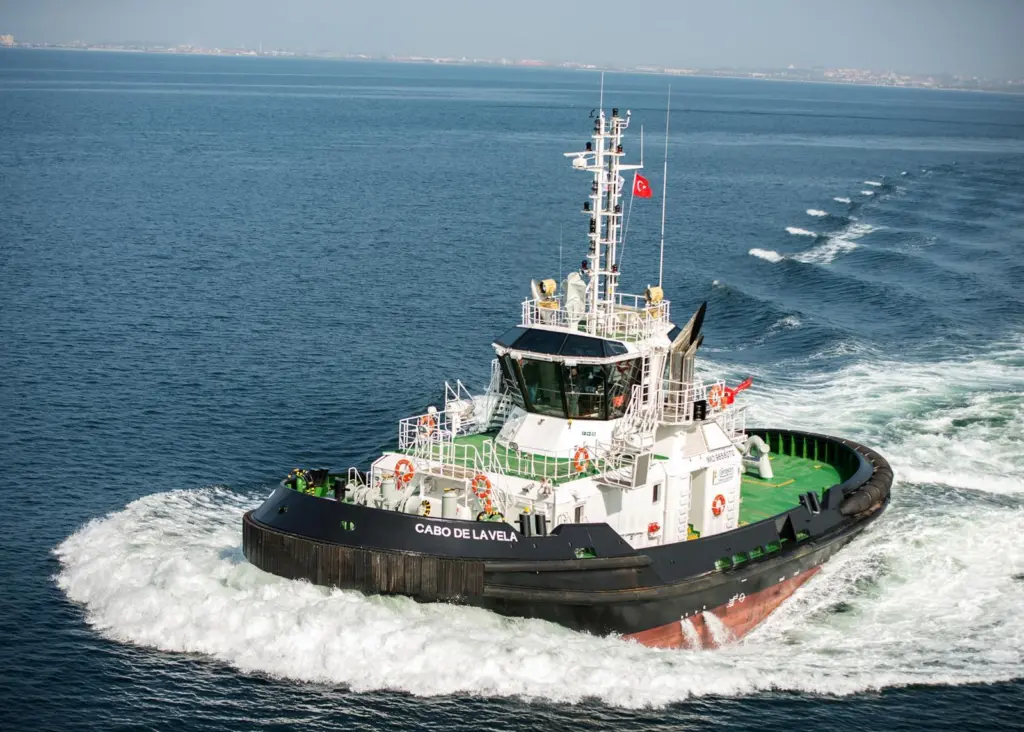
Named Media Luna and Cabo de la Vera, the tugs were built to the new Robert Allan (RAL) AVT 3000 Class design. Media Luna arrived in Columbia at the end of january after sailing under its own power across the Atlantic from Turkey, to be welcomed by a fire fighting display by other Cerrejon tugs. Sister vessel Cabo de la Vela joined the fleet in March. Both new vessels were ordred as part of a fleet renewal programme.
The AVT3000 was designed to meet Carbonnes del Cerrejón’s specific requirements for performance, propulsion equipment, accommodation, tank capacities and outfitting. The vessel features a semi-raised forecastle for operation in rough weather and a large working deck aft for efficient ship handling operations. Designed for a bollard pull of at least 60 tonnes the tugs are the most powerful in the Puerto Bolivar fleet that serves bulk cargo facilities for the export of coal frequented by very large bulk carriers.
Media Luna and its sister ship are vessels of 30.75m in length overall, with a moulded beam of 12.00m, a moulded depth of 4.80m and maximum draft of 6.20m. The tugs were designed and built to Bureau Veritas class requirements with the following notations: BV 1, X HULL, X MACH, TUG, Unrestricted Service.
The hull design incorporates a distinctive sheer and the usual underwater skeg aft. Fendering along the sides of the hull follow the sheerline with 300mm ‘D’ section rubber moulding, terminating at the wide bow fender comprising a series of 300mm ‘W’ section block mouldings. At the stern the fendering for ‘push-pull’ shiphandling operations has an 800mm diameter cylindrical moulding mounted above a series of ‘W’ section mouldings. The stern fender is equipped with a water spray lubrication system controlled remotely from the wheelhouse.
The tugs have identical propulsion systems, powered by a pair of General Electric 12V228 main engines, each rated 2,289kW at 1,050 rpm (total approximately 6,140 bhp). Power is transmitted via Carden shafts to Voith Schneider 30R5-250 cycloidal propellers with a blade orbit of 3m. Electrical power onboard is supplied by two identical Caterpillar C 6.6 ACERT diesel auxiliary generators, each rated at 125ekW, 60 Hz, 480V.
On trials MediaLuna met or exceeded all performance expectations, with a bollard pull ahead of 63.1 tonnes and a free running speed of 13.6 knots.
Also located in the engine room is an independent fire pump driven by a Caterpillar C18 ACERT auxiliary diesel engine rated at 546kW at 1,800 rpm. The horizontal centrifugal pump is an SFP 250×350 XP supplied by Fire Fighting Systems, delivering 1,200m3 of sea water per hour to a single FFS1200LB, 1200/300 m3/hr water/foam remotely controlled monitor.
The same diesel auxiliary is used to drive the hydraulic pump powering the towing winch and deck machinery. An electrically driven standby pump is provided for emergency use or during maintenance.
The vessels can accommodate 182.0m3 of fuel oil, 35m3 of fresh water, 4.4m3 of main engine lubricating oil, 2.2m3 of Voith unit oil, 2.2m3 of hydraulic oil, 4.8m3 of sludge and 4.0m3 of grey water. A sewage tank holds 9.6m3 and 12.2m3 of fire fighting foam is carried.
In common with most high performance Voith tractors, all towing connections are made from the after deck. In this case a Rolls-Royce ATWH 1500/200 single-drum render-recover towing winch, with horizontal warping head, is installed. The winch has a line pull of 20 tonnes at 18m/min. and 5 tonnes at 50m/min. Rendering capability is 30 tonnes at 30m/min and 8 tonnes at 80m/min. The towline is deployed via a single, stainless steel lined staple mounted on what is a spacious ‘uncluttered’ after deck.
Other deck machinery includes a Heila deck crane rated at 5 tonnes at 5m reach located on the after deck. A Rolls-Royce AW20.5U2H anchor windlass with two cable lifters and two horizontal warping heads is provided on the foredeck.
The wheelhouse is designed with frameless bonded windows designed for maximum unobstructed visibility. A single split control station which provides maximum visibility for both ahead and astern operation has an excellent view over the aft working deck. A pilot boarding platform is provided at the bridge deck level.
Both tugs have been fitted out to a high standard for a crew of four people. The main deckhouse contains two officer cabins with shared en-suite, the galley and mess room.
Located on the lower deck is a double berth cabin, a laundry, galley stores, and a common WC space. The engine room features a small sound resistant switchboard room. A workshop and stores area is located in the aft hold.
In common with all RAL designs, significant noise and vibration reduction measures have been implemented throughout, including resiliently mounted main engines, resiliently mounted generators and auxiliary engine, high attenuation engine exhaust silencer systems, ventilation intake air silencers, sound dampening deck treatments, and insulation measures.
Related Articles
 SPECIAL REPORTS
 TUGS & SALVAGE
 EQUIPMENT