![MaritimeJournal[Seawork]](https://www.maritimejournal.com/wp-content/uploads/2026/09/MaritimeJournalSeawork.svg)


Vehicle carrier on the road to recovery
Copenhagen based Svitzer A/S have successfully concluded the salvage of the vehicle carrier Höegh Osaka following its high-profile grounding in the Solent in an incident attracting worldwide media attention.
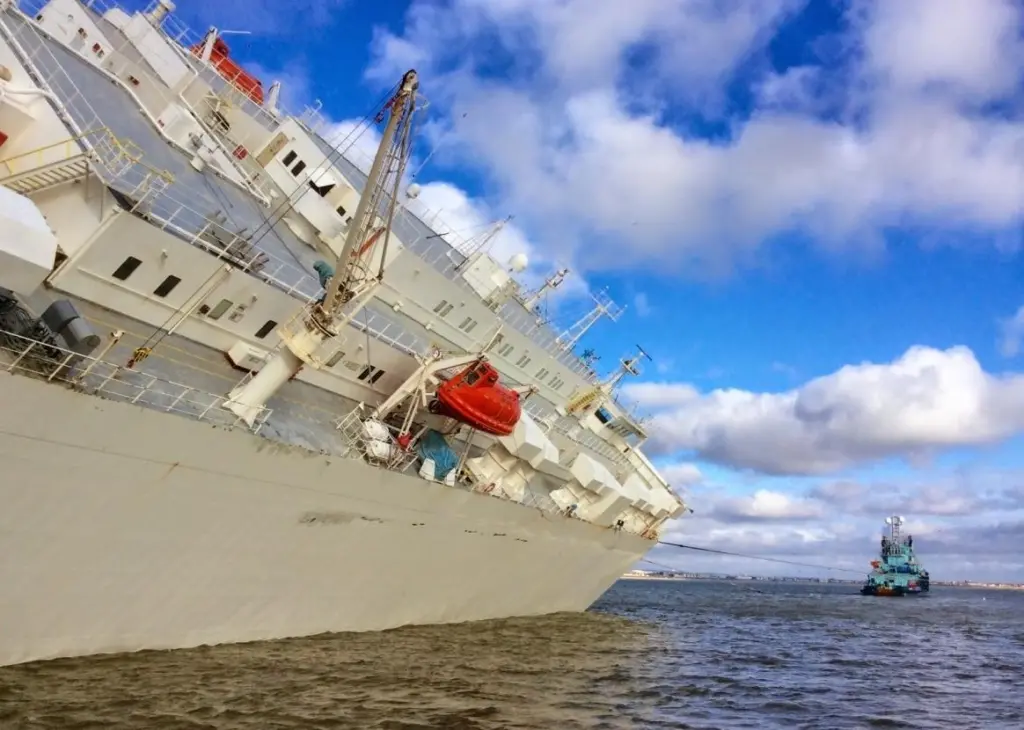
When a ship comes to grief it may well be in a remote part of the world, away from public scrutiny with not much to see anyway; a grounded ship often not looking that much different from one at anchor. Obscure anonymity was not to be the case however when the Höegh Osaka ran aground on the Bramble Bank soon after leaving Southampton on 3 January this year.
The Southampton port pilot and ship’s master took the decision to deliberately ground the vessel to prevent further deterioration of a severe list which had developed. The quick thinking action avoided it foundering in the main channel and all 25 on board were rescued leaving the ship grounded with a 50’ list.
As is standard with such incidents in UK waters, Hugh Shaw, the Secretary of State’s Representative for Maritime Salvage & Intervention (SOSREP) became immediately involved and at a press conference a little over 24 hours later it was announced that Svitzer had been appointed as salvors for the vessel.
Svitzer and Solent Towage are two of the towage service providers at Southampton, the latter providing terminal towage services at the Fawley oil refinery in Southampton Water and tugs from both companies quickly became involved. Solent Towage’s vessels were employed throughout the salvage operation and the initial task for their tug Lomax was to push on the ship’s side to keep it in position over high water, their tug Vortex also being despatched from Ijmuiden to assist.
Höegh Osaka was assessed as being stable and within 24 hours Svitzer began assembling salvage equipment with personnel boarding the vessel to make an initial inspection after which a formal salvage plan was drawn up. A breach in the hull thought to have been caused by some of the cargo moving was quickly dealt with, no pollution was reported during the incident.
The incident occurred in relatively sheltered waters but the salvage was to be carried out during periods of high winds and plans were put in place to secure the vessel (which had a high windage area) at its grounding position. The salvage team on board faced challenging conditions, the angle of list making movement around the vessel difficult calling for an element of abseiling skills. An inspection found more water had entered the vessel than originally thought and a planned refloating attempt had to be postponed.
Four days into the salvage Höegh Osaka, decided not to wait any longer and refloated on its own accord, the attendant tugs able to tow it to a safe holding location two miles away bringing the errant ship under the jurisdiction of Queen’s Harbour Master Portsmouth. Salvage work centred on reducing the vessel’s list in preparation for it being towed to Southampton and it was estimated that 3,000 tons of water had to be removed to stabilise the vessel further. Salvors used a technique to draw water from the bottom of the vessel to avoid disturbing an oily film of hydraulic oil on the water’s surface.
Work had to be halted as periods of bad weather continued with wind speeds of up to 72 knots reported and the tugs remaining attached throughout. Attention then turned to the vessel’s ballasting system as the removal of the flooding water continued with a break in the weather allowing additional pumping equipment to be transferred by a dedicated helicopter.
Two weeks after the initial grounding the salvors were able to report that ongoing ballasting operations were at last reducing the vessel’s list with a limited diving inspection of the hull also finding no significant damage. As the list was gradually reduced, some of the ship’s systems were able to be reinstated and it was decided that consideration would be given to move the ship once the list was reduced to around 15’. Good progress towards that goal was made and as conditions for moving around on board improved investigators from the UK Marine Accident Investigation Branch were able to gain access, along with a skeleton crew to prepare the ship for the tow back to Southampton.
Tugs from Solent Towage and Svitzer were providing the main ‘muscle power’ to keep control of the Höegh Osaka but the scope of activities was broad and saw the involvement of craft including from locally based Williams Shipping, Dutch company Iskes Towage & Salvage (with the tug Ginger) and Multratug’s Multratug 4. Solent Towage’s parent company Østensjø Rederi mobilised their largest tug, the 88tbp Thorax to assist in the operation.
On 22 January, nineteen days after the initial grounding and with the list now reduced to just five degrees the final phase to tow Höegh Osaka back to Berth 101 in Southampton got underway. The vessel was finally berthed safely alongside after an uneventful four hour passage and after completion of the final formalities handed back to its owners. Around 1,400 vehicles were reported to be on board and following their discharge at Southampton Höegh Osaka sailed under its own steam to Falmouth for permanent repairs.
An interesting behind-the-scenes aspect was involvement of Lloyd’s Register’s SERS (Ship Emergency Response Service). The hull data was protected by intellectual property rights and it was realised it would take at least five days to obtain vital information from the vessel’s Japanese shipbuilder. Höegh Osaka’s owners and technical manager therefore approached LR’s Southampton based SERS team and along with Svitzer and a special adviser to SOSREP re-ran the salvors initial calculations and various scenarios using a model of a similar ship. SERS were subsequently able to re-confirm the accuracy of the original modelling.
By Peter Barker
Related Articles
 SPECIAL REPORTS
 TUGS & SALVAGE
 EQUIPMENT