![MaritimeJournal[Seawork]](https://www.maritimejournal.com/wp-content/uploads/2026/09/MaritimeJournalSeawork.svg)






World’s first LNG powered tug is delivered
Borgøy, the world’s first tug to be fuelled by liquefied natural gas (LNG), left the Sanmar shipyard in Tuzla on 14 January bound for Norway under its own power.
As expected with so much new technology involved, the tug underwent exhaustive commissioning and trials prior to delivery. With a little more information available it is now time to take a second brief look at this unique vessel (see also MJ- Nov 2013).
Borgøy is the first of a pair of identical vessels ordered by Buksèr og Berging and designed by the company’s in-house team in Oslo with the assistance of Norwegian consultants Marine Design AS. The design was developed further by Sanmar in its modern shipyard and facilities.
The engines, propulsion package and LNG system were delivered by Rolls-Royce. Using LNG as fuel eliminates sulphur emissions, brings particulate matter emissions down close to zero and reduces the discharge of CO2 and NOx by 26% and 80-90% respectively.
An ASD tug of 35m in length, the vessel carries the currently unique DNV class notations +1A1-E0-GAS FUELLED-TUG-ESCORT (100,10) -OILREC- FIFI I – GMDSS Area 3.
The propulsion system comprises two Bergen C26:33L6PG spark ignition, lean burn main engines, each developing 1,705kW at 1000 rpm (total approximately 4,574 bhp) to drive Rolls-Royce US35 fully azimuthing propulsion units incorporating controllable pitch propellers of 3,000mm diameter.
The gas fuelled engines can operate on low load without any restriction, have a very quick and step-less ramp up time from 0 to 100% load, and are easy to service and maintain. The lean burn principle delivers high efficiency coupled with reduced exhaust emissions and low specific energy consumption. Spark arrestors are fitted in the exhaust systems and the engines have air starting and the cooling systems use plate type heat exchangers.
Electrical power onboard is supplied by two Nordhavn/Scania GASI 12-07-10-60G dıesel driven alternators rated at 240ekW each, 400 V, 50 Hz.
On trials Borgoy achieved a bollard pull of 68 tonnes and a service speed of 13.5 knots. Steering force in the indirect (escort) mode of 110 tonnes at 10 knots is predicted. Manoeuvrability is enhanced with a Schottel SPJ 82- 333kW bow thruster.
The tug will carry out shiphandling and escort operations over the bow from a Karmoy, hydraulically powered winch with a single split drum, specifically designed for escort work and equipped with a 250m towline of 72mm diameter synthetic rope. The later is deployed via a tubular towing staple of inverted ‘V’ configuration.
A second hydraulic winch from Karmoy is located within the aft deckhouse for towing at sea. That winch has a single drum accommodating 600m towline of 57mm diameter steel wire rope. Both winches have a maximum brake holding capacity of 250 tonnes with a bare drum. Also fitted, on the portside aft, is a Heila HLRM 90-5S deck crane.
A well glazed wheelhouse is located high above the deckhouse with excellent all round vision. Borgoy has a comprehensive outfit of navigational and communication equipment to GMDSS A3 standard, including two Furuno radars, GPS, a DGPS compass, a gyro compass, satellite compass, echosounder, AIS, NMEA distributor, autopilot , speedlog, a weather station, VHF, SSB, Navtex, BNWAS, and UHF hand radios,
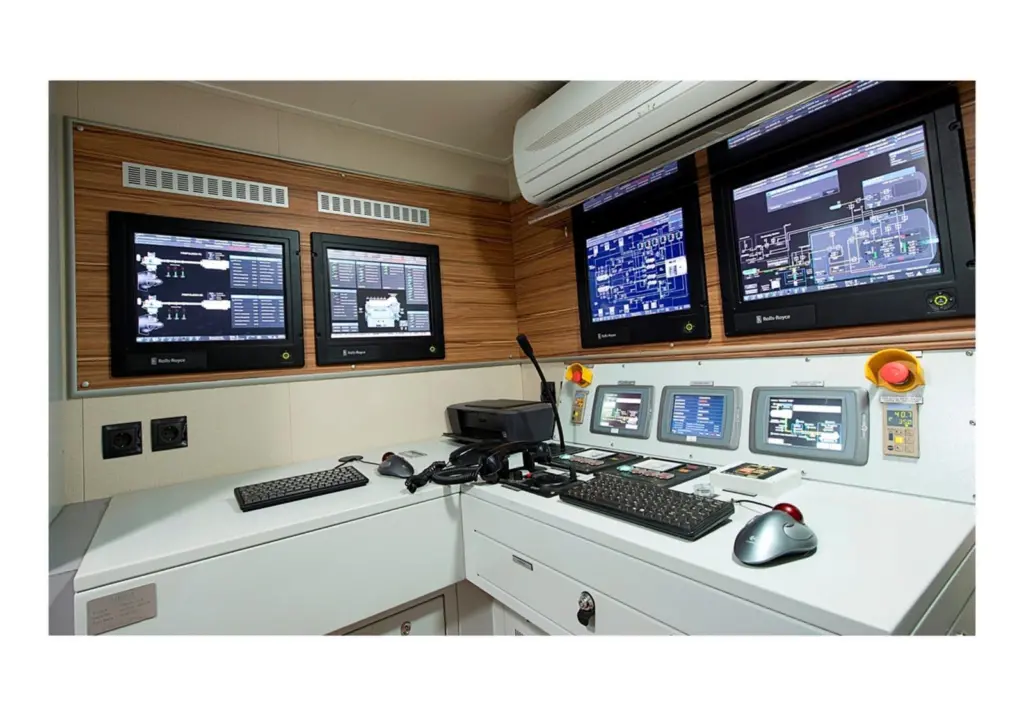
A soundproof engine control room is provided with a comprehensive array of visual display screens to monitor and control all aspects of the machinery and complex fuel systems
Accommodation comprises two single and two double cabins, a mess room, sanitary facilities, adequate storage, pantry and galley, all to North European standards of comfort and quality. Sound levels at approximately 80% engine load are 60-65 dB in the cabins and approximately 65 dB in the wheelhouse, corridors and mess room.
Borgoy will be operated by Buksèr og Berging in Statoil’s Kaarstoe Gas Terminal in Norway. The second tug, Bokn, is expected to leave mid-April 2014.
Related Articles
 SPECIAL REPORTS
 TUGS & SALVAGE
 EQUIPMENT