![MaritimeJournal[Seawork]](https://www.maritimejournal.com/wp-content/uploads/2026/09/MaritimeJournalSeawork.svg)






Groundings and broken turbines among jobs for salvors
From tackling multiple wind turbine blade failures to responding to a damaged jack-up rig off Trinidad, global salvage operations demonstrate how salvors’ expertise stretches far beyond towing disabled vessels to a safe haven.
The industry’s two main activities, traditional salvage and wreck removal, involve similar expertise but are often different when it comes to execution, with wreck removals sometimes following what starts as a salvage operation that is still in progress.
Wreck removal can result from the prospect of the vessel and its cargo being declared as beyond economic repair – or written off, and may involve a separate contract.
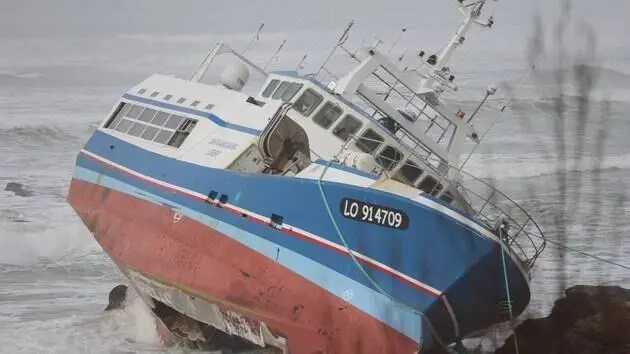
A Coruña, Spain-based Ardentia Marine responded to a series of groundings following severe storms along Europe’s Atlantic coastline, involving vessel removal, wreck recovery and shoreline clearance services in France, Portugal and Canary Islands.
When a fishing vessel ran aground in Les Sables‑d’Olonne, France resulting damage ruled out any refloating attempt, local authorities instead opting for an overland removal solution. Ardentia dismantled the vessel and cleared the site in an operation completed in less than a week.
Separately, the remains of a Portuguese fishing vessel aground on rocks around 200 metres offshore were recovered by Ardentia after several weeks of adverse weather prevented access to the vessel.
La Tejita beach, Tenerife was the final resting place for a sailing yacht that had run aground and Ardentia’s work included removal of the wreck along with clean-up of the affected beach area restoring the shoreline to its previous condition.
Legless in Trinidad
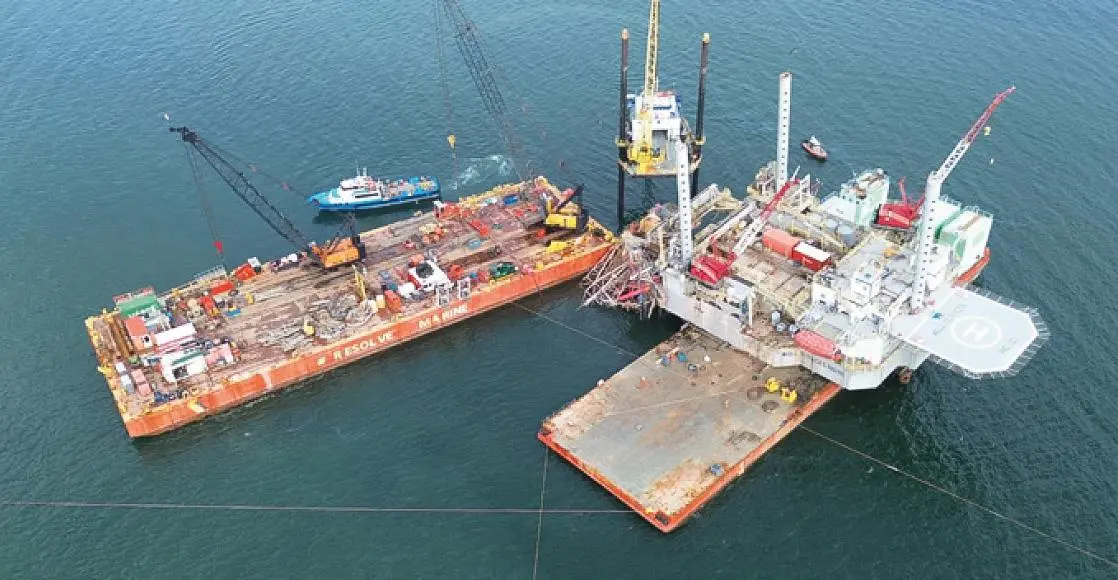
In a year-long operation, US-based Resolve Marine completed a complex wreck removal project after a jack-up rig suffered ‘catastrophic leg failure’ off Trinidad.
Two phases were involved starting with stabilisation, monitoring and pollutant removal using a lift boat. Hydrocarbons and containers were offloaded along with bulk caustic soda, barite and other drilling-related chemicals.
Phase two saw removal of the wreck itself, initially the rig topsides, rig mat, drill floor and derrick. Resolve’s salvage barge RMG 1000, equipped with two 450 ton lift cranes, was mobilised for both phases along with a submersible barge outfitted with grillage to accommodate the topsides allowing for its weight and angle.
With the topsides supported, the rig’s legs were cut and the barge and topsides removed to a separate location. The rig mat was refloated using compressed air and pumping, towed clear of the oilfield and anchored nearby, completing the lengthy operation.
Assisting a disabled bulk carrier in Argentina was another part of Resolve’s more traditional activities, but when problems occur among the increasing number of offshore wind farms, salvors’ expertise and innovation become a natural first call.
Following the failure of multiple turbine blades at a North Sea wind farm, specialist skills such as working at height was needed, and Resolve was contracted to provide speciality engineering and salvage services.
Equipped with walk-to-work access systems, SOVs can manoeuvre within wind farms without disrupting ongoing work elsewhere in the field and one provided a suitable platform for Resolve’s activities.
Engineers used controlled explosives to cut and remove the damaged blades from the towers and after the blades were removed, a subsea survey and debris recovery programme using ROVs and other specialised equipment was completed, all before the end of the working weather season.
The challenges faced by Resolve included working at height and gaining access to the nacelles on top of the turbine towers without power, elevators or the ability to lock the rotors themselves.
Busy Tsavliris
Greek salvor Tsavliris responds regularly to disabled vessels requiring towing, often to a port of refuge. While not attracting the same level of attention as incidents that become casualties, these ‘tow you home’ jobs have potential pollution prevention value.
Few salvage companies operate their own large fleets of tugs nowadays, and for those who do, they will unlikely be in the right place at the right time (and available), so chartering vessels from other operators is common practice.
Boskalis’s 200tbp tug Boka Alpine was mobilised by Tsavliris after the 57,000dwt bulk carrier Common Calypso suffered machinery problems while on passage from Santos, Brazil to Chittagong, Bangladesh. The vessel was east of the Soloman Islands in the Indian Ocean at the time and laden with soya beans.
Boka Alpine was contracted to tow the vessel to Hambantota Port, Sri Lanka and despite having to replace the tow connection during the voyage due to yawing, the convoy arrived safely at its destination 12 days later.
Boskalis provided another tug of the same class for Tsavliris when another bulk carrier, the 174,674dwt Keeper, lost electrical power 126 miles north-east of Trincomalee, Sri Lanka. The laden vessel was en route from South Africa to India at the time.
The 200tbp Boka Expedition proceeded from Colombo Anchorage to the stricken vessel, arriving three days later, and after a four-day tow the convoy arrived safely at Trincomalee when the 97tbp AHT Advantis Libra took over.
Trouble in Turkey
Turkey’s Directorate General of Coastal Safety (DGCS) operates a fleet of dedicated emergency response tugs and has completed a complex rescue operation on a badly damaged tanker.
The 249m long, 61,991gt Suezmax crude oil tanker Qendil was anchored off Bozcaada in the northern Aegean when its anchor chain parted during severe weather, the vessel grounding on a rocky seabed near the approaches to Dardanelle Strait, a busy shipping route.
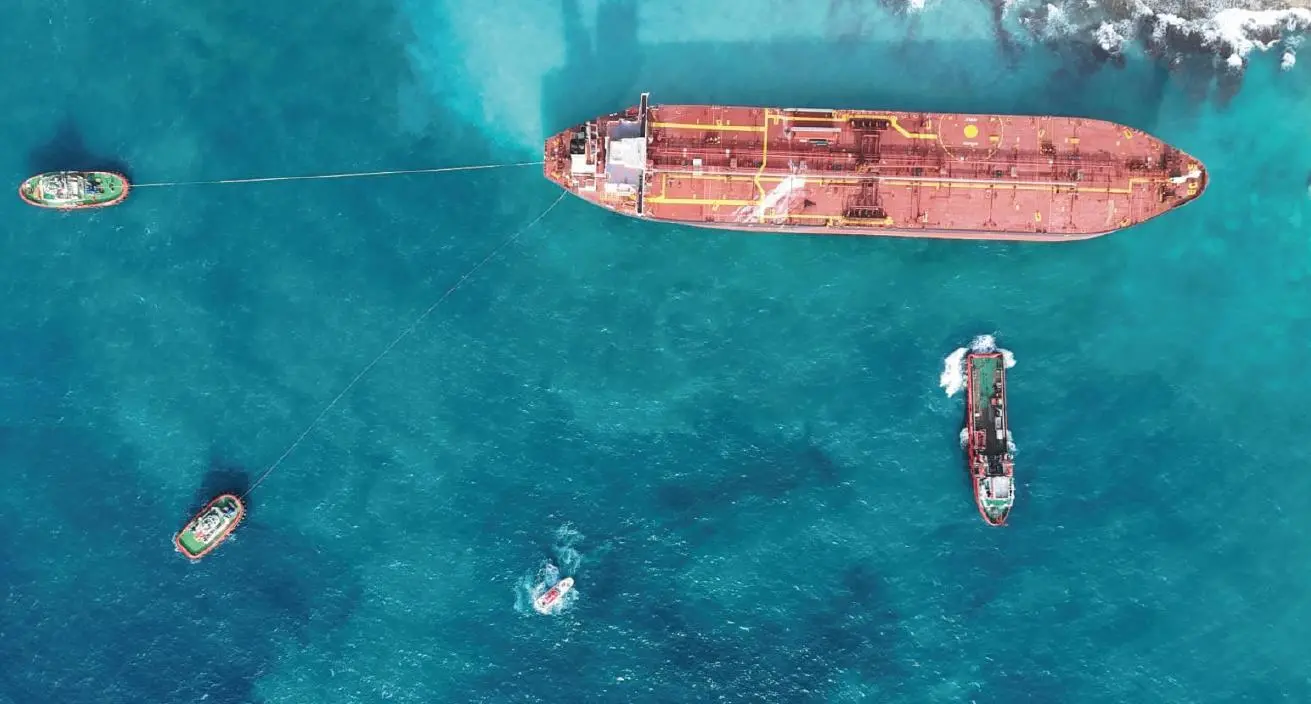
Qendil was preparing to enter a shipyard at the time and carrying around 44,000t of ballast water. Its cargo tanks were already gas free, significantly reducing risks. Five days after grounding, salvage masters from DGCS boarded the tanker.
DGCS divers discovered damage in the port ballast tank with the pump room flooded, but fortunately the cargo tanks and engine room remained intact and dry. Underwater patching techniques sealed the opening in the pump room and flood water was transferred to the vessel’s slop tank.
Despite the combined pulling force of four tugs – totalling 445tbp – the vessel remained firmly aground, and a complex ballast discharge operation to reduce draught and ground reaction forces was carried out.
Due to damage to ballast tanks and ongoing water ingress de-ballasting was described as ‘initially challenging’. Ballast volume had already reduced to around 30,000t following grounding and divers subsequently sealed damaged hull sections using epoxy compounds and wooden plugs.
A further 20,000m3 of ballast water was discharged and propeller wash techniques from one of the tugs removed seabed material beneath the hull. The length of the operation required 50t of potable fresh water to be transferred to Qendil for its 25-strong crew, and after 12 days of continuous efforts the tanker was successfully refloated, towed clear and taken to anchor off Bozcaada for further inspection.
Salvage professionals following this story will be familiar with the complexities involved when vessels such as tankers and bulk carriers suffer hull damage after grounding. In such instances, the industry’s specialist skills, professional competence and equally important patience and innovation are vital in saving property and protecting the environment.
Related Articles
 ACCESSORIES & EQUIPMENT
 SPECIAL REPORTS
 DIVING SERVICES