![MaritimeJournal[Seawork]](https://www.maritimejournal.com/wp-content/uploads/2026/09/MaritimeJournalSeawork.svg)





20 years of semi-foiling experience
One Seawork 2024 exhibitor can quietly boast two decades of steadily working on a simple but clever foil system to improve both the fuel efficiency and ride comfort of its catamarans.
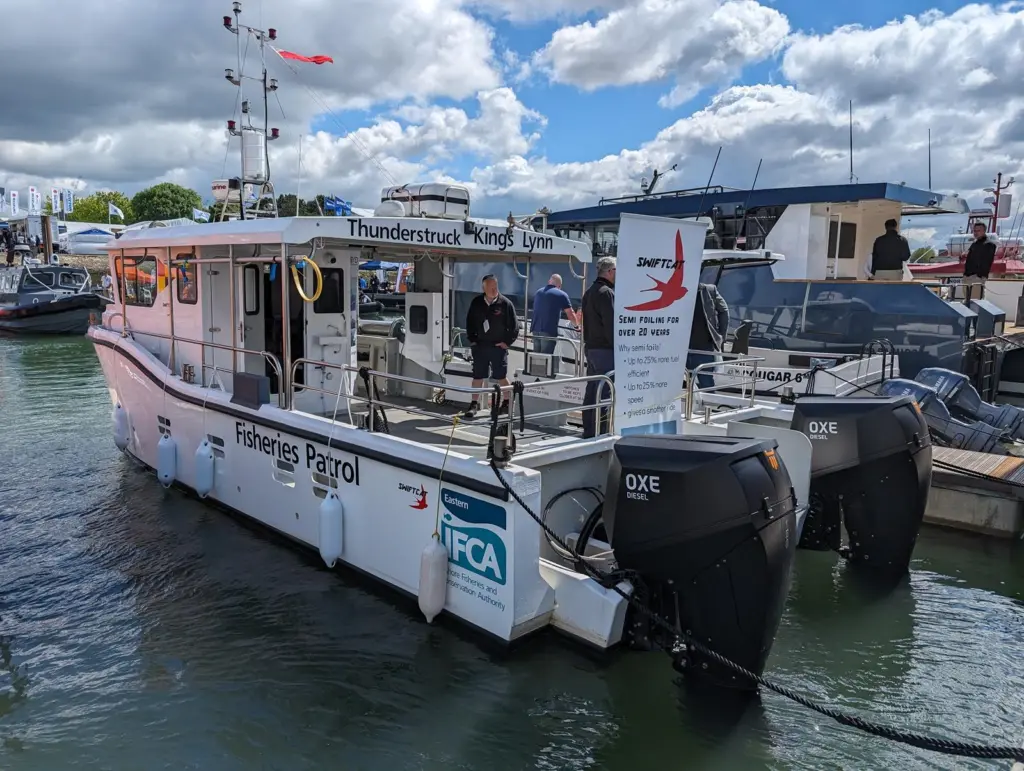
Swiftcat Boats, based on Mersea Island, Essex, UK has been gaining a following in fishing, marine research and commercial marine, thanks in part to its offering of a lift foil roughly amidships, that claims top speed and economy improvements up to an eyebrow-raising 25%.
According to Swiftcat Boats’ Director Chris Dawson, the addition of the foil is a no-brainer for most buyers of the boats, offering multiple benefits with few downsides.
“We build most of the foils out of marine stainless steel, although we have been asked for one in fibreglass, which worked equally well,” he says. “The foil spans between the inner top sides of both hulls, but is always positioned higher than the keel so it never compromises our boats’ ability to take the ground, as this is an important feature for many of our buyers.
“It needs to run in as deep water as we can get it in to generate efficient and predictable lift tendencies. It also doesn’t project outboard of the hull sides, so it is never a hindrance to berthing. Because the foil is steel, even if it was to touch the bottom when taking the ground or even hit an item of flotsam at speed, it’s unlikely to sustain damage.”
Once these sort of daily usage compromises have been addressed, as Swiftcat seems to have done, the principle of using a foil to only partially lift a catamaran is a persuasive concept.
Full foiling is a massive potential efficiency booster and as we all know, some commercial marine vessels are already doing it.
However, the mechanisms, competencies, software and in many cases predictive AI-driven systems to achieve reliable full foiling flight (with hull or hulls completely clear of the water) in all sea conditions and multiple states of boat loading are always expensive and can sometimes be fragile.
Therefore operators of vessels in commercial marine, where time off service is costly, can be quite reticent to invest in full foiling technologies despite their on-paper potential to meet decarbonisation targets.
Full foiling requires a whole world of maths to balance factors such as pitch, roll and yaw, along with potential changes to foil angle of attack.
Any one of these variables can be moved out of its sweet spot, whether due to hitting seaweed or half a ton of generator placed on the foredeck, and leave a super-efficient full foiler unable to ‘fly’, and stuck on the surface in inefficient non-foiling mode. Or that’s the common industry perception.
Semi-foiling is a much more forgiving technology.
In the context of a catamaran, the boat retains its stability in pitch, roll and yaw without any moving foils and their attendant control systems because a proportion of its hulls still remain in the water. In terms of adjusting the single foil’s angle of attack, to fine tune its lift, this facility is simply provided by the outboard engines’ power trim. According to Chris Dawson, the Swiftcat runs about 30cm higher in the water when fitted with foils.
This is where the foil delivers its efficiency gain. Lifting any hull 30cm higher in the water represents a major reduction in wetted surface area, and hence drag.
When the hull is a catamaran, there is a lot to be gained from running the hulls drier, but in the context of the Swiftcat this foil-derived lift means the tunnel between the hulls also runs almost completely dry, evidenced, Dawson says, by glancing behind when under way at speed. With the foil there is green water being left behind between the hulls. Without it there is a maelstrom of white water behind, suggesting considerable drag.
Numbers-wise, Swiftcraft claim a 25% increase in speed or a 25% reduced fuel use for the same speed.
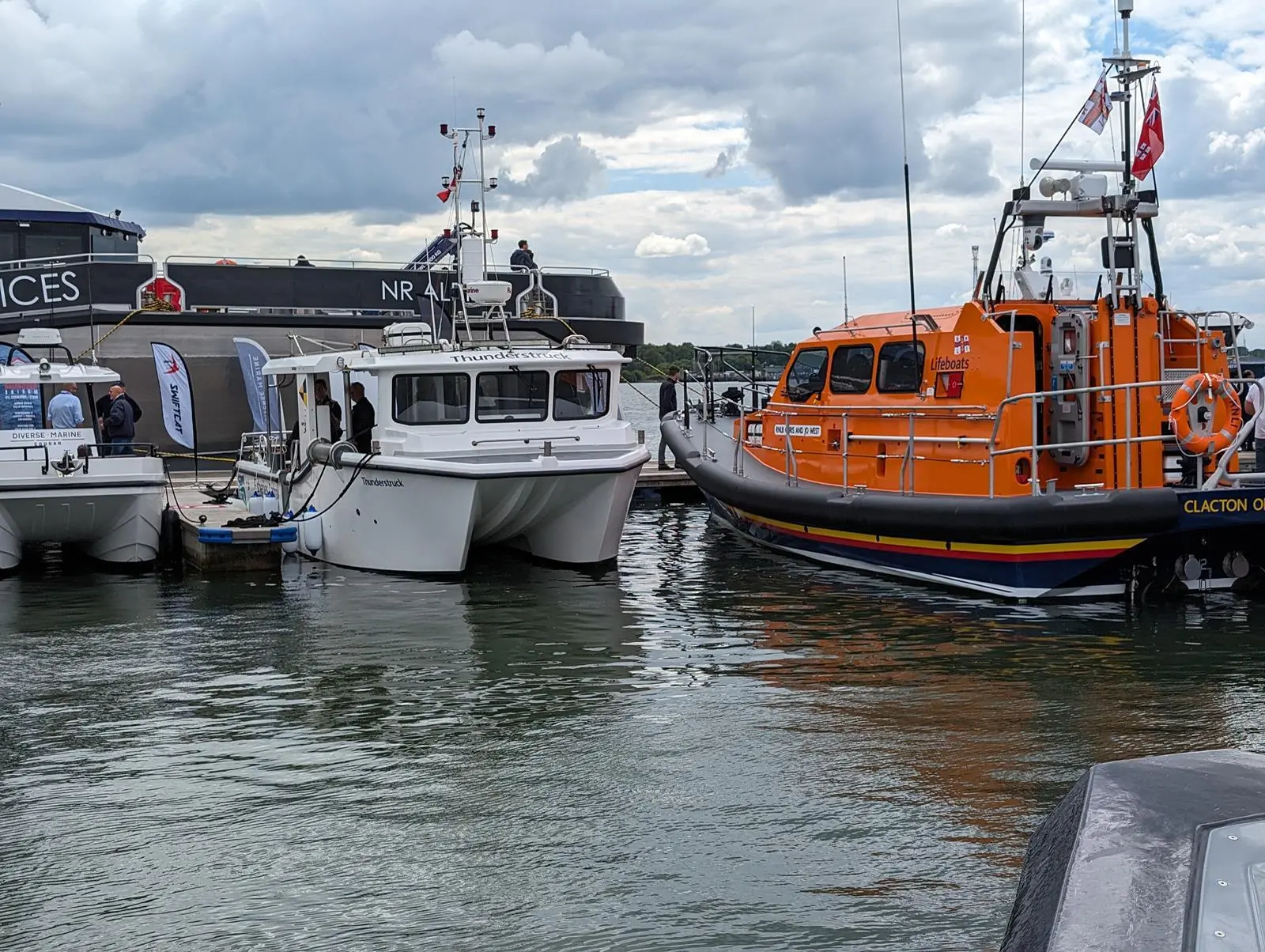
Indeed, for vessels on which the company has retrofitted a foil, there is almost always a propeller change required to up the pitch to cater for the higher speed and more easily driven hull. When a hull becomes partially foil bourne, there is also a reduction in hull slamming; when there is less hull in the water, the boat is deflected less by waves from below. Dawson speaks of boats that are 10 knots faster with the addition of a foil yet offer more comfort at this higher speed.
These retrofits are about as far as you can get from AI-controlled foil flight though. While the reality is perhaps a little more complex, Chris speaks of the tried-and-tested system of hoisting the boat and balancing it on blocks to find its centre of gravity, then fitting the foil a certain measurement forward of that. Because the majority of the boats are outboard powered, the engine’s trim takes care of any fine tuning.
In commercial marine, durable and simple solutions often win out, as Swiftcraft has been quietly demonstrating since 2004.
Related Articles
 OTHER NEWS
 ACCESSORIES & EQUIPMENT
 SPECIAL REPORTS