![MaritimeJournal[Seawork]](https://www.maritimejournal.com/wp-content/uploads/2026/09/MaritimeJournalSeawork.svg)


BMT unveils modular uncrewed ship concept
BMT has unveiled a modular uncrewed ship concept that it says advances the evolution of medium and large uncrewed vessels for commercial and military purposes.
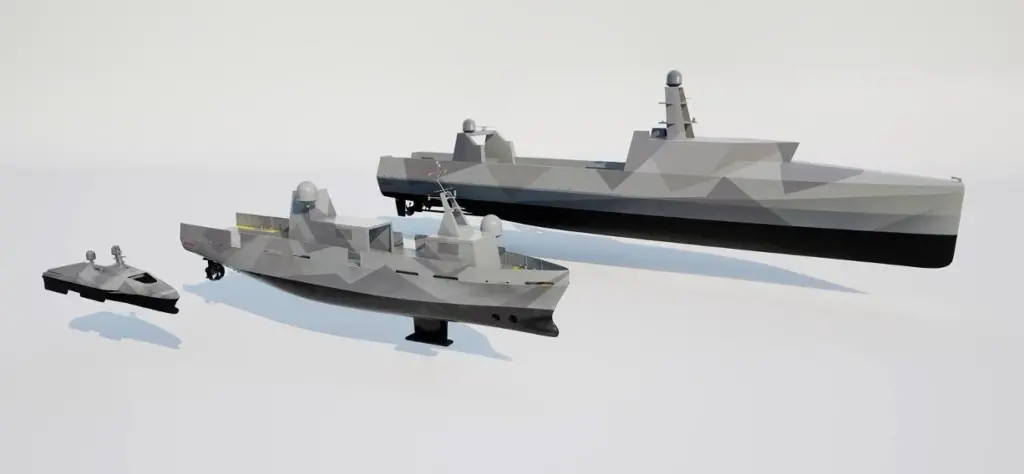
The concept, says BMT, has a modular approach to allow for more adaptable solutions for specific operations rather than a one-size-fits-all vessel.
The concept, which it is calling ’MODUS’, reflects ambitions set out in the UK’s Strategic Defence Review, and meets broader industry trends towards larger uncrewed vessels.
It’s basically a single design of vessel that can be easily adapted for specific uses – scaled up or down, and with different equipment installed – or not.
“Challenging everything we know about traditional crewed vessel design, MODUS aims to unlock the benefits of autonomy and uncrewed vessels at scale,” it says. “The project has developed pre-concept designs for a medium USV (40 metres) and a large USV (75 metres), designed for specific use cases including offshore survey, seabed warfare and anti-submarine warfare.”
Calling it a ‘MODUS family’, BMT says it is proposing a new narrative that scalable autonomous solutions shouldn’t just be one design and don’t need to have a common hull form.
“Instead, to get the most cost-effective solution in the autonomy space, we shouldn’t be afraid to have different solutions for different tasks,” it says. “This visualisation *above) shows 15m, 40m and 75m elements of the family, showcasing how a stepping stone approach to development can be used to derisk the solutions, starting small and building up to larger blue ocean capabilities, pushing design horizons.”
The project has been six years in development, BMT says, and has been announced shortly after the maritime services provider Serco revealed an uncrewed vessel design of its own for operations in the navy, as Maritime Journal has reported.
Seeking technical partners
“The power and propulsion considerations for an uncrewed vessel are key to achieving the necessary availability of a platform when it’s at sea and on patrol,” said chief mechanical engineer John Buckingham. “As part of that we look at the power and propulsion options, mechanical, hybrid, all the way through to all electric.
“We consider the options for those solutions based on operating profile, payload duties, the type of manoeuvrability, as well as the space and weights balances we have for the machinery.”
“While we’ve spelled out the vision there still remain a gap as to what we need to do for the future,” said Jake Rigby, head of Innovations and Research. “That’s not something BMT can do on its own and we are looking for key technical partners to really spell out and help us bring those solutions to market.
“There are challenges but the opportunities are huge.”
Related Articles
 OTHER NEWS
 ACCESSORIES & EQUIPMENT
 SPECIAL REPORTS