![MaritimeJournal[Seawork]](https://www.maritimejournal.com/wp-content/uploads/2026/09/MaritimeJournalSeawork.svg)





Boluda expands operations into Finland with purchase
Boluda Corporación Marítima has continued its steady expansion programme with the acquisition of Finland’s Yxpila Hinaus-Bogsering (YHB), consolidating the Spanish towing giant’s presence in Northern Europe.
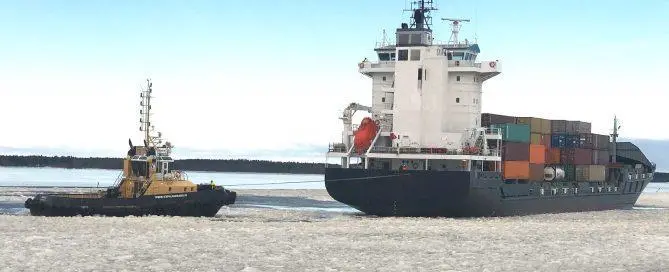
The acquisition will see Boluda entering the Scandinavian market so it can serve its clients in the Gulf of Bothnia. It will add six tugs, five of which are ice-classed, to its fleet operating in the ports of Kokkola, Vaasa, Raahe and Kemi.
Kokkola in particular has grown significantly in the last decade, becoming one of the largest facilities in Finland with significance for the mining industry alongside handling dry bulk, chemicals and timber cargoes.
The move will add YHB’s experience of towing operations in the extreme conditions of the Baltic, where ice and low temperatures require the knowledge and expertise of the Finnish company’s crews to perform manoeuvres ‘safely and efficiently’.
“This purchase is a further step in our consolidation in Northern Europe, a complex market where the experience and expertise of the crews are key to carry out towing and marine salvage operations in extreme conditions,” said Boluda president Vicente Boluda Fos. “In addition, we are opening the Scandinavian market, providing coverage to our customers in the northernmost part of the Baltic Sea.”
Long Finnish history
Like Boluda, YHB is a family-owned business operating for more than 40 years in the main areas of Kokkola and Raahe. Unlike similar tug-owning companies working in warmer climes its duties, as well as shiphandling, include keeping ports ice free in winter, which requires availability at short notice over a large area.
YHB’s ice-breaking activities require a recurring response in winter, where in Kokkola and Raahe the sea is frozen for an average of three months a year, and at the most extreme temperatures, a newly opened shipping lane can freeze over again in under an hour.
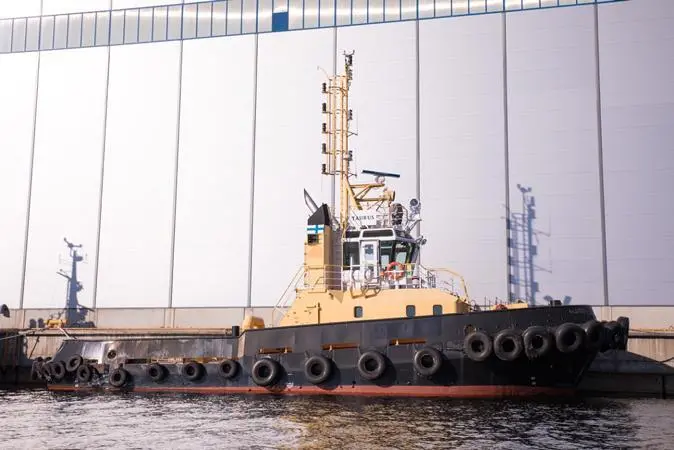
At the heart of YHB’s fleet are the Damen ASD Tug 2509s Aquila, Draco and Taurus. Built by Leningradskiy Sudostroiteinyy Zavod ‘Pella’ between 2001 and 2003, the trio of ice-classed tugs previously operated in Russia at St Petersburg Port.
They develop up to 40 tonnes bollard pull and speed 12.9kn from twin 1,000kW Caterpillar 3512B main engines with all three meeting Ice Class 1A requirements.
The other ice-class tug in YHB’s fleet include Aries, built in 1996 by Donghai Shipyard, Shanghai and powered by twin Daihatsu 6DLM-26 main engines developing 2,352kW in total delivering a bollard pull of 41 tonnes and speed 13.4kn.
The non-ice classed tug originally operated for Maju Maritime Pte of Singapore (now a subsidiary of Rimorchiatori Riuniti SpA of Italy), and spent a period operated and managed by Smit Singapore Pte, group-owned by Smit International BV.
Finally, the 28tbp, 13kn conventional tug Cetus was built in 1976 by Åsiverken AB, Åmål, Sweden and is powered by a single 2,060kW, WH Allen, Sons & Co Ltd of Bedford 16PVBCS12-F main engine driving a single controllable pitch propeller.
While not ice-classed, Cetus is certified for winter navigation and the 24.75m long vessel has a pedigree of previous Scandinavian owners and operators including Svitzer Sverige AB.
Busy Boluda
With both a shipping and towage division, Boluda Corporación Marítima’s origins date back to 1837 and for the towage element 2024 has seen a number of notable takeovers alongside this latest acquisition.
The year started in February with the acquisition of Resolve Salvage and Fire (Gibraltar) strengthening its presence in the strategic maritime location of the Strait of Gibraltar.
In May its tug fleet expanded by 20 vessels with the acquisition of Hull UK-based SMS Towage, and just a month later, arguably Boluda’s most notable expansion of the year saw its takeover of Les Abeilles International in a move that included the French Emergency Towing Vessel fleet protecting France’s coastline.
Related Articles
 OTHER NEWS
 ACCESSORIES & EQUIPMENT
 SPECIAL REPORTS