![MaritimeJournal[Seawork]](https://www.maritimejournal.com/wp-content/uploads/2026/09/MaritimeJournalSeawork.svg)


Boskalis announces new cable-lay vessel order
Boskalis aims to bring a new cable-lay vessel (CLV) into its fleet to target growing demand for long-distance cable installation as the offshore wind and interconnector sector soars.
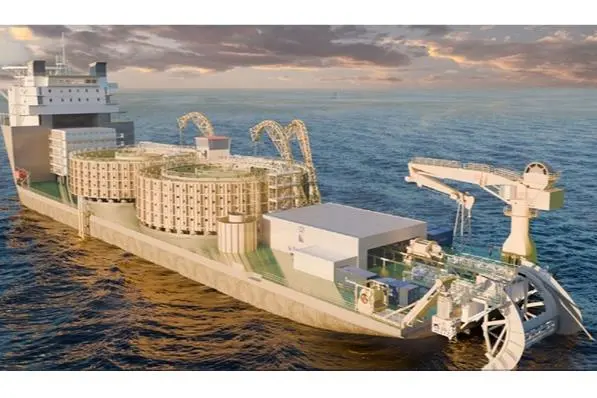
The vessel will have a total cable carrying capacity of 24,000 tonnes through two 12,000-tonne cable carousels, including a concentric carousel intended to support the installation of longer cable sections in a single continuous run.
The company says high-voltage direct current (HVDC) cables are particularly needed as energy transmission infrastructure building accelerates, and this vessel should be ready to go in 2029.
“The electrification of energy demand, driven by decarbonisation and energy independence objectives, is accelerating the need for robust grid infrastructure,” Boskalis says.
Boskalis said the ship’s advanced layout enables the installation of longer, continuous cable sections, minimising costly offshore joints and enhancing long-term cable integrity.
The CLV is being developed initially to install HVDC export cables linking offshore wind farms to shore, alongside interconnector systems that transport electricity between national grids. These long-distance cable systems are increasingly viewed as essential to strengthening energy security and balancing renewable power flows across Europe.
Global cable-lay fleet
Boskalis’ new vessel has one of the largest cable carrying capacities in the world currently, at 24,000 tonnes.
Among the largest operators is Prysmian Group, whose Leonardo da Vinci is one of the world’s biggest cable-layers at around 171 metres with cable capacity exceeding 17,000 tonnes, used for high-voltage subsea power links. Sister vessel Monna Lisa supports offshore wind export cable projects.
Nexans operates the 149.9m Nexans Aurora, capable of carrying around 10,000 tonnes of cable, mainly for offshore renewables and interconnector projects.
Italian contractor Saipem owns Giulio Verne, a 167m vessel designed for deep-water installation with dual turntables and dynamic positioning.
In telecoms, Orange Marine operates vessels including the 100m-plus René Descartes for transoceanic fibre-optic cable installation and repair.
Norway-based DeepOcean and Global Marine Group operate multi-purpose cable and subsea construction vessels focused on maintenance and offshore energy.
Newer vessels increasingly feature DP2 or DP3 dynamic positioning, large cable carousels, hybrid propulsion and equipment for both burial and repair, reflecting demand from offshore wind, subsea interconnectors and digital infrastructure.
Related Articles
 OTHER NEWS
 ACCESSORIES & EQUIPMENT
 SPECIAL REPORTS