![MaritimeJournal[Seawork]](https://www.maritimejournal.com/wp-content/uploads/2026/09/MaritimeJournalSeawork.svg)

Dutch firms reveal Innovation Series of offshore vessels
Windcat and Damen Shipyards have revealed their Multi-Purpose Accommodation Support Vessel (MP-ASV) with options for five more vessels.
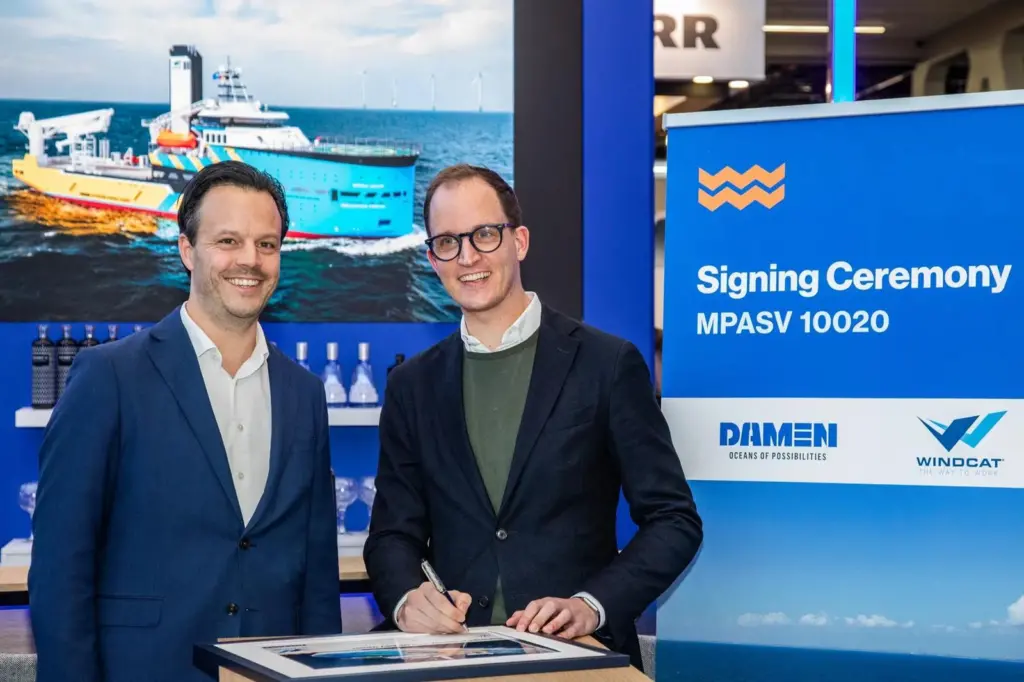
An agreement made in Amsterdam this week marks the launch of the series following the two firms’ collaboration on its Elevation Series of Commissioning Services Operations Vessels (CSOVs).
While based on the CSOV design, Damen and Windcat are calling the MP-ASV ‘a completely new vessel type’, with increased deck space of 750m2, subsea crane capacity of 150 tonnes and the ability to launch and recover Remotely Operated Vehicles (ROVs). The new vessel measures 102 metres by 20 metres.
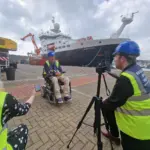
Damen sales manager Joost van der Weiden (pictured left) said the agreement was an evolution of the partnership between the two companies.
“Our collaboration with Windcat is a good example of the way that Damen works,” he said. “Together with clients who share our values and ambitions, we seek to innovate next-generation solutions. We are delighted to have received this latest order.”
Windcat managing director Willem van der Wel (pictured right) said the project introduced a new vessel type, not only to the fleet, but also to the market.
“We take the best of two worlds: the large deck and crane of an MPSV combined with the offshore accommodation of an ASV,” he said.
Each vessel will operate with a 3,981kWh battery pack on a DC grid to support peak-shaving and optimise engine efficiency, especially during dynamic positioning operations. A dual-fuel hydrogen engine will allow the auxiliary genset to run on hydrogen.
Accommodation capacity is planned for up to 190 personnel with 28 days’ endurance.
A motion-compensated gangway will support safe transfers to offshore structures, while the interior layout focuses on comfort and wayfinding to reduce fatigue during long deployments.
Operational redundancy will be strengthened through a DP2+ system, incorporating azimuth thrusters and fore-and-aft tunnel thrusters designed to maintain DP2 capability even in the event of a thruster failure.
Construction of the first vessel is scheduled to begin at Damen’s Ha Long Shipyard in Vietnam in February 2026, with delivery expected in 2028.
Related Articles
 OTHER NEWS
 ACCESSORIES & EQUIPMENT
 SPECIAL REPORTS