![MaritimeJournal[Seawork]](https://www.maritimejournal.com/wp-content/uploads/2026/09/MaritimeJournalSeawork.svg)






E-CTV and offshore charging system ready for sea trials
Charge Offshore has completed installation of the charging system for the ‘world’s first’ diesel-to-electric retrofit crew transfer vessel (CTV).
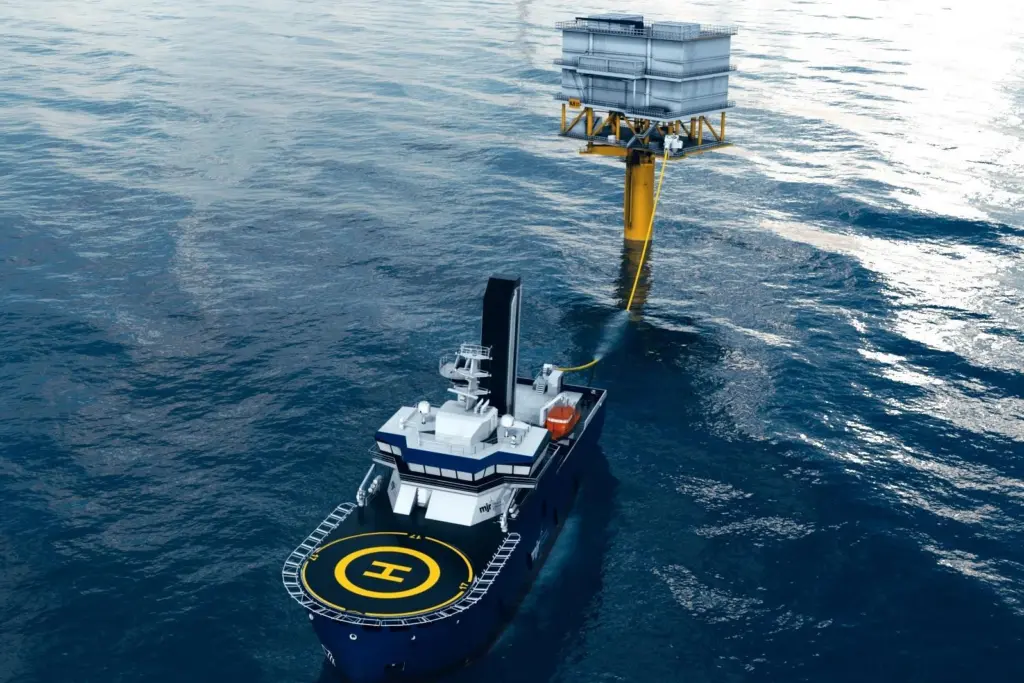
The e-Ginny project, funded by the UK Government’s Zero Emissions Vessel and Infrastructure (ZEVI) competition, marks a major step forward in vessel electrification for offshore wind operations.
“Robust offshore charging infrastructure is critical to support the industry as it ramps up the transition to electrification,” said Paul Cairns, CEO of Charge Offshore.
“This landmark e-Ginny project demonstrates that, with the right systems in place, we can finally eliminate reliance on fossil fuels and unlock a new sustainable future for offshore wind operations.”
Real world demo
During the project, the project’s CTV, named e-Ginny, will demonstrate how engine retrofit technology can deliver zero-emission propulsion while providing essential support to offshore windfarms.
Charge Offshore, a spinout of MJR Power & Automation, has developed the Aquarius Eco charging system to deliver emissions-free power from offshore wind generation.
Its connector deployment system will soon be installed on a fixed offshore structure in the North Sea, enabling fast, safe and reliable charging for e-Ginny.
As the vessel prepares for sea trials in October 2025, Charge Offshore has successfully delivered and installed the connector ‘catcher’ for its Aquarius Eco charging system, designed to deliver emissions-free power from offshore wind generation.
The connector deployment system will then be installed on a selected fixed offshore structure in the North Sea, providing safe, fast and reliable charging for e-Ginny during her charter.
Backed by expertise from Elsys, Blackfish, Volvo Penta and Tidal Transit, it’s hoped that the e-Ginny project represents a scalable blueprint for the wider maritime industry.
The project forms part of UK SHORE’s GB£200m programme to decarbonise the UK maritime sector and capture economic opportunities in green shipping.
Related Articles
 OTHER NEWS
 ACCESSORIES & EQUIPMENT
 SPECIAL REPORTS