![MaritimeJournal[Seawork]](https://www.maritimejournal.com/wp-content/uploads/2026/09/MaritimeJournalSeawork.svg)






Electric foiling CTV makes waves at Vattenfall wind farm
A 100% electric crew transfer vessel (CTV) developed by Artemis Technologies has completed a technical demonstration at the Aberdeen Offshore Wind Farm off the east coast of Scotland.
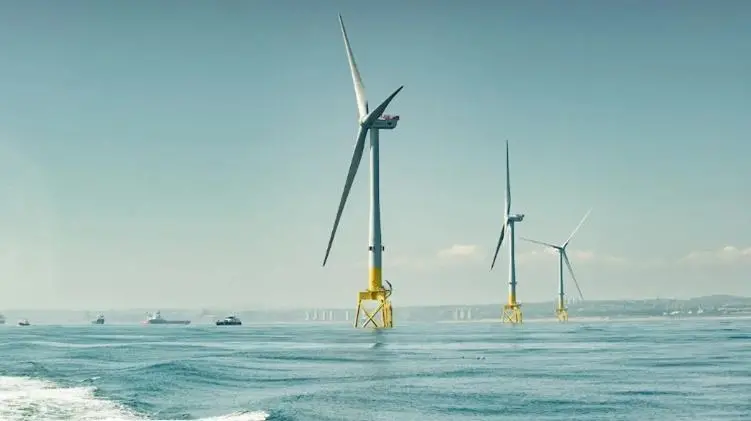
The trial showcased the capabilities of the Artemis EF-12, a dual propulsion, hydrofoiling vessel designed for crew transport in offshore wind operations.
Led by Artemis Technologies in collaboration with Vattenfall, Tidal Transit, Lloyd’s Register and the Offshore Renewable Energy (ORE) Catapult, the project aimed to evaluate the performance of the EF-12 CTV in a real-world offshore environment.
“This technical demonstration provided an essential platform to test the capabilities of the dual propulsion Artemis EF-12 CTV,” said Dr Iain Percy, CEO of Artemis Technologies. “This included operating in a variety of sea and weather conditions and performing critical bollard push manoeuvres to demonstrate the vessel’s stability, efficiency and performance.”
The Aberdeen Offshore Wind Farm, also known as the European Offshore Wind Deployment Centre, served as the demonstration site. Approximately 2.5km off the coast of Aberdeen, the wind farm has 11 Vestas turbines and a total capacity of 96.8MW. It has operated since 2018 and functions as a testbed for innovation in the offshore wind sector in partnership with ORE Catapult.
Tidal Transit contributed its offshore crew transfer expertise to the project.
“Artemis Technologies’ next generation eFoiler has set a new standard in electric crew transfer,” said Leo Hambro, commercial director of Tidal Transit. “At Tidal Transit, we’re proud to have supported Artemis Technologies in demonstrating the operational benefits and practical applications of E-CTVs in the field, and we look forward to collaborating further as we continue our collective mission to decarbonise the offshore wind industry.”
Vessel equipment
The Artemis EF-12 vessel is equipped with dual electric propulsion units, located on the front and rear hydrofoils. According to an Artemis Technologies spokesperson, “this improves the ability to steer the vessel as the thrust direction moves with the rear foil. Dual propulsion provides additional thrust and redundancy for the vessel.”
Central to the vessel’s performance is the Artemis eFoiler system, which combines an autonomous flight control system with a twin-propeller submerged drivetrain.
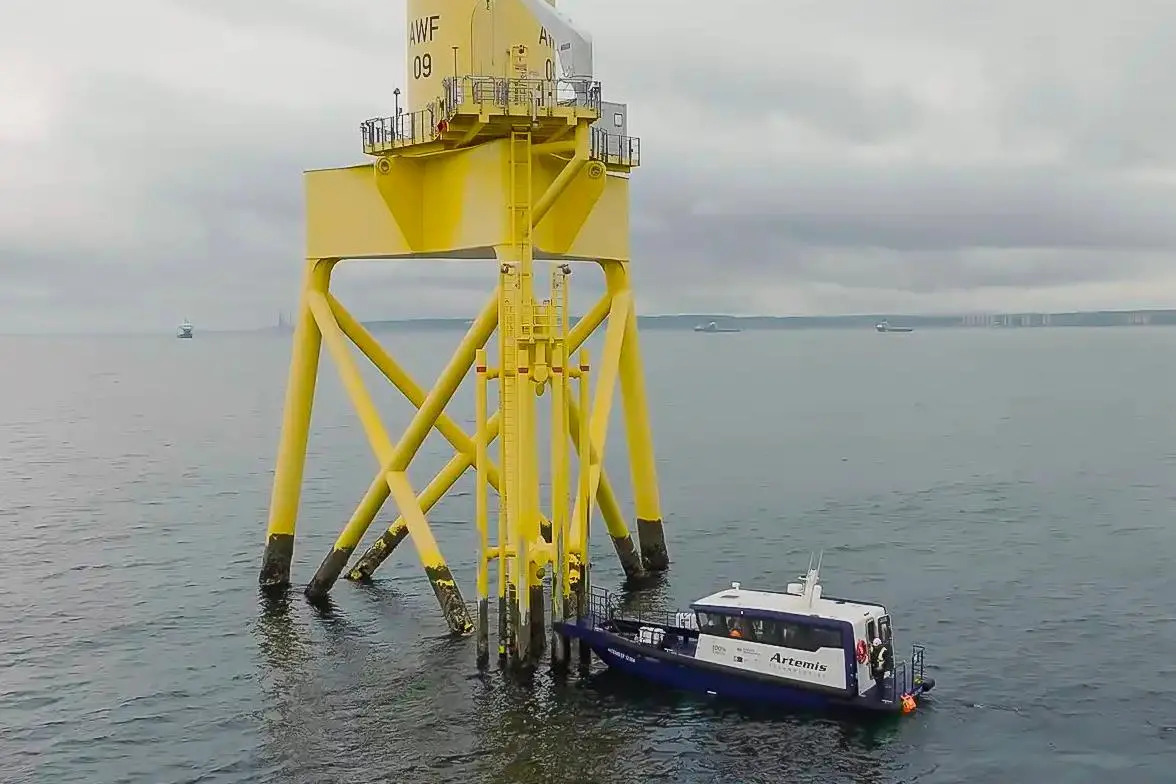
“Our unique technology of an autonomous flight control system, coupled with directional power delivered by a twin propellered submerged drivetrain, delivers stable crew transfer with zero operational emissions,” said the spokesperson.
The 12-metre vessel demonstrated the ability to perform ‘pushing-on’ operations necessary in wind farm crew transfers. The bow fender, used for contact with turbine structures, is based on an industry standard design.
“The bow fender is an industry standard fender design, designed to meet the needs of typical wind farm sites, and acts similarly to a shock absorber,” said the spokesperson.
While the EF-12 is relatively small for some offshore operations, Artemis Technologies says it is targeting near-shore applications.
“Wind farms have varying needs and we are building a range of products to address these market needs,” said the spokesperson. “Working together with our partners, we prioritised developing a 12m CTV to address the transfer needs of crew for close-to-shore wind farm operations. Artemis eFoiler technology is adaptable to larger vessels via the Artemis EF-24 platform.”
Project background
The vessel was fitted out and launched in Belfast, Northern Ireland, where Artemis Technologies is based. The company also has a strategic office in New York and offers a range of fully electric foiling vessels including pilot boats, passenger ferries, and water taxis.
The project was part-funded by the UK Government through the UK Shipping Office for Reducing Emissions (UK SHORE), a Department for Transport initiative supporting maritime decarbonisation.
Since 2022, UK SHORE has committed more than £200 million (€230 million) to projects aiming to reduce emissions in the sector, with Innovate UK serving as the main delivery partner.
Although the EF-12 has been successfully demonstrated, Artemis Technologies confirmed that further development work is ongoing.
“This demonstration is the first critical step in developing commercially viable solutions for the offshore crew transfer industry,” said the company. “Additional tests and developments will be taking place through 2025, with the aim for the vessels to be available for commercial operation in early 2027.”
At present, offshore charging is not available at the Aberdeen Bay Wind Farm. Vattenfall said it is exploring green logistics options in line with its sustainability strategy.
Related Articles
 OTHER NEWS
 ACCESSORIES & EQUIPMENT
 SPECIAL REPORTS