![MaritimeJournal[Seawork]](https://www.maritimejournal.com/wp-content/uploads/2026/09/MaritimeJournalSeawork.svg)




Navigating the future of propeller systems
As the maritime industry steers toward a more sustainable and efficient future, the fifth edition of the “Get Set for Workboat 2050” session at Seawork 2025 offered a deep dive into the propulsion solutions shaping tomorrow’s workboat sector.
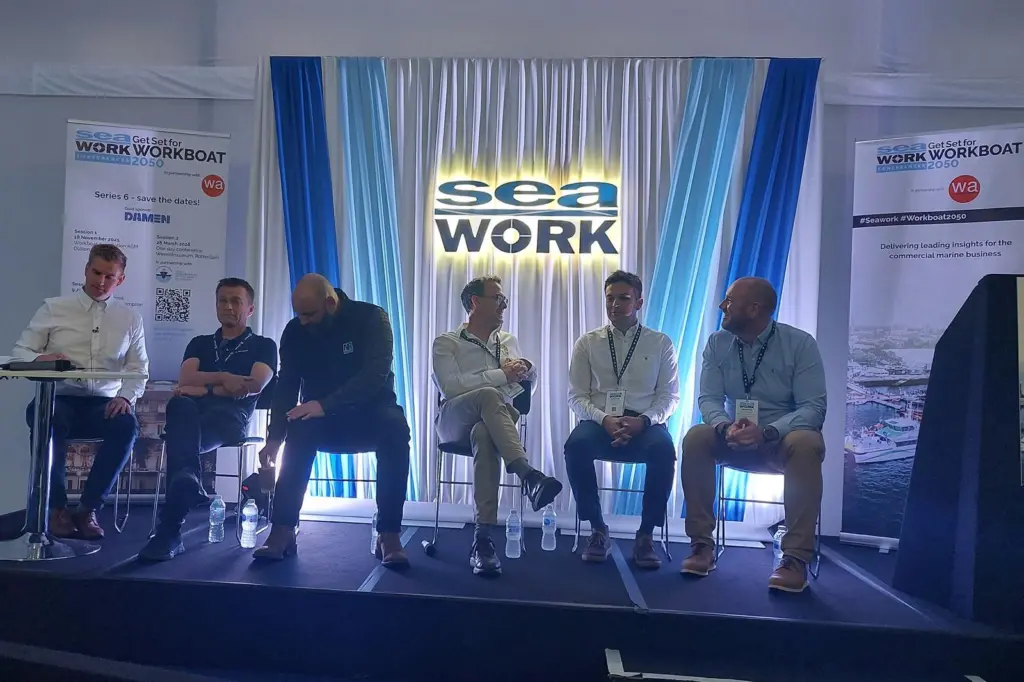
Moderated by Kerrie Forster, CEO of the National Workboat Association, and Andy Page, managing director of Chartwell Marine, the session unpacked the pros and cons of four key propeller systems, spotlighting innovation, efficiency and practical experience from industry leaders.
“For workboats, there is no one-size-fits-all solution,” said Mr Forster, setting the tone for a nuanced and highly engaging discussion. “Different propulsion systems come with both opportunities and challenges.”
Innovation in IPS
Volvo Penta’s James McPaul championed the company’s latest Integrated Propulsion System (IPS) Professional Platform. Positioned as a future-ready system, it’s compact, electrification-prepared and designed for performance.
“This is a true game changer in the industry we believe – it’s ready for the future, but available now,” said Mr McPaul.
The dual-engine configuration enables real-time switching between engines or combined use, significantly reducing CO₂ emissions and fuel consumption. It also offers up to 50% less noise and vibration, ensuring premium onboard comfort.
In a real-world case study, the repowering of a 199-passenger Norwegian ferry has demonstrated the system’s ability to enhance acceleration, manoeuvrability and efficiency, while cutting operational costs.
Reinventing Fixed Pitch Propellers
Alex Stevens of CJR Propulsion offered a spirited defense of the humble Fixed Pitch Propeller (FPP), asserting its relevance in a modern context through advanced design and manufacturing techniques.
“Prop design is not a black art, it’s just physics,” said Mr Stevens. “It’s an iterative process – we’re designing bespoke solutions. One prop is not the same as another.”
CJR’s use of automation, robotic machining and CNC milling enables fuel savings of 8 to 10% compared to hand-finishing techniques.
The company’s UK-based production facility delivers cast-ready concepts within nine hours and complete replacements in as little as two weeks. Though fixed pitch systems lack the adaptive performance of CPPs, their lightweight, cost-effective nature makes them an efficient long-term choice for many.
Precision with CPP
Representing Servogear AS, Bjørn Svendsen highlighted the versatility of Controllable Pitch Propeller (CPP) systems. By adjusting pitch to operational demands, CPPs can optimise performance across varying conditions – ideal for search and rescue vessels for example.
“We can adjust the pitch according to a particular operation to give the optimal response,” said Mr Svendsen.
Additional efficiency enhancements such as propeller tunnels offer 2 to 5% savings and allow larger propeller use with adjustable draughts. Load control options and pitch-RPM adjustments give CPPs a distinct edge in scenarios requiring rapid adaptability and strong bollard push.
Expanding waterjet reach
Antony Tomkins of HamiltonJet underscored the expanding relevance of waterjets beyond their traditional high-speed niche. The company’s new LTX series caters to the broader market of low-speed commercial operations – central to HamiltonJet’s expansion and sustainability strategy.
“Waterjets are now no longer just for high speed,” said Mr Tomkins. “More customers will now be able to take advantage of their benefits.”
Durability and simplicity are waterjets’ strongest suits – few moving parts result in extended lifespan, often outlasting the vessels themselves. With a new production facility launching in October, HamiltonJet is set to increase capacity by 40%, reinforcing its global reach and stock availability.
The operator’s perspective
Richard Thurlow of NR Marine, the only speaker offering direct operational experience across three of the four systems, brought valuable perspective to the discussion.
The consensus from the speakers was that there’s no perfect solution, “There’s a compromise with all of them,” Mr Thurlow said.
He also acknowledged that for the right solution you may need to invest more, be that money or time, that is the reality.
Mr Thurlow’s preference leaned toward waterjets paired with diesel engines, followed by CPP systems for their performance and efficiency and IPS for maintenance ease.
However, he noted the point from the audience that the choice would likely shift if operators directly bore fuel costs, where IPS would then emerge as the preferred option.
What lies ahead
The session closed by looking ahead to the electric horizon. Volvo Penta is already testing electric Crew Transfer Vessels (CTVs) with offshore charging, offering carbon-free operation and potential cost savings through self-generated power.
HamiltonJet is actively working on three electric projects in Auckland, adapting insights from these into future offerings.
NR Marine emphasised the broader ecosystem changes which will be needed to better embrace new propeller technology – efficiency in hull design, crew behaviour and operational strategy must accompany any propulsion innovation.
While no single propeller system emerged as universally superior, the session affirmed that each technology has distinct advantages depending on the operational profile.
Volvo Penta’s IPS system stands out for its suitability in quiet, low-emission operations that demand high manoeuvrability and future-proofing through electrification. The system’s ability to reduce CO₂ emissions and noise, coupled with ease of maintenance and adaptability, makes it a compelling choice for operators focused on long-term sustainability.
Fixed pitch propellers, often overlooked in favour of more complex systems, are still proving their worth as a cost-effective and efficient solution when paired with modern design and manufacturing techniques. With rapid turnaround for replacements and impressive fuel savings, FPPs remain a strong contender for operators seeking simplicity and durability without sacrificing performance.
Controllable Pitch Propeller (CPP) systems, as championed by Servogear, offer unmatched flexibility in adjusting to variable loads and operational demands. Their ability to fine-tune RPM and pitch makes them especially well-suited to vessels involved in missions such as search and rescue, where performance under changing conditions is critical.
Waterjets, traditionally associated with high-speed vessels, are now expanding into new territory. With advancements like the LTX series, HamiltonJet has opened the door for waterjets to serve low-speed commercial applications. Their minimal maintenance requirements and exceptional durability, often outlasting the vessels they power, position them as a long-term investment with broadening relevance.
Ultimately, the key message was clear: Selecting the right propulsion system requires a deep understanding of a vessel’s operating environment, performance requirements and strategic goals.
As the speakers aptly summarised, there is no perfect system, but choosing the right propeller system for the job, will ensure optimal performance and returns for operators.
Related Articles
 OTHER NEWS
 ACCESSORIES & EQUIPMENT
 SPECIAL REPORTS